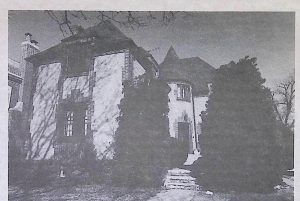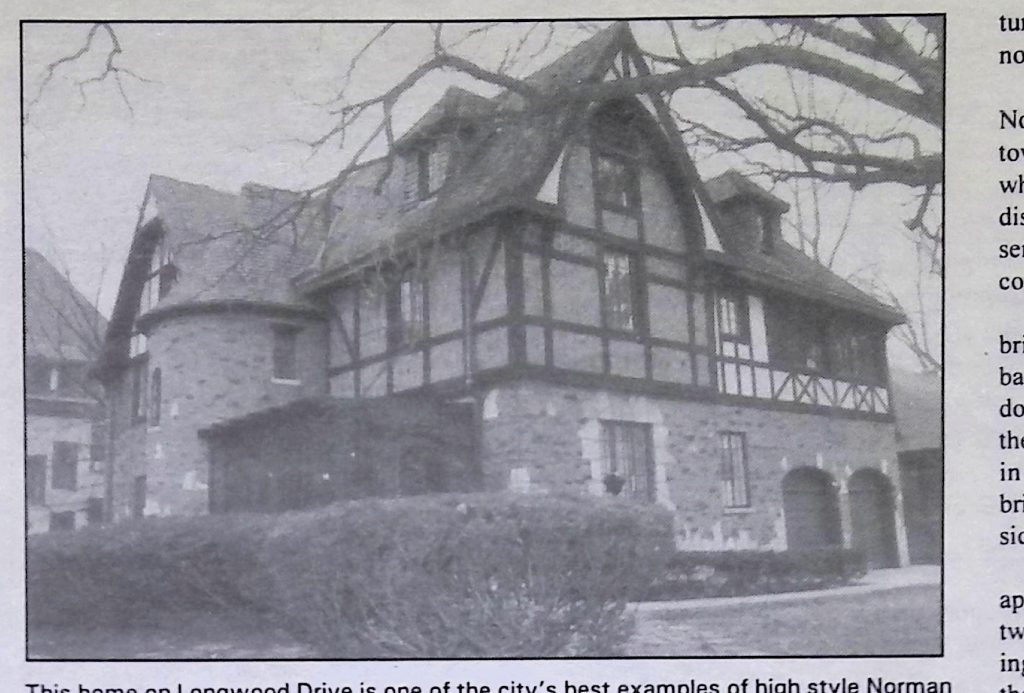
Although there are many houses on the Ridge that qualify as examples of the French eclectic styles much favored by architects and builders in the 1920s, few compare with the Norman-style manor house at 10100 S. Longwood Dr. (Its owners have thoughtfully left up the signpost carrying the former address, 1929 W. 101st St.) This house, whose extensive front yard extends up the slope from Longwood Drive, was built in 1927 and 1928, and may be the finest high-style example of Norman architecture in the city.
The house was designed by Ralph H. Oliver (1882-1968), whose family occupied a house, now gone, that stood on what are now the grounds of the Morgan Park Academy on the north side of 112th Street across from the gymnasium.
Ralph Oliver attended the Academy in the years when it was operated by the University of Chicago. He held the Walker Scholarship, and would have been in the class of 1904, but after 2 1/4 years he left school and entered the office of Chicago architect (and former Morgan Park resident) Harry Hale Waterman to obtain training in design. He then spent the years 1906-1910 as an architect on the Panama Canal and, after returning to the United States, joined the architecture staff of the International Harvester Company.
In 1913 Oliver opened his own architectural practice, and over the years designed a number of residences on Longwood Drive as well as Hansen Hall for the Morgan Park Military Academy.
After the Depression, he was a partner in an architectural and contracting firm, Oliver and Hageman.
Oliver's client for the house was Walter E. Kistner, a securities investor. Kistner had grown up in Beverly/Morgan Park, and his second job was as an assistant cashier of the Calumet Trust and Savings Bank, which was located where Doc's Great Fish is now, at 111th Street and Longwood Drive. He may have come to know of Oliver's work while there. (In later years, Kistner was a trustee of the Morgan Park Military Academy, though he had not attended the school, and of the Loring School for Girls.)
The Kistner house is composed of two great wings forming an “L” joined at the northeast corner. Norman-style houses are very similar to those in the Tudor style, and the prototypes of both date to 16th century Europe, Normandy being a region in northwestern France.
The distinguishing features of the Norman style are a steep roof and a round tower, and this house has both. The tower, which is on the east front of the house, displays a few narrow windows (which serve to emphasize its massiveness) and a conical roof.
The house is chiefly constructed of brick, but this gives way to stone at the base, and several of the first-floor windows have stone surrounds. To enhance the Medieval effect, stones are inserted in the brick walls here and there, and bricks stick out from the walls on the north side.
Above the first floor, half-timbering appears extensively, and the filling between the timbers is carried out in exacting detail. The gable on the east wall and the area above the two-car garage on the north wall have stucco filling, but elsewhere the rectangles bordered by the timbers are filled with bricks laid in various patterns. Sometimes the patterns consist of alternate light and dark bricks forming a checkerboard. Other areas are filled with bricks laid diagonally, or in wave-like patterns resembling the letter W.
The great roof extends so far beyond the walls that in places, particularly on the east side, it is carried on brackets. The roofs over the gables also extend well beyond the walls below, and are fitted with vergeboards which appear to shield the windows below from rain. The gable above the north wall has a striking arched vergeboard colored to match the stucco, while the gable above the east wall has only short decorative vergeboards. Unobtrusive dormers provide light to the attic.
The composition of the house reflects the domestic requirements of the late 1920s, providing a two-car garage with a sleeping porch above. The garage doors are rounded, framed by arches of brick with keystones. Most of the visible windows are of the casement type, and the front door has a round window with an arched glass panel. The porch leading to the main entrance is a later addition, but is in keeping with the rest of the house.
The Kistner house provides a striking example of the architecture of the Norman countryside, replicating a large manor which nevertheless displays rustic features. The color of the stonework is echoed by that of the stucco.
The martial aspect of the round tower is contrasted with the homey touch of the apparently random brick patterns infilling the half-timbering and the occasional protruding brick. Indeed, the effect is so convincing that we expect to see the seigneur in muddy boots driving off a complete assortment of barnyard animals just as we arrive.