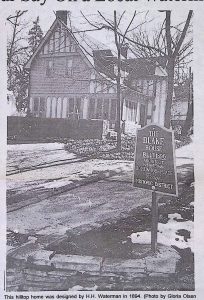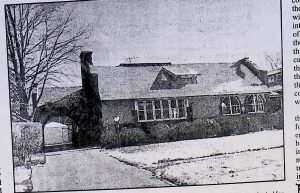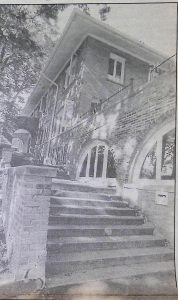

One of the advantages of writing this column is that when new owners find themselves in a home with a significant architect, the fact is likely to be reported to you. This is the case with the large residence at 2141 W. 116th Pl. The house already caught the eye of the Commission on Chicago Landmarks, and is now proved to have been designed by Harry Hale Waterman by a set of the original construction blueprints.
This large frame dwelling, which originally occupied five acres of ground and had a Longwood Drive address, was built in 1901 or 1902 for William Linaker Gregson (1866-1931), his wife, Fannie Beveridge Gregson, and their three children. W. L. Gregson, was born in Lancashire, England, and came to the United States in 1882. He was primarily engaged in the meat-packing business, though was briefly a commission merchant. He was president of several firms, a director of the Chicago Board of Trade several times, its vice-president in 1902 and 1903, and its official provision inspector, weighmaster and registrar from 1922 until his death.
Gregson also found time to be a trustee of the Village of Morgan Park for eight years and a commissioner of the Calumet Park District. His wife Fannie was active in the Morgan Park Woman’s Club and had a famous garden, upon which she did most of the work herself.
The Gregsons’ architect, Harry Hale Waterman, is famous for designing a number of the most imposing residences in Beverly Hills/Morgan Park, including the Barker home at 10650 S. Longwood Dr., which is now the Beacon Therapeutic School, and the Hiram H. Belding House at 9167 S. Pleasant Avenue.
Waterman began his architectural career as a draftsman in the office of Joseph Lyman Silsbee, working there roughly at the same time as Frank Lloyd Wright. He established his own architectural practice in 1893, shortly after erecting the “honeymoon cottage” at 10838 S. Longwood Dr., where he and his first wife lived briefly. Waterman chiefly built apartment buildings everywhere but on the Ridge, where he built a number of houses, both impressive and modest, and an occasional commercial building. He was the architect of the former bank building which now serves as the Dock’s Fish headquarters at Monterey Avenue and Longwood Drive. (His career stretched perhaps into the 1940s.)
Because of its great size, the Gregson house defeats any effort not only to photograph it but even to take it all in from a single vantage point. Its grounds contain many splendid trees, planted by the original owners nearly a century ago, which have grown to great height and whose branches are lifted high over the lawn, but even they fail to clear the lofty roof line.
Although the home’s numerous gables seem at first to be the dominant compositional element, closer inspection reveals that Waterman intended the artistic integrity of the house to be carried by great bays of windows on the south, north and east sides. On the Longwood Drive side, the most prominent of these bays climbs two stories to support the gable of the principal roofline, and a single-story bay carries the theme to the south side of the house. The smaller octagonal bay on the 116th Place side contains the principal staircase to the second floor.
The windows of the bays, and, indeed, almost all of the windows in the house, have diamond-shaped panes leaded into place in the upper half. The multiplicity of reflections from these windows results in a decorative theme over the whole exterior of the house. The gables, one of which has a chimney for its street face, serve to define the skeleton to which the walls cling and upon which the roof is draped.
The main entrance opens to an entrance hall extending across the width of the house to a porch so commodious it really is more like a verandah. The parlor/living room is to the front of the entrance hall, the dining room and smoking room to the rear, with the kitchen, which appears to have been expanded early on, beyond.
The second floor is devoted to sleeping rooms. The rooms on the first floor and the principal staircase are extensively paneled in hardwoods and the interior cabinetry also has windows with diamond-shaped panes which echo the exterior decoration.
Truly the Gregson house not only merits a careful inspection on foot but cannot be understood without doing so.