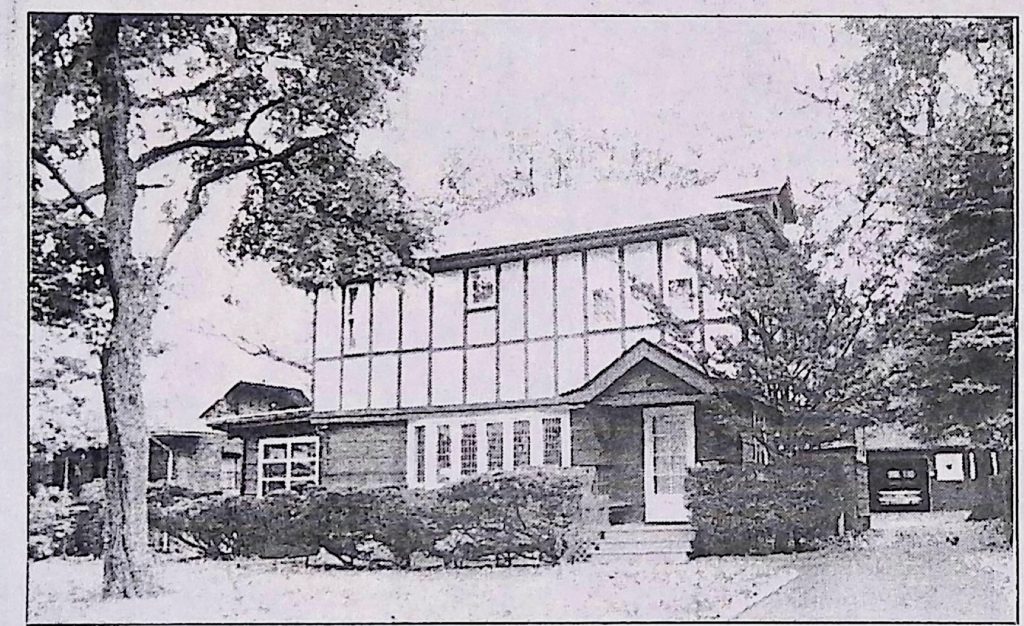
Although Beverly/Morgan Park has many excellent Prairie School residences designed by the masters of the style, including Frank Lloyd Wright, George Washington Maher, Spencer and Powers, and Walter Burley Griffin, there are also houses in this mode turned out by architects who made a practice of keeping abreast of current architectural fashion without confining their work to it. Such a house is the residence pleasantly sited far back on its lot at 2039 W. 108th Pl.
This house was built in 1906 and 1907 for Ralph E. Wilder, the cartoonist for the Chicago Record-Herald. Although Wilder was born in Worcester, Massachusetts in 1875, his parents soon moved to Chicago, and he was one of the pupils in the original wooden Esmond School. He was also educated at Morgan Park Academy when it was a preparatory school for the University of Chicago, and at the Art Institute.
Wilder took the position of newspaper cartoonist in 1903 and his work was popular. About 10 years later he moved to Michigan and took up farming. He died in 1924.
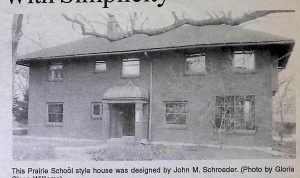
Wilder's choice for architect of his house was John M. Schroeder, of whom very little is known. There are several houses by him in the Longwood Drive Historic District, most notably the James McKee house at 10415 S. Seeley Ave. Schroeder's houses often focus on one particular feature, and this is the case in the McKee house, which has a projecting sunroom on its street side.
The Wilder house, however, is a balanced composition with strong vertical lines which are subordinated to horizontal forces to keep the house within a Prairie School framework. The ground floor is of board and batten construction—that is, the wide siding boards have narrow strips of wood fastened over the joints between the boards. This form of construction was much favored in early Prairie School buildings because, when laid horizontally, it emphasizes the planes parallel to the ground. The front of the house has a simple bay composed of six windows with small panes of glass.
Protruding brackets at the corners of the house give the appearance of supporting the horizontal boards which form the base of the second floor. There is a timber string course about a third of the way up the stuccoing, and all of the windows are above it. There are three large windows at the left balanced by three at the right, and one small window off-center to add charm. Like most Prairie-style houses, this one has a hipped roof, but it is extended on each side by long narrow dormers which reach almost to the end of the roof.
If there is a single element of the exterior design which commands attention, it is the Craftsman-style porch. Not only is the porch roof the only front-facing gable on the house but it is braced from beneath by typical diagonal beams anchored to timbers running up and down the house beside the front door. The gable flares somewhat so as to cooperate with the horizontality of the house rather than upset it.
The sides of the porch are formed by two benches with curved sides though which the boards of the seat protrude to be pegged securely in place. The backs of the benches are made up of vertical slats out of each of which a diamond has been cut; each of the curved bench sides also has a diamond cut-out.
The porch is clearly intended to open the visitor's expectations to further Craftsman features within—inglenooks, glowing fireplaces, beamed ceilings, and the like—but as exterior viewers we have to content ourselves with filling the details from our imaginations.