
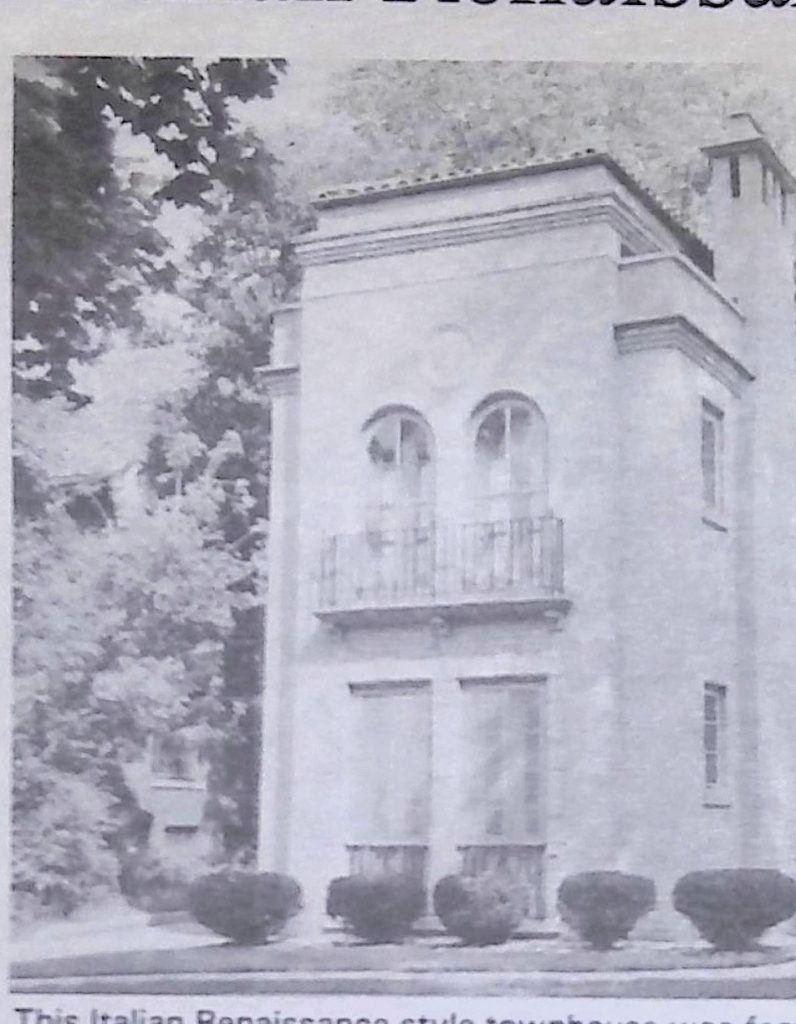
Scattered throughout Beverly/Morgan Park are many residences designed in the Italian Renaissance style of the early 20th Century. They range in size from the yellow-brick foursquares with green tile roofs commonly found throughout the neighborhoods to the landmark villa now used as the residence of the president of Chicago State University on Longwood Dr. Among the most unusual is the townhouse-like example at 9229 S. Damen Ave.
This house was built in 1927 for the Custom Built Home Company, perhaps as a model house. The architect was Anthony A. Tocha who designed houses throughout the city and suburbs in the 1920s and 1930s, including several on the Ridge.
Although it is free-standing and not in a row of similar houses, it nevertheless conveys the feeling of a townhouse because of the narrow masses into which the L-shaped house is divided. The north leg of the L juts out and approaches the street, while the shorter leg, containing the entrance, is recessed. This configuration affords a considerable advantage in terms of cross-ventilation and light, since the living room and the front bedroom upstairs have the advantage of having windows on three sides, while the room above the entrance has two exposures. The front rooms have French windows to take full advantage of breezes.
The exterior decoration of the house is partly carried out by massing and partly through the use of color. The forward wing has flanking setbacks with lower roof lines. Both the main mass of this wing and the setbacks have simple cornices achieved by stepping out the brickwork to support a final plain band of the same material on top.
The roof above is of green tile. On the side of the wing adjoining the entrance, the cornice is interrupted by the chimney, which is topped with similar cornice above its side vents. The cornice continues onto the other leg of the ell and along its side.
Color is also a component of the decor of this residence. The window surrounds at both the first and second story levels of the front wing are of a rose composition material, which also frames the round window above the second floor. The entrance has a similar surround. The wooden parts of the windows have been painted dark blue to add a fourth color to the yellow brick, rose surrounds, and green tile roof.
Other detailing has been kept to a minimum. The second floor front balcony is supported on three brackets scaled to the load they support. The small windows have rows of bricks turned on their sides above, and a masonry sill below.
There are narrow windows that flank the entrance and enhance its importance. The one-story attached garage to the north has its own tile roof.
This house was on the BAPA Home Tour in 1985, and the guidebook for that year tells us that the interior walls are stucco which contributes to the Mediterranean ambiance. A sunken living room with a built-in fireplace completes the southern European theme.
Although the Italian Renaissance style reached the height of its popularity in the 1920s, this house manages to look forward to the simplified residential designs of the 1930s, with its elemental massing and muted exterior decoration.
It also exemplifies a trend toward color in architecture which was terminated almost as soon as it started, due to ruthless emphasis on form and massing of the proponents of the International Style. Yet the net effect is of a forward-looking design with the charm of understated traditional decorative features.