
By Harold T. Wolff
Ridge Historical Society
No development of modern times has disrupted the architecture of houses more than the attached garage. Even when garages can be made into a harmonious wing of the house, the size of a typical lot dictates that they face the street, exposing their unsightly collection of clutter to neighbors and strangers. There are suburbs that require that garages that face the street be closed except when their contents are being removed or returned, and this has encouraged home-builders to buy wider lots so the garage can face sideways. But the house at 8926 S. Hamilton Ave. incorporates a solution to this problem which is both ingenious and convenient.
This house was designed by Lyman J. Allison (1865-1945), about whom surprisingly little information is available, considering that his work is widely distributed throughout the Ridge and in the upscale suburbs. The client was Charles Michael Postl (1885-1964), who had the house constructed in fall 1924, shortly after he married his second wife, Florence J. Murphy.
When Charles Postl came to this house, he had already had an adventurous life. Born in Vienna in 1885, the son of a physician and grandson of a surgeon, Postl’s ambition was to become a wrestler. He came to the United States in October 1908, settling in Chicago. He was first employed as a trainer at Simon’s Health Institute here, but having already attained fame as a professional wrestler in Austria, he continued to wrestle professionally until he had saved $18,000, and then opened his own health club.
The business was not at first successful, but was saved by a critical endorsement.
Postl had wrestled President Theodore Roosevelt several times, and when Roosevelt was recuperating in Milwaukee from wounds suffered in an attempted assassination while running for president on the Bull Moose ticket in 1912, a friend of Postl told Roosevelt that Postl’s club was foundering. Roosevelt offered to put up the money to save the club, but the friend suggested that Roosevelt’s name in a public announcement would be of much greater help, and such an advertisement appeared in the Chicago Tribune. Postl credited this ad with saving his business.
Until Postl’s death his health club was the best known in Chicago, and he was called a “maker” by Paul Gilbert and Charles Lee Bryson in their book, “Chicago and Its Makers.” He was careful to keep in shape, and at the age of 76 single-handedly collared a would-be mugger and held him in a hammer lock until the police came.
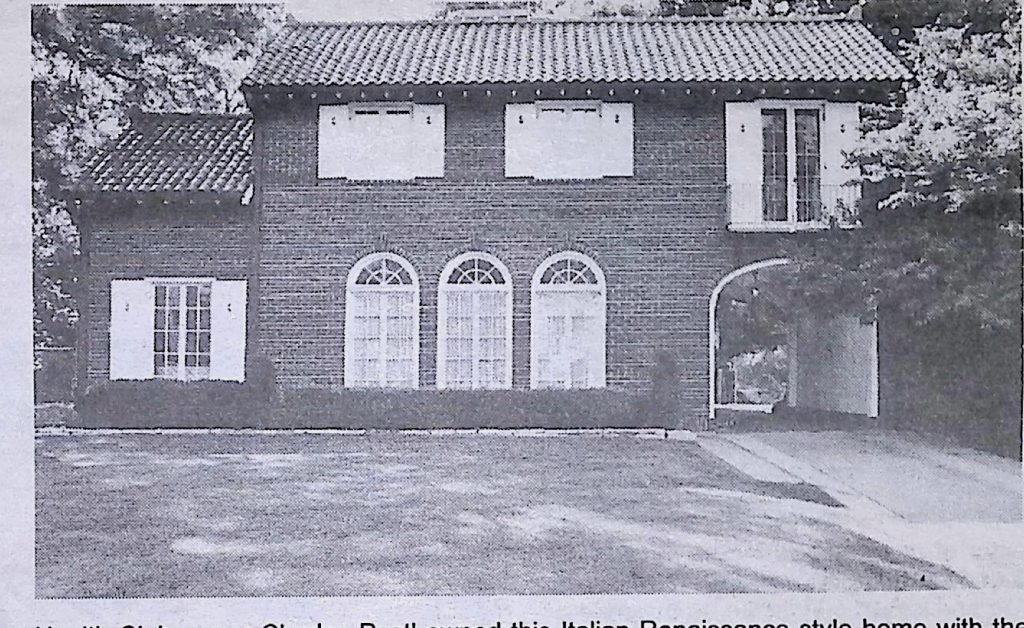
The house that Lyman Allison designed for Charles Postl was a simplified version of the Italian Renaissance style. It has two one-story wings depending from the central two-story structure, with both the wings and core roofed in green tile supported on simple brackets. The ground floor presents to the street the three arched windows typical of this style. (The room behind has an elaborately sculptured stone fireplace.) The windows of the second floor and in the ground-floor south wing are regular double-hung windows. Above the main entrance floor-length windows open onto a small iron balcony on simple brackets.
The elegant main entrance usually seen with this style is replaced with a high arched opening, which in fact is a porte-cochere passing all the way through the core of the house. The main entrance to the house is a door cut into the south side of this opening, from which one steps out onto a curbed walk in the passage.
On its other side, the passage isolates the north one-story wing from the rest of the first floor. This wing contains the garage, whose doors open towards the back of the house, while the wing presents a blank wall to the street. Thus, the owner could drive into the porte-cochere, discharge his passengers in any kind of weather, then proceed into the back yard and swing around into the garage.
As the present owners point out, however, the garage is scaled to cars of 1924, and they have never used it for their own vehicles. Nevertheless, Allison’s layout provided for access to the house from automobiles in all kinds of weather and kept the garage clutter from the public view. Thus the house succeeded in serving both the private comfort of the owners and the public appearance of the street.