
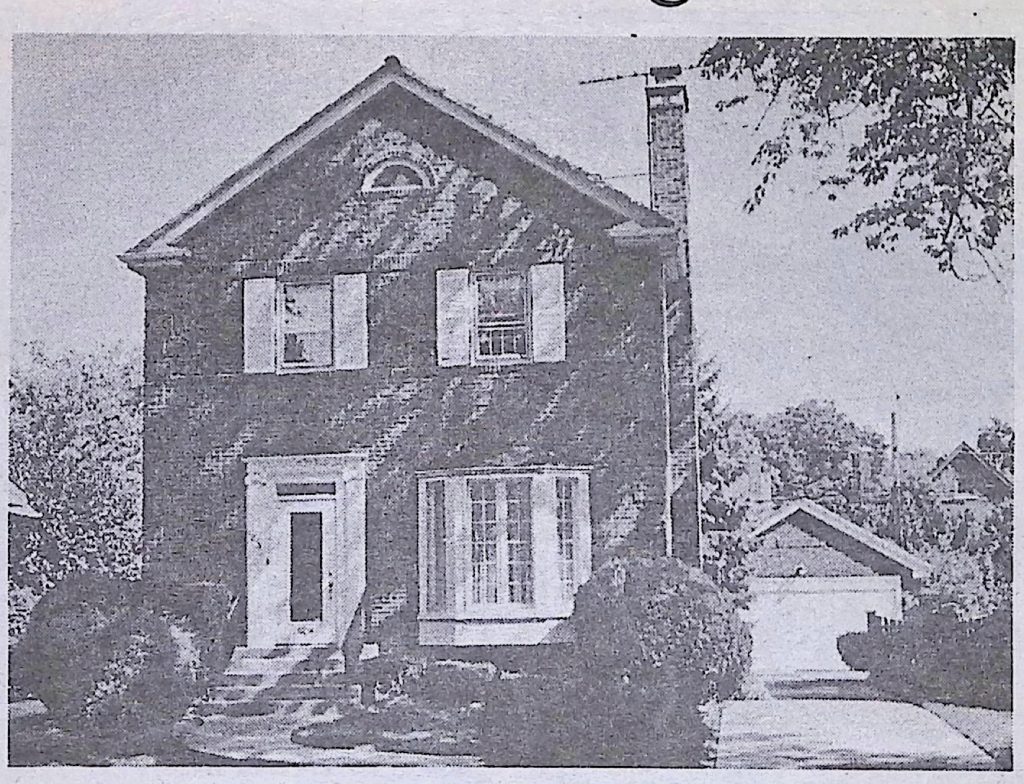
In the western part of Beverly/Morgan Park, on the north-south streets on both sides of Western Avenue, can be found many narrow-fronted Neocolonial houses, usually called “Georgians” in the real estate ads. When most architectural historians think of Georgian architecture, what comes to mind is the sort of broad-fronted house one associates with Colonial Williamsburg, with an elegantly detailed central front door and five ranks of windows. So, where did these narrow-fronted “Georgians” come from? To answer this question, with the help of Joan Wynne Murphy I scouted around for a narrow-fronted Neocolonial house with accurate historical precedents, and found one at 9815 S. Hamilton Ave.
The house was built in 1928 and its architects were Lautz & Christensen, a firm very active in Beverly/Morgan Park before World War II. (Its successors after the war were Luther & Christensen, Luther & Peecher, and Phillip Peecher Associates.)
The name “Georgian” arises from the fact that this was the predominant style in England under the various kings of the Hanover dynasty, the first four of which were named George, who reigned between 1714 and 1830. Since the English had suffered through the War of the Roses in the 15th century, the Protestant Reformation in the 16th century, and the overthrow of the Stuarts and their restoration in the 17th century, there was a certain craving for a peaceful and orderly existence and the tone of their lives was set by a style of architecture which was orderly and methodical.
It is estimated that there are just over a million small Georgian houses built in the period 1700-1830 surviving in the British Isles. These narrow-fronted Georgian houses were often also small, and when an orderly two- or three-ranked facade had to contain behind it not only the functional rooms of the house but a stairway, it was difficult to have as many as two rooms per floor. For this reason, the kitchen was often located in the basement, under the dining room. In cities, small Georgian houses were often grouped in rows called terraces, and could be as high as four stories.
The house at 9815 S. Hamilton Ave., having been built in 1928, is of the period of Neocolonial style rather than of the Georgian era. (This distinction of stylistic periods, however, has to be made in the United States because there are many true Georgian-era homes in the east, and not just at Williamsburg.) The house is two-ranked, with the first story facade containing the principal entrance and a bay window, each aligned with the second-story windows above. This house differs from most of the narrow-fronted “Georgians” of the Ridge, because most of the other houses have three windows across the second story, with a door and a bay window on the first floor, one or both of which are not aligned with the second story fenestration. True Georgian houses almost never have unaligned windows on the first floor.
I have been careful to describe these houses as “narrow-fronted” rather than “small.” Almost all of our narrow-fronted Neocolonial houses extend far back on their lots and have plenty of room, unlike their British predecessors.
Detailing on these Neocolonial homes is rather simple. The main entrance of the house on Hamilton has a classical treatment, with flanking Ionic columns, but no elaboration of the fanlight over the door. The corners of the front facade have quoins — raised areas of brick intended to suggest bracing of the turn of the wall against stresses — but they do not project much beyond a half-inch from the surface. Another subtle feature is the string courses of brick running from quoin to quoin at the top and bottom of the second-floor windows, the upper course a brick-length high and the lower course a half-brick high. There is a semicircular window in the gable.
Despite its simplicity, the house is an excellent departure point for illustrating the difference between Georgian and Neocolonial narrow-front houses.