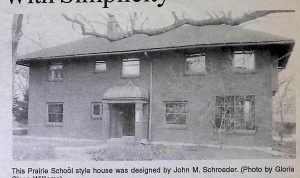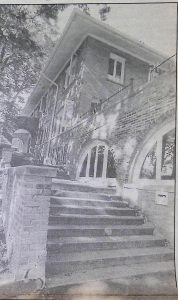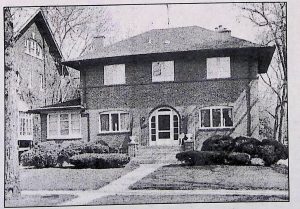
The use of contrasting dark wood beams and light stucco, so common among Prairie School houses, sometimes provokes a sense of uneasiness among viewers, as if it were Tudor half-timbering in the guise of novel wall treatment four centuries later. The question arose in the era when these houses were constructed, and because of the light it throws on the treatment of wall surfaces by Prairie School architects, it is worth discussing a local example.
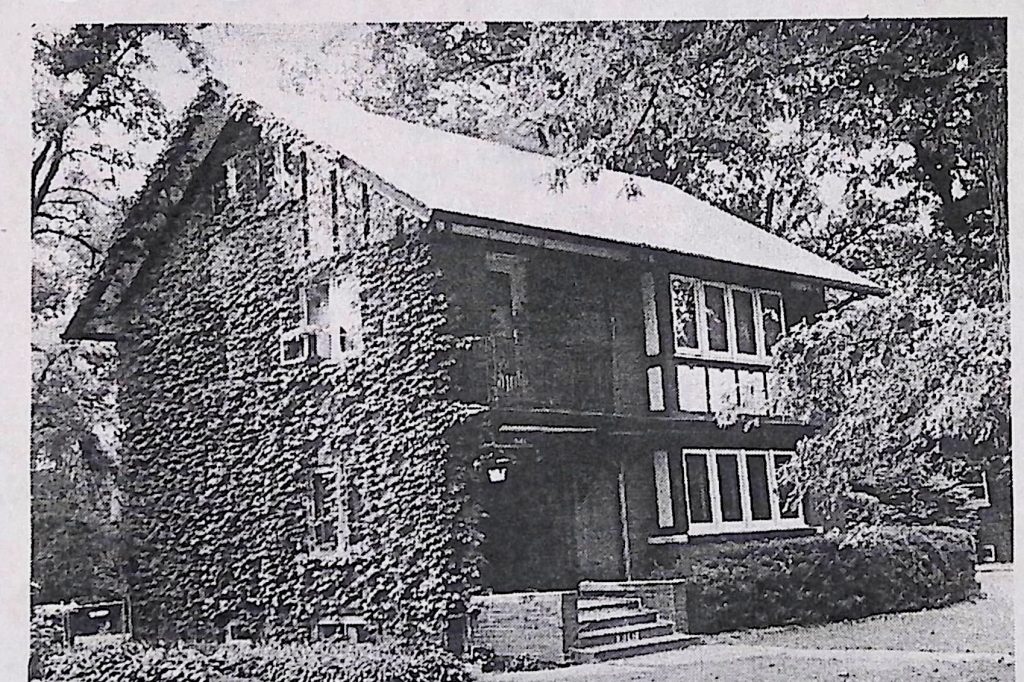
The residence at 10745 S. Seeley Ave.
was designed for Charles I. Drake, an accountant, and built in 1909. It is the work of Spencer and Powers, one of three of the firm's houses on the Ridge. Design partner Robert Clossen Spencer (1865-1953) obtained a degree in mechanical engineering from the University of Wisconsin in 1886, then studied at the Massachusetts Institute of Technology. He worked for a couple of Boston architecture firms, went to Europe on a traveling fellowship, and landed in Chicago in 1893, at first working on the interior of the Chicago Public Library, now the Cultural Center.
Partner of Wright
In 1896, Spencer joined Dwight Perkins, an associate from MIT, working from space in Steinway Hall. They were soon joined by other younger architects including Myron Hunt and Frank Lloyd Wright. The Steinway Hall group continued until 1901, with Wright the leading spirit.
From Nov. 1905 to Jan. 1, 1923, Spencer was in partnership with Horace S. Powers, a graduate of the Armour Institute of Technology. Spencer is regarded as the moving spirit in the forward-looking architecture of the firm. He was a close friend and admiring critic of Wright.
Simplicity of Style
The Drake House conveys the simplicity of the Prairie School movement despite certain variations from the usual style practice. For instance, the house has a gabled roof instead of the hipped roof favored by Wright and often used by Spencer & Powers. The roof, however, is set off from the usual appearance of gabled roofs by the broad overhang, its stuccoed underside unsupported by rafters or brackets.
The front windows are arranged in a box bay which rests on a brick base extending out from the front wall. There is no pretense of support from brackets, although, curiously, the woodwork under the second floor windows and the side attic windows has a sort of vestigial beam end in the woodwork under each pane.
'Very Best' of Prairie Style
The front box window bay is interrupted between the first and second floors by a ledge which continues to the north end of the house to overhang and shield from the rain the deeply recessed front door. Above the main entrance there is a small balcony.
Although the wood beams and stucco might at first seem to ape medieval half-timbering, on closer examination the scheme is devoid of false braces, peg heads and brackets. The intent, rather, is to divide the wall surface into natural panels in a way which makes a regular pattern with the casement windows. The stucco and beam panels of the side gables continue around the front of the house up under the eaves.
The Drake house exhibits the simplicity of form and grace of the very best Prairie School houses as well as conveying the lesson that the use of older materials and patterns can be done without reference to what William Gray Purcell calls “architecture which has only a literary value.”