
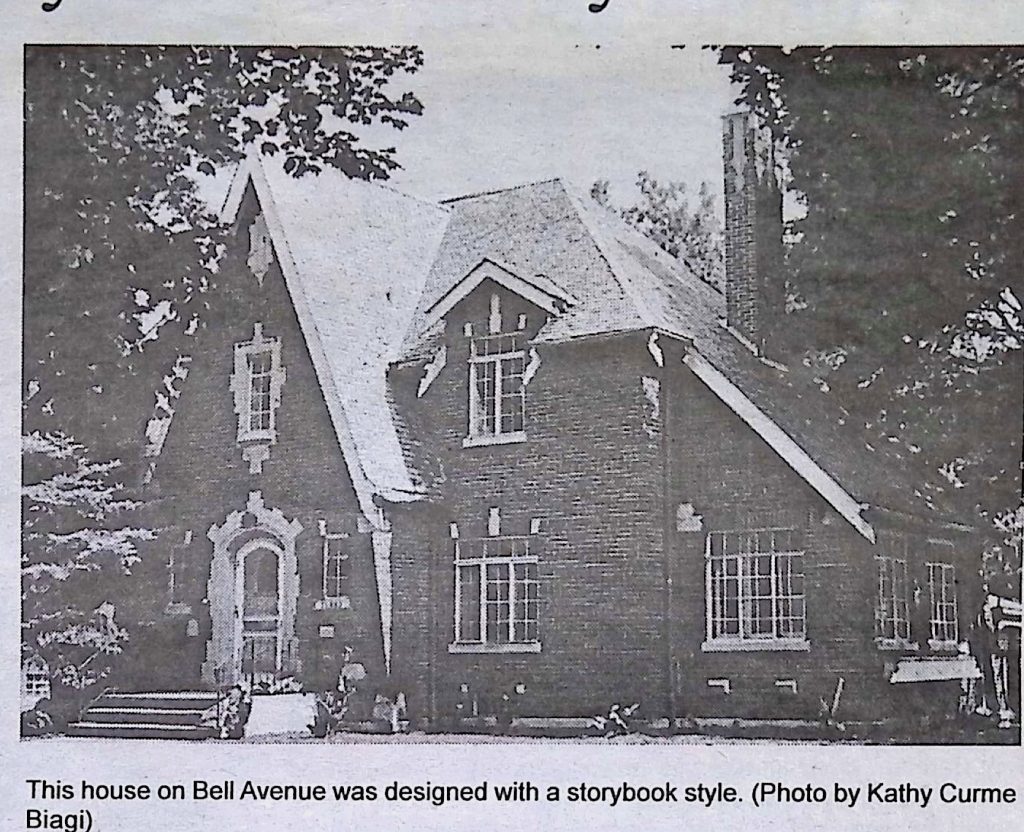
Although Homer Grant Sailor (1887-1968) was not the architect of every storybook house on the Ridge, he was responsible for a good many of them. Designs for such houses came so effortlessly from the pen of Homer Sailor, and it should be fun to look over one of them in detail. The example for our study will be the George D. Rees House at 11453 S. Bell Ave.
Born in Akron, Ohio, and brought to Chicago by his parents at the time of the World's Columbian Exposition of 1893, Sailor, after graduating from Englewood High School and Armour Institute of Technology, became a draftsman for the visionary of the modern movement, Louis Sullivan.
Sailor also worked for Charles Hammond before setting up his own practice in 1918.
Once in practice for himself, Sailor built a few small Prairie-style residences before turning to larger houses in historical styles, many of them on the Ridge. He also did an Art Moderne apartment house in West Beverly and an Art Deco residence in East Beverly before the Depression dried up new work for most architects, at which time he became involved in Republican politics and patronage until he was able to return to architecture in 1948. Sailor retired in 1950 and about 1963 moved to 2148 W. 110th Pl. He died in 1968. His son, H. Grant Sailor has worked to make his father's work better known.
The house at 11453 S. Bell Ave. exhibits several unusual features, and some details have to be added to give style to the house. The main entrance receives an elaborate limestone surround, and since there is no room for a window above it, an oval limestone plaque in the gable. All of the windows are casements, but the windows on the front have diamond-shaped panes worked into the rectangular panes. The front windows also are topped with Queen Anne squared arches with stone corner blocks and keystones. All of the diagonal rooflines are defined by bold vergeboards which end in elaborate projecting tails, like spears.
So far, all of these details convey (rather fancifully) a Tudor theme, but when we look further, there is something else. The architect has been careful to let the rafter tails emerge from under the sloped roofs, and the wall around the garage entrance is battered (sloped), as are the front and rear walls of the porch on the other side. These battered walls are capped with rounded boulders of Lemont stone, which almost serve as capitals to non-existent columns. These are exaggerated stylistic features that harken back to the Craftsman era, and are intended to invoke an association with handcrafts. Finally, the motif in the limestone oval and also forming the keystones over the front windows are three stakes of limestone, the central one in each case being taller and thicker than those on each side. This is really an Art Moderne design, and is intended to convey that, while there may be a fairy tale being lived inside, the fairy tale is up to date.
Thus, Sailor has used decorative elements from three styles (to which may be added the highly exaggerated spear tips of the vergeboards) to set this house out of the Tudor Revival mainstream and to proclaim it as something else. It becomes a house that solicits close inspection and conveys an air of mystery. In short, it becomes a storybook house.
This house has been willed to the Beverly Arts Center of Chicago by the late Lieut. Col. Donald Probes. Persons interested in the property should contact the BAC for further information.