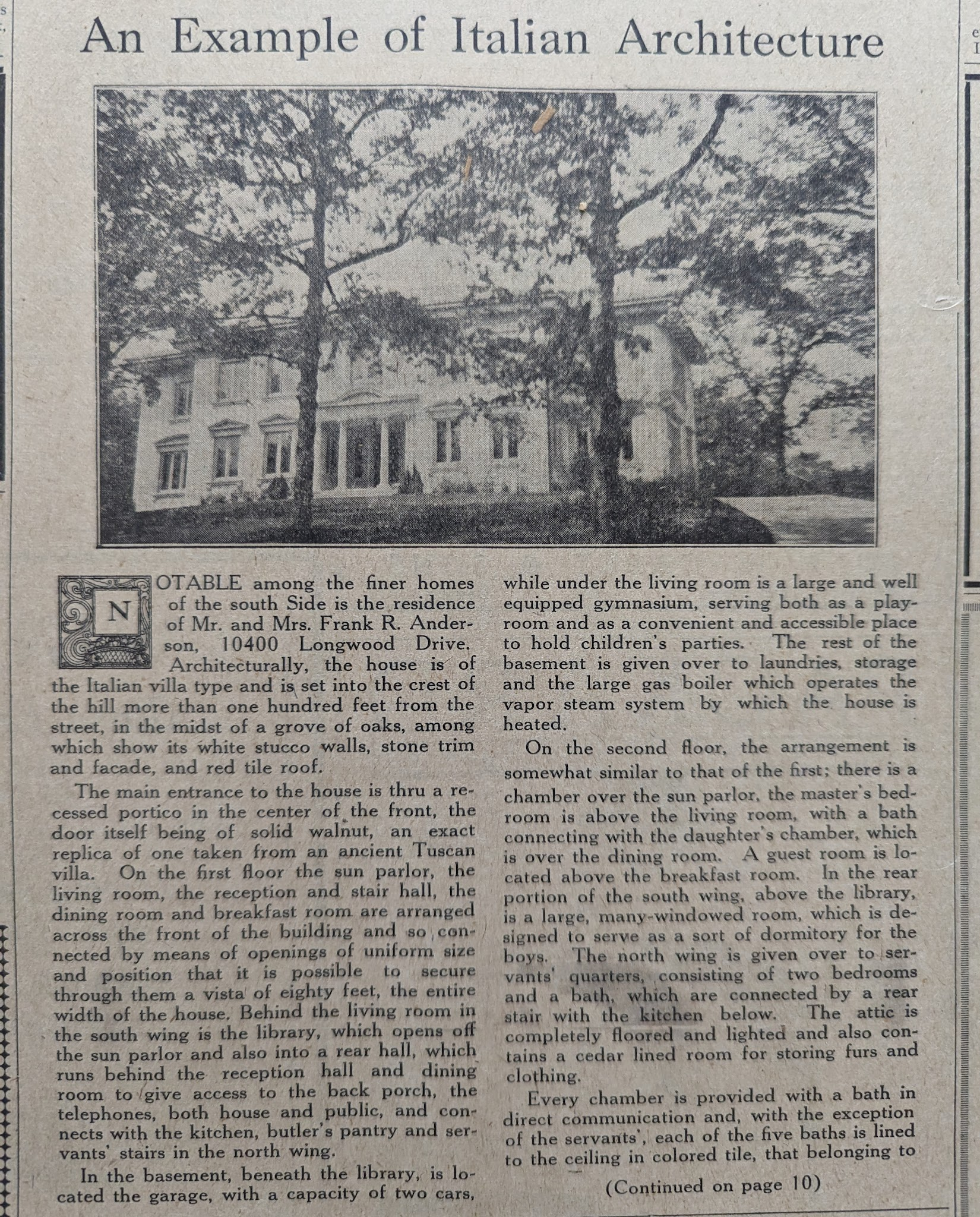
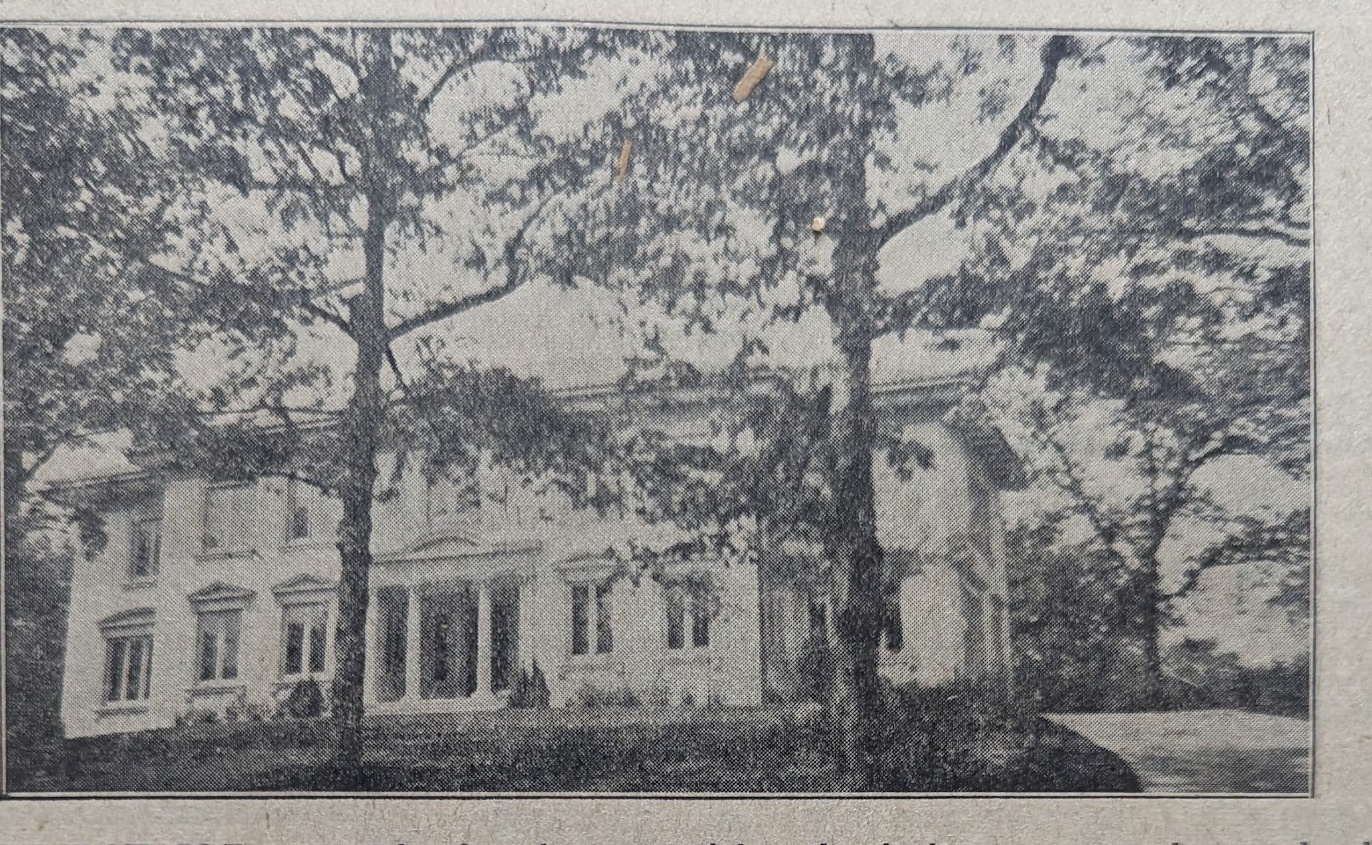
NOTABLE among the finer homes of the south Side is the residence of Mr. and Mrs. Frank R. Anderson, 10400 Longwood Drive. Architecturally, the house is of the Italian villa type and is set into the crest of the hill more than one hundred feet from the street, in the midst of a grove of oaks, among which show its white stucco walls, stone trim and facade, and red tile roof.
The main entrance to the house is thru a recessed portico in the center of the front, the door itself being of solid walnut, an exact replica of one taken from an ancient Tuscan villa. On the first floor the sun parlor, the living room, the reception and stair hall, the dining room and breakfast room are arranged across the front of the building and so connected by means of openings of uniform size and position that it is possible to secure through them a vista of eighty feet, the entire width of the house. Behind the living room in the south wing is the library, which opens off the sun parlor and also into a rear hall, which runs behind the reception hall and dining room to give access to the back porch, the telephones, both house and public, and connects with the kitchen, butler’s pantry and servants’ stairs in the north wing.
In the basement, beneath the library, is located the garage, with a capacity of two cars, while under the living room is a large and well equipped gymnasium, serving both as a playroom and as a convenient and accessible place to hold children’s parties. The rest of the basement is given over to laundries, storage and the large gas boiler which operates the vapor steam system by which the house is heated.
On the second floor, the arrangement is somewhat similar to that of the first; there is a chamber over the sun parlor, the master’s bedroom is above the living room, with a bath connecting with the daughter’s chamber, which is over the dining room. A guest room is located above the breakfast room. In the rear portion of the south wing, above the library, is a large, many-windowed room, which is designed to serve as a sort of dormitory for the boys. The north wing is given over to servants’ quarters, consisting of two bedrooms and a bath which are connected by a rear stair with the kitchen below. The attic is completely floored and lighted and also contains a cedar lined room for storing furs and clothing.
Every chamber is provided with a bath in direct communication and, with the exception of the servants’, each of the five baths is lined to the ceiling in colored tile, that belonging to
(Continued on page 10)
Original Article