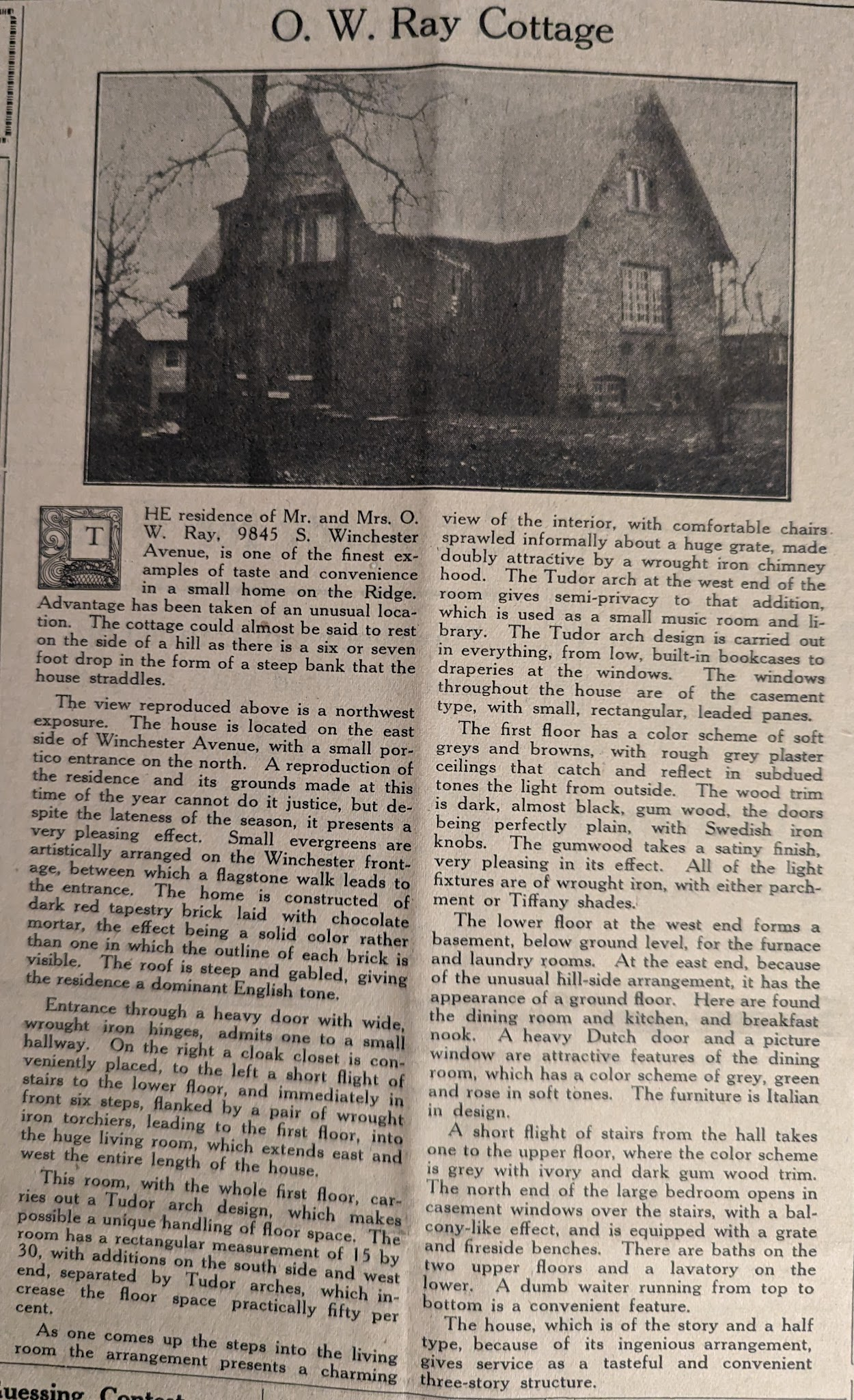
THE residence of Mr. and Mrs. O. W. Ray, 9845 S. Winchester Avenue, is one of the finest examples of taste and convenience in a small home on the Ridge. Advantage has been taken of an unusual location. The cottage could almost be said to rest on the side of a hill as there is a six or seven foot drop in the form of a steep bank that the house straddles.
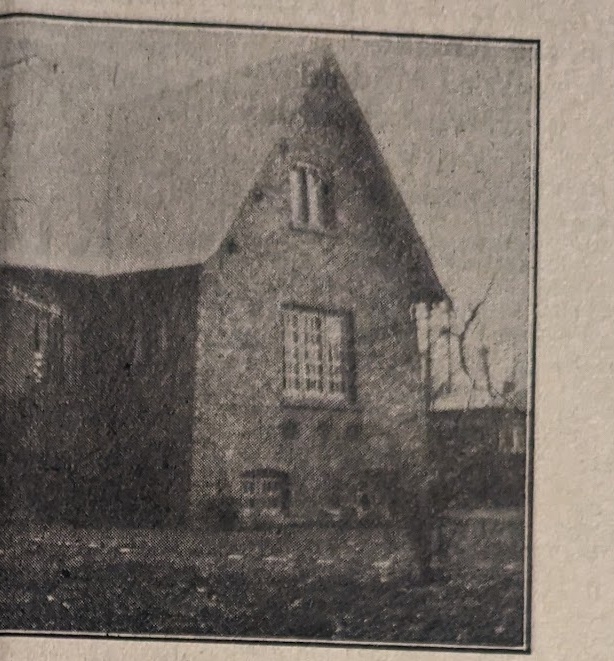
The view reproduced above is a northwest exposure. The house is located on the east side of Winchester Avenue, with a small portico entrance on the north. A reproduction of the residence and its grounds made at this time of the year cannot do it justice, but despite the lateness of the season, it presents a very pleasing effect. Small evergreens are artistically arranged on the Winchester frontage, between which a flagstone walk leads to the entrance. The home is constructed of dark red tapestry brick laid with chocolate mortar, the effect being a solid color rather than one in which the outline of each brick is visible. The roof is steep and gabled, giving the residence a dominant English tone.
Entrance through a heavy door with wide, wrought iron hinges, admits one to a small hallway. On the right a cloak closet is conveniently placed, to the left a short flight of stairs to the lower floor, and immediately in front six steps, flanked by a pair of wrought iron torchiers, leading to the first floor, into the huge living room, which extends east and west the entire length of the house.
This room, with the whole first floor, carries out a Tudor arch design, which makes possible a unique handling of floor space. The room has a rectangular measurement of 15 by 30, with additions on the south side and west end, separated by Tudor arches, which increase the floor space practically fifty per cent.
As one comes up the steps into the living room the arrangement presents a charming view of the interior, with comfortable chairs sprawled informally about a huge grate, made doubly attractive by a wrought iron chimney hood. The Tudor arch at the west end of the room gives semi-privacy to that addition, which is used as a small music room and library. The Tudor arch design is carried out in everything, from low, built-in bookcases to draperies at the windows. The windows throughout the house are of the casement type, with small, rectangular, leaded panes.
The first floor has a color scheme of soft greys and browns, with rough grey plaster ceilings that catch and reflect in subdued tones the light from outside. The wood trim is dark, almost black, gum wood, the doors being perfectly plain, with Swedish iron knobs. The gumwood takes a satiny finish, very pleasing in its effect. All of the light fixtures are of wrought iron, with either parchment or Tiffany shades.
The lower floor at the west end forms a basement, below ground level, for the furnace and laundry rooms. At the east end, because of the unusual hill-side arrangement, it has the appearance of a ground floor. Here are found the dining room and kitchen, and breakfast nook. A heavy Dutch door and a picture window are attractive features of the dining room, which has a color scheme of grey, green and rose in soft tones. The furniture is Italian in design.
A short flight of stairs from the hall takes one to the upper floor, where the color scheme is grey with ivory and dark gum wood trim. The north end of the large bedroom opens in casement windows over the stairs, with a balcony-like effect, and is equipped with a grate and fireside benches. There are baths on the two upper floors and a lavatory on the lower. A dumb waiter running from top to bottom is a convenient feature.
The house, which is of the story and a half type, because of its ingenious arrangement, gives service as a tasteful and convenient three-story structure.
Original Article