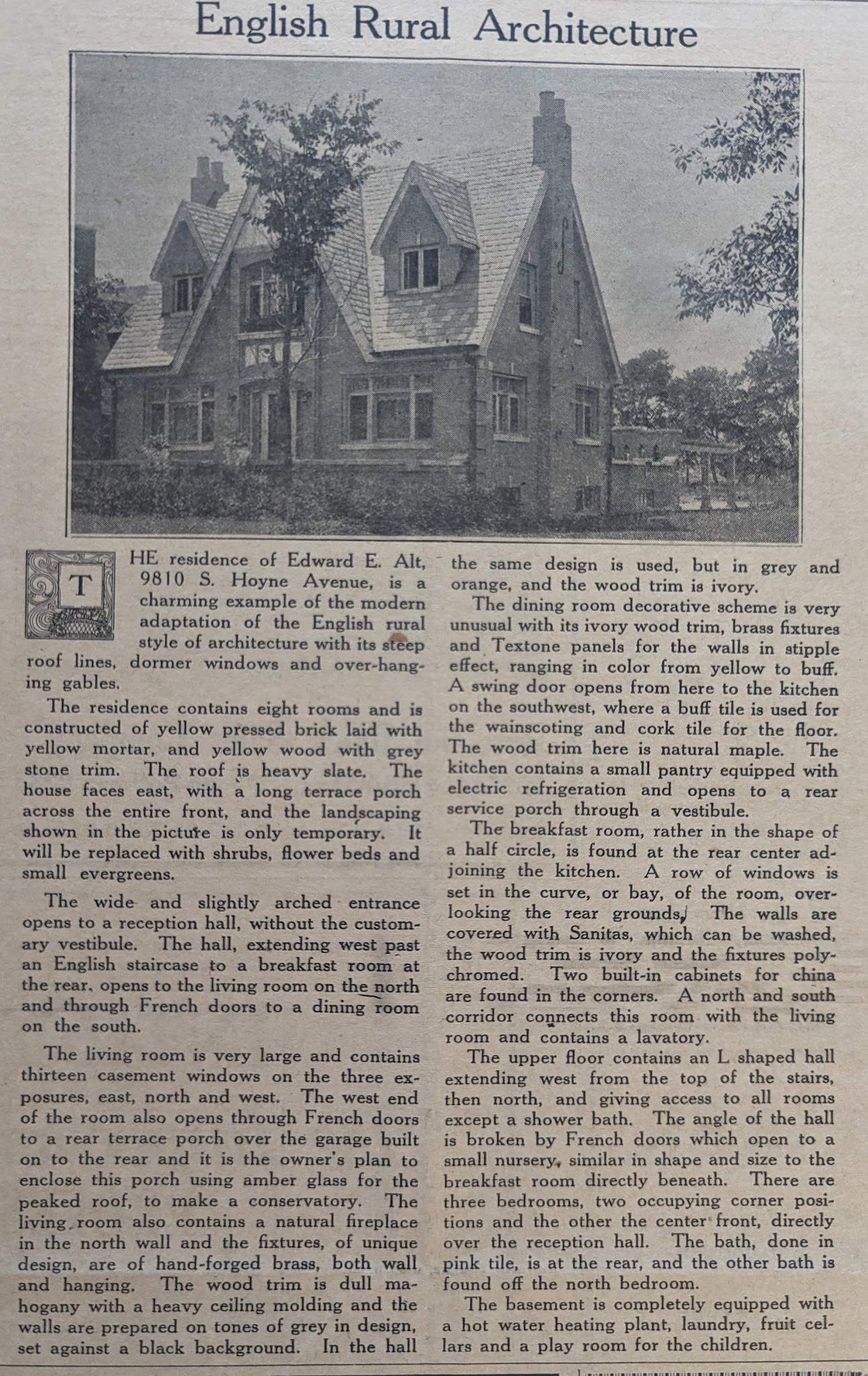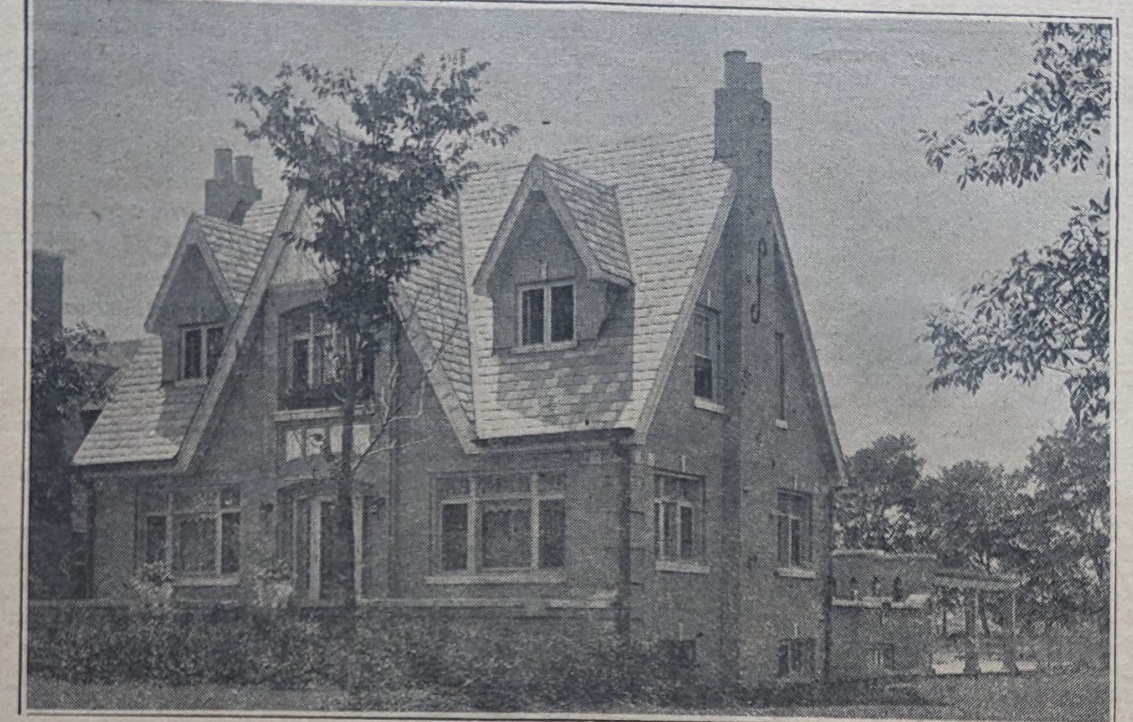
THE residence of Edward E. Alt, 9810 S. Hoyne Avenue, is a charming example of the modern adaptation of the English rural style of architecture with its steep roof lines, dormer windows and over-hanging gables.
The residence contains eight rooms and is constructed of yellow pressed brick laid with yellow mortar, and yellow wood with grey stone trim. The roof is heavy slate. The house faces east, with a long terrace porch across the entire front, and the landscaping shown in the picture is only temporary. It will be replaced with shrubs, flower beds and small evergreens.
The wide and slightly arched entrance opens to a reception hall, without the customary vestibule. The hall, extending west past an English staircase to a breakfast room at the rear, opens to the living room on the north and through French doors to a dining room on the south.
The living room is very large and contains thirteen casement windows on the three exposures, east, north and west. The west end of the room also opens through French doors to a rear terrace porch over the garage built on to the rear and it is the owner’s plan to enclose this porch using amber glass for the peaked roof, to make a conservatory. The living room also contains a natural fireplace in the north wall and the fixtures, of unique design, are of hand-forged brass, both wall and hanging. The wood trim is dull mahogany with a heavy ceiling molding and the walls are prepared on tones of grey in design, set against a black background. In the hall the same design is used, but in grey and orange, and the wood trim is ivory.
The dining room decorative scheme is very unusual with its ivory wood trim, brass fixtures and Textone panels for the walls in stipple effect, ranging in color from yellow to buff. A swing door opens from here to the kitchen on the southwest, where a buff tile is used for the wainscoting and cork tile for the floor. The wood trim here is natural maple. The kitchen contains a small pantry equipped with electric refrigeration and opens to a rear service porch through a vestibule.
The breakfast room, rather in the shape of a half circle, is found at the rear center adjoining the kitchen. A row of windows is set in the curve, or bay, of the room, overlooking the rear grounds. The walls are covered with Sanitas, which can be washed, the wood trim is ivory and the fixtures polychromed. Two built-in cabinets for china are found in the corners. A north and south corridor connects this room with the living room and contains a lavatory.
The upper floor contains an L shaped hall extending west from the top of the stairs, then north, and giving access to all rooms except a shower bath. The angle of the hall is broken by French doors which open to a small nursery, similar in shape and size to the breakfast room directly beneath. There are three bedrooms, two occupying corner positions and the other the center front, directly over the reception hall. The bath, done in pink tile, is at the rear, and the other bath is found off the north bedroom.
The basement is completely equipped with a hot water heating plant, laundry, fruit cellars and a play room for the children.
Original Article