
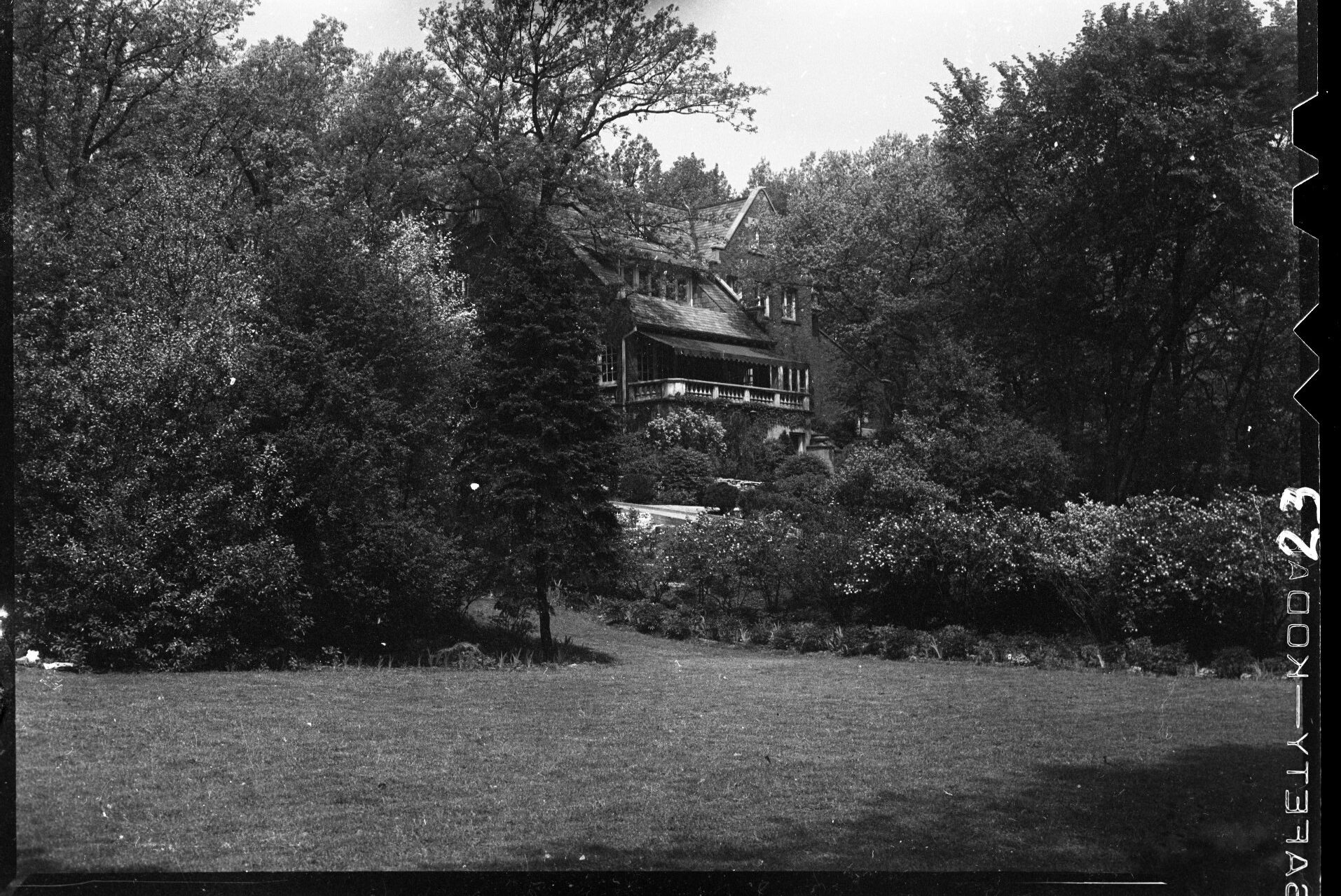
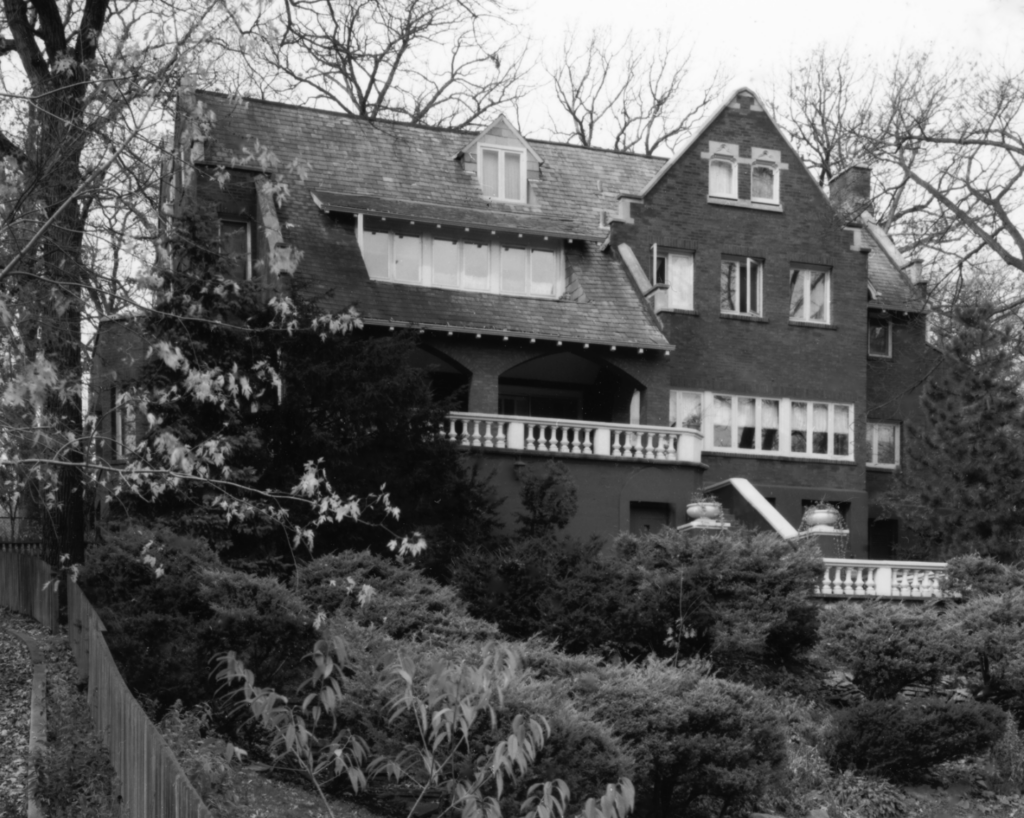
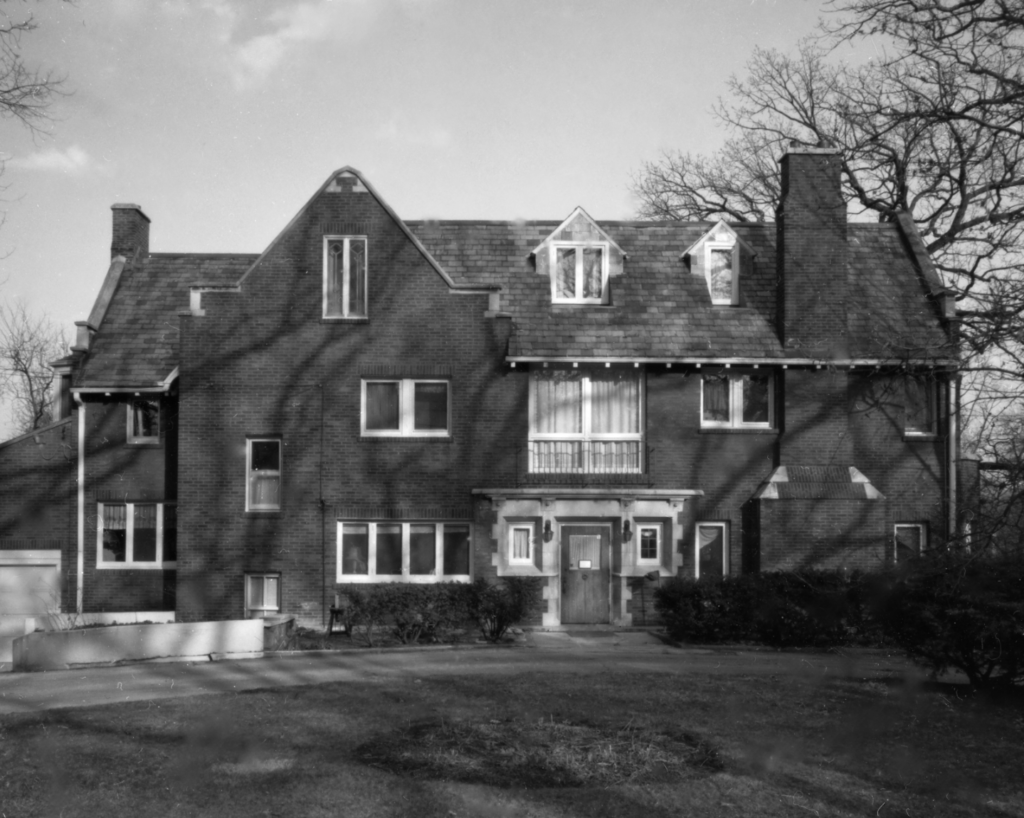
The historic Graver-Driscoll House is home to the Ridge Historical Society (RHS). The name of the house is derived from two prominent former owners.
The house was designed by architect John Todd Hetherington and built in 1921-1922 for Herbert S. Graver, Sr. In 1972, the house was donated to RHS by James P. Driscoll.
The Ridge Historical Society and James Driscoll
The Ridge Historical Society (RHS) was founded in 1971 by local volunteers to preserve the unique history of the communities on the north end of the Blue Island Ridge – Washington Heights, Beverly Hills, Morgan Park, and Mount Greenwood.
In 1972, the Graver House was donated to RHS by James P. Driscoll (1930-2008), of Chicago and Fort Lauderdale, Florida. Driscoll was an electrical contractor, founding Driscoll Electric in the early 1960s. He was active in many organizations and charities, and a director of Standard Bank and Trust Company. The donation was arranged by Justin O’Toole, President of Standard Bank, and RHS Finance Chairman.
The House
The Graver-Driscoll House has two addresses. The house faces east at 10616 South Longwood Drive, the original entrance to the property. A west driveway at 10621 South Seeley Avenue was added in the 1940s and is the address used today.
Architect John Todd Hetherington designed the Graver-Driscoll House as a Tudor Revival-style manor house. Built of brick and stone with a slate roof, the house has four levels including a full basement and attic, and an attached two-car garage. The walk-out terraces on the Longwood Drive side, nestled into the Ridge, blend the house into the natural terrain.
A fire in the house in 1962 destroyed some of the original features, and owners through the years made changes to the house, but the external façade largely reflects Hetherington’s original vision.
The Architect
John Todd Hetherington (1858 – 1936) began a dynasty of architects that spanned four generations.
Hetherington was born in Ontario, Canada, in 1858, where his parents, Henry Duncan and Jessie Todd Hetherington, owned a drug store. After his father died in 1862, his mother returned to her native Scotland with John and his siblings. He received his architectural training in Scotland.
Immigrating to the U.S. in 1881, Hetherington began his career in Chicago as a draftsman. After eight years, he began an independent architecture practice. He was known for the quality of his designs, solidly constructed brick buildings in public, business, church, and residential settings. Rather than developing a singular style, he showed his versatility by designing houses in Tudor Revival to Prairie School to American Foursquare styles.
Hetherington became a naturalized citizen in 1886. In 1888, he and Jane C. Welsh, from the same village in Scotland where he spent his youth, were married in Chicago. They had three children that survived into adulthood, Alec, Murray, and Jean. Moving to Beverly around 1901, Hetherington designed and built a home for his family at 9326 S. Winchester Avenue in 1906. They became valued members of the community.
Hetherington began designing residences locally and in 1912 his neighbors asked him to design Ridge Park at 96th Street and Longwood Drive. Around 1920, Murray joined his father’s practice, and he also designed many fine residences in the Beverly area. The Hetheringtons are credited with over sixty buildings in the community. Father and son together designed the current Ridge Park field house in 1929.
John Todd Hetherington died in 1936 from injuries sustained in an auto accident the year before. He was buried in Oakwoods Cemetery. His son Murray Douglas, grandson John Murray, and great-grandson John Lawrence continued the architecture legacy.
The First Owner
The early life of Herbert Spencer Graver, Sr., was filled with sports accomplishments. He was a track star at Englewood High School. He attended the University of Michigan, earning a degree in engineering, and gaining lifelong fame as a star football player. He played in the first Rose Bowl game on January 1, 1902, in Pasadena, California.
After graduation, Herbert worked as a college coach but then joined his father and brothers at the Graver tank business. He held the office of Corporate Secretary. Herbert married Anna T. Thorne in 1910 and they had one son, Herbert Spencer, Jr.
All five of the Graver sons and their parents established homes in Beverly. Herbert and Anna sold their Tudor Revival-style house at 10616 Longwood Drive in 1940 and moved to 10428 South Seeley Avenue.
Herbert stayed with the Graver company as a vice president after the family sold the business in 1930. He was still working as a sales manager when he suffered a fatal heart attack while watching wrestling matches at the International Amphitheater. He was buried in Mount Hope Cemetery on the Ridge.
The Location
The Graver-Driscoll House is built on the Blue Island Ridge, an ancient table of land formed by glacial activity around 13,000 years ago. The land was home to Native Americans for many thousands of years and became an important trade route for early European explorers and traders. The first recorded European settler built a cabin on the land in the 1830s.
The expansion of the Rock Island commuter railroad line circa 1870 made the land more accessible, leading to the development of suburban bedroom communities. The scenic beauty of “the Ridge” attracted wealthy Chicagoans to build homes here.
The Village of Washington Heights, which included much of the area now known as Beverly Hills including the site of the Graver-Driscoll House, was incorporated in 1874. The residents voted to annex to the City of Chicago in 1890.
– By Carol Flynn
– Photography by Mati Maldre
Owners of the Graver-Driscoll House
| Herbert S. and Anna T. Graver | February 14, 1921 – October 2, 1940 |
| Grant and Grace Fenn | October 2, 1940 – April 15, 1946 |
| Nicholas A. Cummings | April 15, 1946 – February 11, 1963 |
| William J. and Myrtle Heim | February 11, 1963 – April 20, 1964 |
| James McHugh | April 20, 1964 – November 7, 1968 |
| James Driscoll | November 7, 1968 – December 21, 1972 |
| Ridge Historical Society | December 21, 1972 – Current |