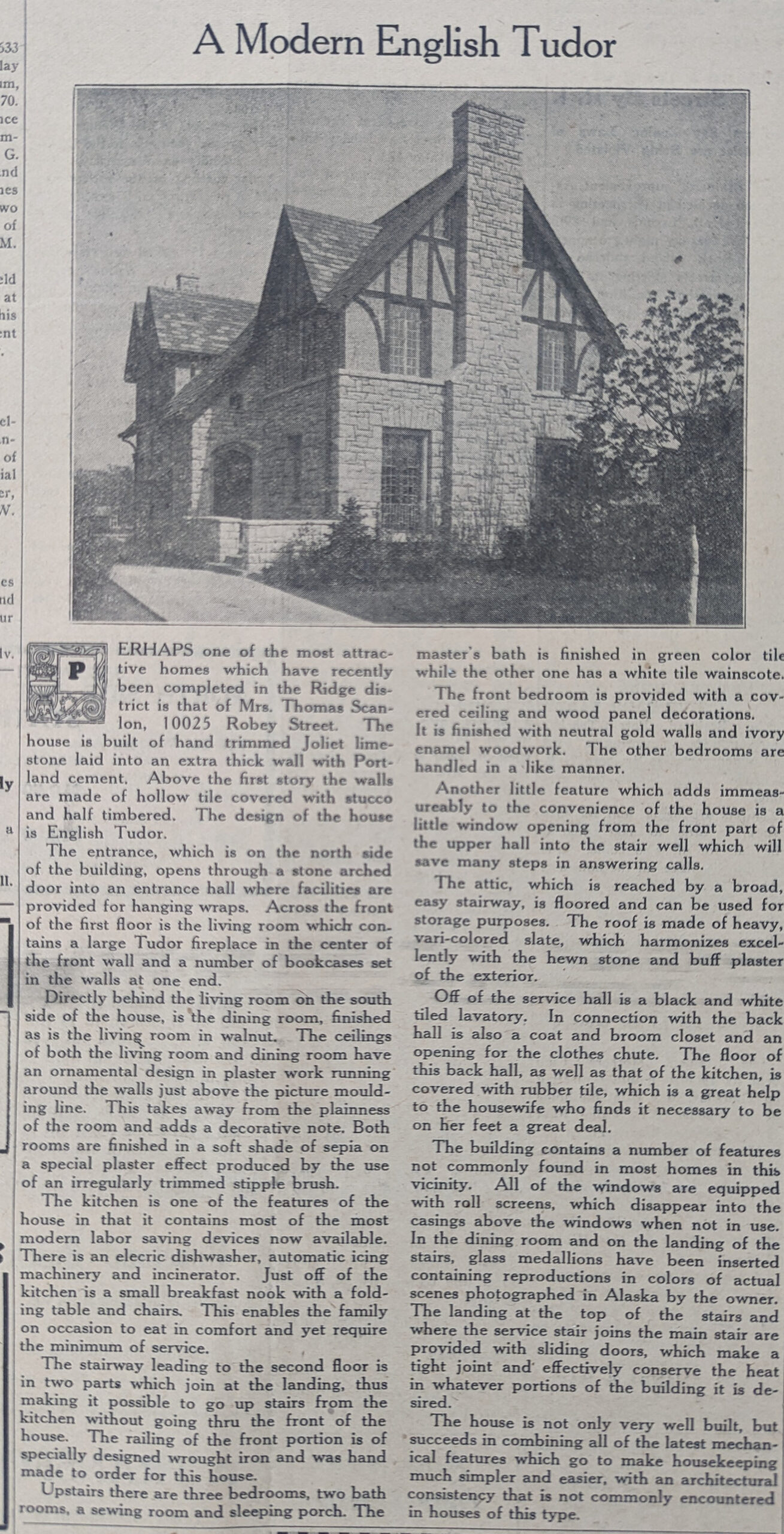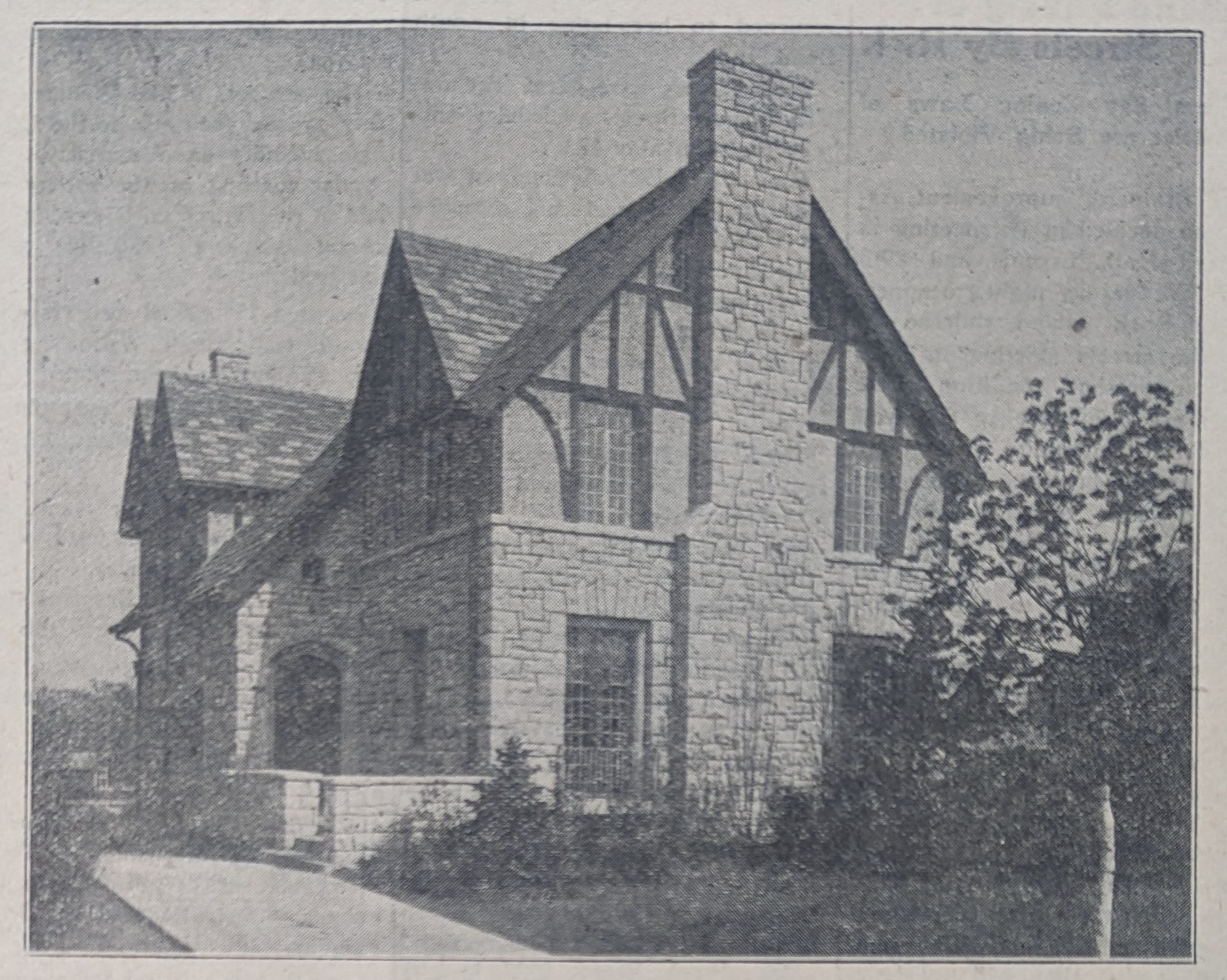
PERHAPS one of the most attractive homes which have recently been completed in the Ridge district is that of Mrs. Thomas Scanlon, 10025 Robey Street. The house is built of hand trimmed Joliet limestone laid into an extra thick wall with Portland cement. Above the first story the walls are made of hollow tile covered with stucco and half timbered. The design of the house is English Tudor.
The entrance, which is on the north side of the building, opens through a stone arched door into an entrance hall where facilities are provided for hanging wraps. Across the front of the first floor is the living room which contains a large Tudor fireplace in the center of the front wall and a number of bookcases set in the walls at one end.
Directly behind the living room on the south side of the house, is the dining room, finished as is the living room in walnut. The ceilings of both the living room and dining room have an ornamental design in plaster work running around the walls just above the picture moulding line. This takes away from the plainness of the room and adds a decorative note. Both rooms are finished in a soft shade of sepia on a special plaster effect produced by the use of an irregularly trimmed stipple brush.
The kitchen is one of the features of the house in that it contains most of the most modern labor saving devices now available. There is an elecric dishwasher, automatic icing machinery and incinerator. Just off of the kitchen is a small breakfast nook with a folding table and chairs. This enables the family on occasion to eat in comfort and yet require the minimum of service.
The stairway leading to the second floor is in two parts which join at the landing, thus making it possible to go up stairs from the kitchen without going thru the front of the house. The railing of the front portion is of specially designed wrought iron and was hand made to order for this house.
Upstairs there are three bedrooms, two bath rooms, a sewing room and sleeping porch. The master’s bath is finished in green color tile while the other one has a white tile wainscote.
The front bedroom is provided with a covered ceiling and wood panel decorations. It is finished with neutral gold walls and ivory enamel woodwork. The other bedrooms are handled in a like manner.
Another little feature which adds immeasurably to the convenience of the house is a little window opening from the front part of the upper hall into the stair well which will save many steps in answering calls.
The attic, which is reached by a broad, easy stairway, is floored and can be used for storage purposes. The roof is made of heavy, vari-colored slate, which harmonizes excellently with the hewn stone and buff plaster of the exterior.
Off of the service hall is a black and white tiled lavatory. In connection with the back hall is also a coat and broom closet and an opening for the clothes chute. The floor of this back hall, as well as that of the kitchen, is covered with rubber tile, which is a great help to the housewife who finds it necessary to be on her feet a great deal.
The building contains a number of features not commonly found in most homes in this vicinity. All of the windows are equipped with roll screens, which disappear into the casings above the windows when not in use. In the dining room and on the landing of the stairs, glass medallions have been inserted containing reproductions in colors of actual scenes photographed in Alaska by the owner. The landing at the top of the stairs and where the service stair joins the main stair are provided with sliding doors, which make a tight joint and effectively conserve the heat in whatever portions of the building it is desired.
The house is not only very well built, but succeeds in combining all of the latest mechanical features which go to make housekeeping much simpler and easier, with an architectural consistency that is not commonly encountered in houses of this type.
Original Article