
Ridge Historical Society
By Carol Flynn
School Series – Part 1 of Profile 5: Johnnie Colemon
This is fifth in our series of people who have schools named for them on the Ridge.
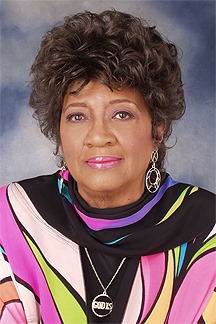
Johnnie Colemon (1920 – 2014) was a religious leader who inspired tens of thousands of people. Despite persistent racism and discrimination, she was a trailblazer who opened paths for other African American women to enter the ministry. And even though she had numerous distinctions, she always insisted people just call her Johnnie. Today is an appropriate day to begin Johnnie’s story.
Today is June 19th, or Juneteenth, a day we commemorate the end of slavery in the United States. It dates back to 1865, when Union soldiers landed at Galveston, Texas, with the news that the Civil War had ended and that all slaves were now free. Actually, of course, President Abraham Lincoln had declared the end of slavery as of January 1, 1863, with the Emancipation Proclamation, but the southern states had not honored that. It took over two more years of bloodshed to make emancipation a reality.
Annual celebrations on this day started with African Americans in Texas and with time spread throughout the country. The day has been celebrated in African American communities for over 150 years, and is finally receiving more widespread recognition. Some states recognize it as an official holiday. The Federal government has acknowledged the day as “Juneteenth Independence Day” and efforts continue to establish it as a national holiday. The day is known as America’s Second Independence Day.
More of Johnnie Colemon’s life will be covered in a second post. These are just some highlights.
Johnnie was born in Alabama and raised in Mississippi. In 1943, she earned a bachelor’s degree from Wylie College, which, interestingly for our story today, is a historically black college located in Texas.
Historically black colleges and universities (HBCUs) are those institutions founded specifically to serve African Americans. Most are located in the southern states and most were founded in the years following the U.S. Civil War. Prior to the Civil Rights Act of 1964, most colleges in the south prohibited African Americans from attending, and quite a few colleges in other parts of the country had policies and quotas limiting black students. HBCUs were established to allow black students to receive the educations rightfully due to them, and they persisted despite racism, segregation, and Jim Crow laws. These colleges were often started with the assistance of religious missionary organizations. Wylie College was founded in 1873 by Rev. Isaac Wiley, a physician, and bishop of the Methodist Episcopal Church.
After earning her degree, Johnnie moved to Chicago and was a Chicago public school teacher. A health crisis in the early 1950s led her to the Unity Church, which had started in 1889 as a spiritual healing ministry. In 1956, Johnnie became the first African American woman ordained a Unity minister. She returned to Chicago and started a congregation in a YMCA.
Johnnie’s positive and practical approach to religion and life drew many followers. She built her first church in the 1960s. She was elected the first African American president of the Association of Unity Churches in 1968. This caused some of the churches to quit the association. Even though the church preached that every person was a unique expression of God, sacred and worthy, the reality is that there was much systemic racism.
Johnnie named her church the Christ Universal Temple. In 1985, she became the minister of the “megachurch” she aspired to when she had a new 3500-seat facility built at 119th Street and Ashland Avenue. In addition to the auditorium, the building included a 470-seat chapel, a banquet hall, a bookstore, and a prayer ministry. More facilities were added later. At the time the Temple was built, Johnnie had a following of over 10,000, and this would more than double before she retired in 2006.
Videos of some of Johnnie Colemon’s sermons can be found on YouTube. Her doctrine was to think positively and concentrate on the present and the future. One of her sermons that was published, given in 2002, is titled, “Dear Enemy, I Love You.” Here is an excerpt.
“…. I want to say – “Dear enemy, I love you,” not because I want to, but because I have to! Not for your sake, for my own sake. I love you, enemy, because to hate, to harbor resentment, is what I call spiritual suicide. Hate ain’t killing nobody but yourself.
“Let’s review the word forgiveness. You’ve heard it a million times here in class, and you need to hear it a million times more. Forgiveness means to give for. Forgiveness means the giving up of something. It means to give love for hate. It means to give understanding for misunderstanding. It means to give joy for sadness. What do you need to give up? Can’t nobody answer that for you but you.
“What did Jesus Christ say about it? Jesus Christ said, ‘Father, forgive them for they know not what they do.’ Now, that’s what Jesus said. Can you live according to the teachings of Jesus Christ? Can you follow His example? Jesus was above all hatred, all animosity, and all thoughts of revenge. He proved it that day at Calvary.”
Words for all of us to consider.