
The Ridge Historical Society
February – Black History Month –#2
By Carol Flynn
The second person who has a school named for her in a Ridge community to be profiled for Black History Month is Reverend Johnnie Colemon.
Johnnie Colemon (1920 – 2014) was a religious leader who inspired tens of thousands of people. She was a trailblazer who opened paths for other African American women to enter the ministry. And even though she had numerous honors and distinctions, she always insisted people just call her Johnnie.
Johnnie was born in Alabama and raised in Mississippi. In 1943, she earned a bachelor’s degree from Wylie College, a historically Black college located in Texas. She moved to Chicago and became a Chicago public school teacher.
In 1952, a health crisis took her to the Unity Church, which was founded in 1889 as a spiritual healing ministry. Today it is part of the “New Thought” movement.
Johnnie visited Unity headquarters near Kansas City, Missouri, and immediately felt at home with the teachings. She was accepted into the Unity School of Christianity, but even though the church taught that each person was a unique expression of God, sacred and worthy, Black students were not allowed to live in the school’s cottages or eat in the school restaurant, and had to sit in a segregated, roped off section in church.
Johnnie voiced her objections to these arrangements, and many of the whites considered her “arrogant.” But an unused cottage was made ready for her, although it was set apart from those of the white residents. She was the first Black person to live on campus.
She became an ordained Unity minister in 1956, the first African American woman to do so. Returning to Chicago, Reverend Colemon started her own church, at first meeting in a YMCA, but in a few years raising the money for her own building.
In 1968, Rev. Colemon was elected the first Black president of the Association of Unity Churches, causing some churches to quit. She then withdrew her church from the Unity organization, in part due to the systemic racism, and also because her philosophies were developing in other directions.
At that time, she renamed her church Christ Universal Temple (CUT). She also formed her own denomination, the Universal Foundation for Better Living, that now has thirty member churches internationally.
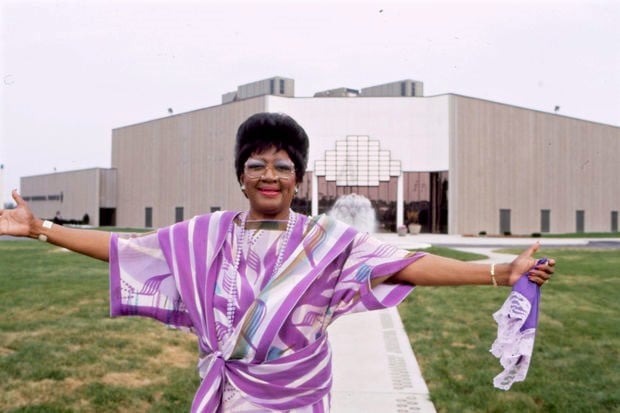
Rev. Colemon’s influence spread. Her sermons with positive, practical, understandable messages were well-received and her congregation kept growing. By 1985, CUT had grown into a megachurch and needed a building to accommodate its size.
Financial loans were almost impossible to come by for an African American woman, but Rev. Colemon persisted, and succeeded in obtaining funding through loans and donations. She had a new facility built at 119th Street and Ashland Avenue. This facility included a 3,500-seat auditorium, chapel, bookstore, banquet facility, and prayer center. She started an institute to train ministers and teachers. Her following grew to 20,000 members.
CUT has been the site for memorable events, including a 2005 Father’s Day address by then U. S. Senator Barack Obama. Rev. Colemon lived on the same block as the Obamas in Hyde Park/Kenwood. She ordained actress/singer/author Della Reese a minister in the 1980s; they became close friends.
In addition to her ministry, Rev. Colemon also held civic positions. She was a director of the Chicago Port Authority and a commissioner on the Chicago Transit Authority Oversight Committee. Her awards, including honorary doctorates, are too numerous to list here.
In 1999, she built a private elementary school as part of the CUT complex, which was named the Johnnie Colemon Academy. Because of the necessary tuition, the school met with limited success, and beginning in 2001, the Chicago Board of Education (CBOE) took over the building for a public school.
The Johnnie Colemon name was kept for the school, even though today’s CBOE rules, in keeping with the separation of church and state, prohibit naming a public school for a religious leader.
Picture: Rev. Johnnie Colemon outside her new Christ Unity Temple when it opened in 1985. Ebony magazine.