
The Ridge Historical Society
Black History Month: The Underground Railroad (UGRR) and the Ridge – Part 2
By Carol Flynn
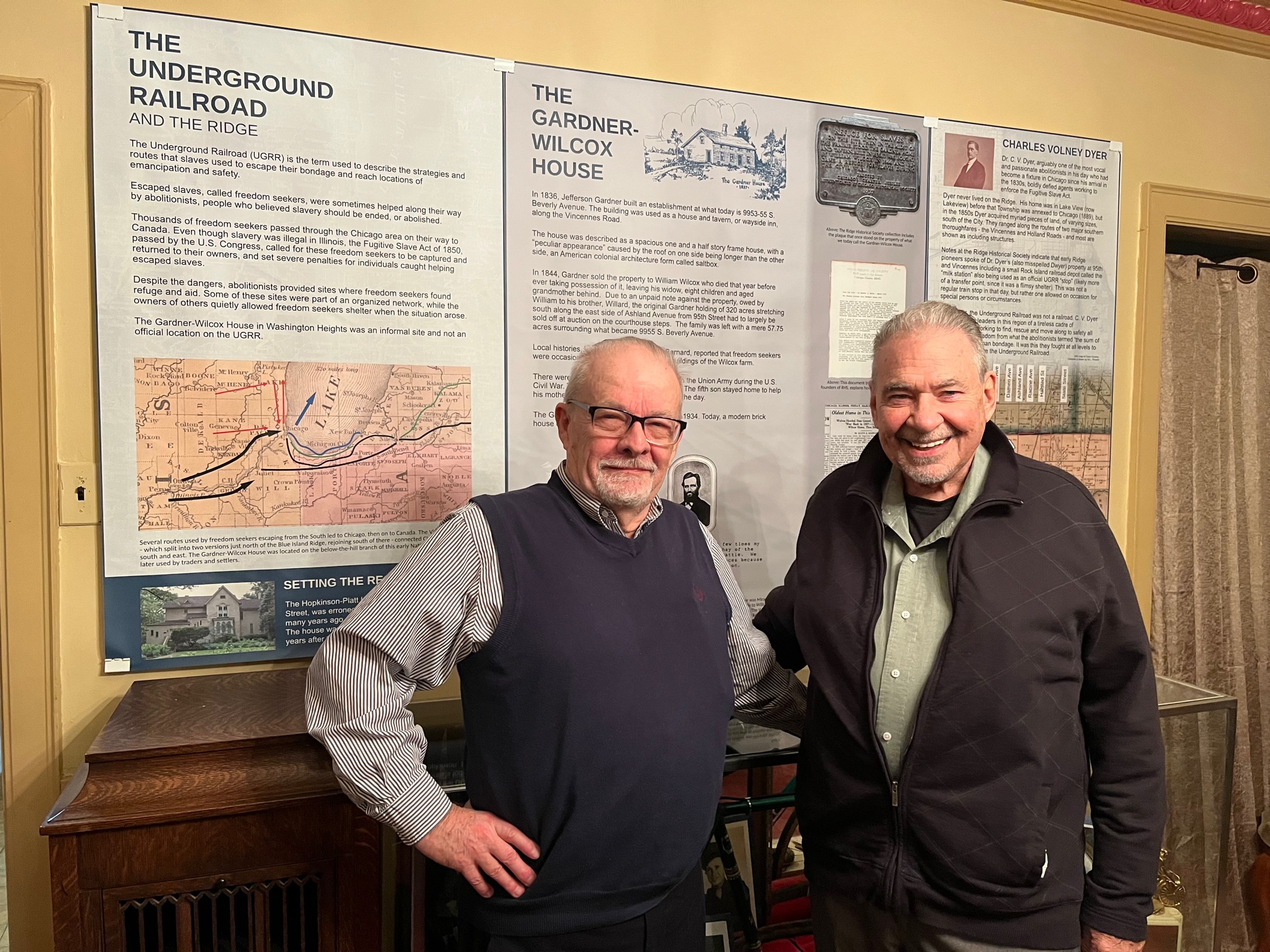
The Ridge Historical Society hosted Dr. Larry McClellan and Tom Shepherd from the Little Calumet River Underground Railroad Project for a presentation on Friday evening, February 17th.
McClellan is the leading expert on the Underground Railroad (UGRR) in northeastern Illinois and has written three books related to the topic: To the River, the Remarkable Journey of Caroline Quarlls (available now), The Underground Railroad South of Chicago (reprint will be available in a few weeks), and Barefoot to Chicago: Freedom Seekers and the Underground Railroad in Northeastern Illinois (coming this summer).
Shepherd is well-known preservation, environmental, and social activist in the south Chicagoland region, hailing from the Pullman community. He was with the Southeast Environmental Task Force for fifteen years, where he served as President.
The UGRR started in response to enslaved people escaping the inhumane and immoral system allowed to exist in the southern states. As these people made their way to places of freedom like Canada, they started to receive assistance along their ways from others sympathetic to their cause. The informal network of safe houses and other means of assistance became known as the Underground Railroad. Information was passed along by word of mouth.
The preferred terminology for escaped slaves is “freedom seekers.” This takes the emphasis off of their standing as fugitives, escapees, runaways, and breakers of the law. Instead, emphasis is placed on their humanity and their intrinsic right to live in freedom, and their bravery to risk everything, their very lives, to achieve that goal.
A major route for freedom seekers traveling to Canada was through the Chicago area. Usually traveling at night along ancient trails first carved by animals, then used by Native Americans and later traders, it is estimated that as many as 4,500 freedom seekers came through the area. Many made the journey on their own, but many were helped by white and Black abolitionists, people who believed slavery should be abolished.
Although Illinois was a free state, the Fugitive Slave Act of 1850, passed by the U.S. Congress, mandated the capture and return of runaway slaves who escaped from one state and fled into another. Individuals who helped slaves to escape were heavily penalized, with a fine of $1,000, about $35,000 in today’s value, and possible jail time. The actual number of abolitionists willing to break the law and help escaped slaves was small.
The next posts will cover the Chicago-area community of abolitionists who helped the freedom seekers and UGRR sites in the area, including those connected to the south side of Chicago and the Ridge.
Picture: Larry McClellan (left) and Tom Shepherd at RHS in front of an exhibit on the Ridge site known to have harbored freedom seekers. Photo by D. Nemeth.