
Ridge Historical Society
By Carol Flynn
School Series – Profile 7: Annie Keller (1901 – 1927)
This is the seventh profile in our series on people for whom schools on the Ridge are named.
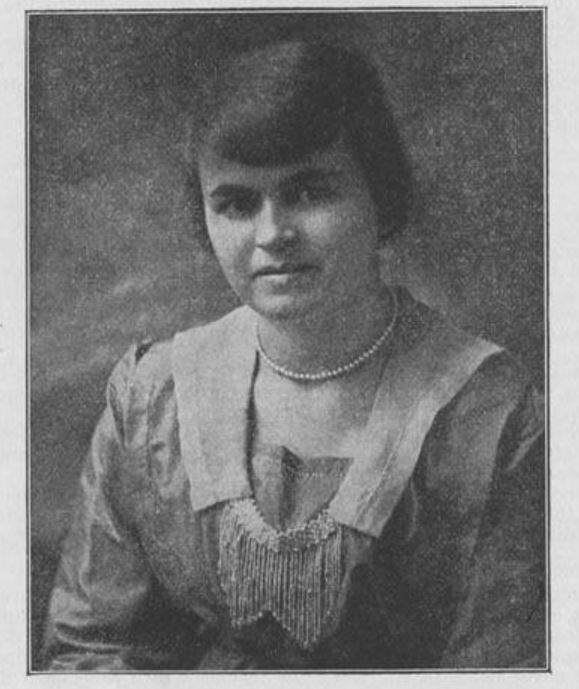
Anna Louise Russell Keller was a young teacher who lived downstate and became a hero. Although she never lived in Chicago, her story was so compelling it earned her a school named in her honor, at 3020 West 108th Street.
“Annie,” as she was known, was born in Greene County, IL, on October 31, 1901. Greene County is in the west central part of the state, just north of the St. Louis area. Her mother’s family, Russell, was a pioneer family in that community. Annie attended Illinois State Normal University with her younger sister Mary, and both became teachers.
In 1927, Annie was in her third year of teaching in Centerville, a town in Greene County. She was the only teacher in a one-room brick and wood schoolhouse built in 1848 that still used an old coal stove for heat. The building was described as weather-beaten and “growing feeble,” with cracks in the walls. Still, it had always been sturdy enough to withstand Midwestern weather, and had served many generations of the local community. There were 21 students in the school then, at various grade levels; the oldest student was 15, the youngest, 6.
On April 19, at noontime, there was a severe rain and hail storm, so Annie and the students had to eat their lunches inside. Three of the students ran home for lunch.
A woman who was a 9-year-old student at the school that day recounted forty years later what happened next: “We were all standing at the window. Suddenly there was a lull in the storm and the sky turned black. The wind was getting stronger and stronger. We could see debris flying across the fields. The coal shed next to the school was blown away, and we realized we were in for a tornado.”
With only a few seconds to think, Annie ordered the class to flatten themselves on the floor under their desks. She grabbed the little ones who were too frightened to act and pushed them down.
The students had just gotten to safety and Annie was still by the door when the roof of the schoolhouse was blown off and the school collapsed. Annie was hit by the timber doorframe as it fell.
Another student, then 12, remembered seeing Annie get hit, and called out to her, but there was no response. Then the student was buried by falling bricks and glass as were most of the other students.
Those few students who were not buried frantically started to dig out their classmates. Three farmers who had been working in the fields nearby and witnessed the disaster rushed to the school. One of them was Howard Hobson, Annie’s fiancé. They came across a scene of chaos and devastation, with terrified students screaming and buried in the rubble.
Miraculously, all of the students survived, and there were only minor injuries. Thanks to Annie’s quick thinking, the desks had shielded the children from the worst of the destruction.
Annie’s body was found buried in the debris. Her neck had been broken by the collapsing timber. She was 25 years old.
In 2002, one of the last living students, then age 83, said, “Miss Keller was a wonderful teacher. We respected her and always obeyed her. It hurt us badly that she was killed. I think she saved us all.”
Annie’s funeral two days later was the largest the town had ever seen, attended by over 1,000 people crowding in and around the little Methodist church in White Hall, her hometown in Greene County. A truck was needed to transport all the floral displays people sent.
The papers of the day reported that the tornado had crossed the Mississippi river from Missouri and ripped a path through central Illinois, leaving at least 21 people dead and over 120 injured, and causing over a million dollars in damage. The injured were brought by train to the hospitals in Springfield and other larger towns. Greene County was hit the hardest, right where Annie’s school was.
Within days of the Annie’s death, two memorials were planned. A tablet was to be erected In Carrollton, the county seat, near where the school had been located. In White Hall, the historical society announced plans to raise funds to erect a monument at the public park.
Funds were raised by the schools of Illinois to provide the memorial. Students donated their pennies and the money was sent to Francis G. Blair, the state superintendent of schools, in Springfield. When they raised $5,000, they began a search for an artist to create the memorial.
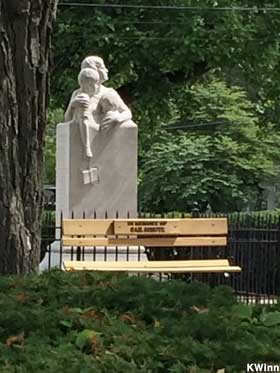
Famous sculptor Lorado Taft contacted them. At the time, he was an instructor at the School of the Art Institute of Chicago. He was interested in the project and offered his services for a greatly reduced fee, and of course they accepted. The memorial originally was to be made of bronze, but Taft decided he wanted to work in Tennessee pink marble instead. The $5,000 did not cover the cost of the marble, so Taft paid the difference himself.
In January of 1929, Mary Keller, Annie’s sister, and a friend, traveled to Chicago to meet with Taft. They were joined by Blair, who also had become personally committed to the project. Mary posed as the model, and Taft also worked from photos of Annie. Mary visited a second time, and reported she was pleased with the sculpture, a bust of Annie with one arm around a boy student and the other arm hugging a small girt student close to her.
Over 3000 people attended the dedication of the monument in August 1929. Her students made a human chain around the monument and laid roses at the base. Superintendent Blair was the host for the event, and a highlight was Taft’s attendance and speech. Said Taft: “There is no more beautiful story than that told in the life and death of Miss Keller. I rejoice in my profession that makes possible this memorial to her if it becomes an inspiration to others.”
People that knew Annie during her brief life described her as a talkative, jolly, light-hearted person, and a good teacher. She was always doing something for someone else. She was not a flashy person. She was an average girl from an average small town who became an average teacher and never had a chance to distinguish herself. She would never have thought of herself as a hero. But when the emergency came, it took her less than 10 seconds to prove herself. She rose to the occasion.
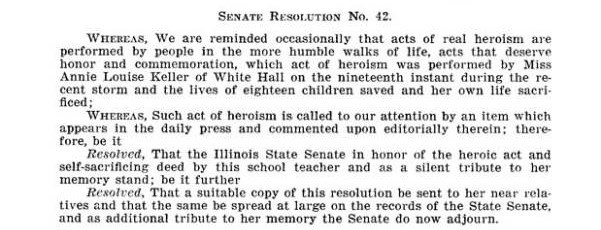
The Illinois State Senate passed a resolution paying honor to Annie’s heroism. A copy of that resolution is attached.