
Ridge Historical Society
Teacher Appreciation Week – May 3-9, 2021 – Part 3
School Series – Profile 11: Kate Starr Kellogg
By Carol Flynn
Kate Starr Kellogg was an educator whose career spanned over 40 years. Obviously, there is no way a Facebook post can cover that much detail, but here are a few documented stories about her that reveal something of her character and philosophy of teaching – and life.
Most of what we know about Kate’s teaching philosophy comes from her twenty-two years as principal of the Lewis-Champlain School in Englewood.
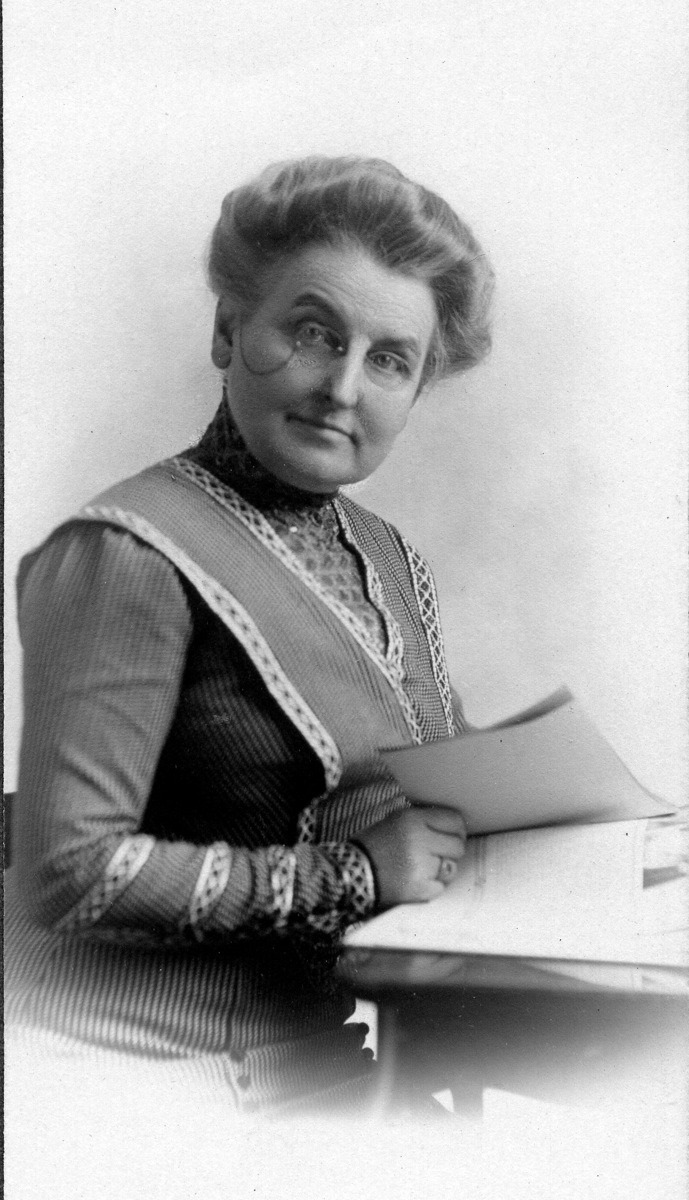
A lot of times, people in early photographs come across as formal and stern, usually because of their poses and lack of smiles. Back then, that was proper photo etiquette. Early cameras and film techniques required sitting still for a period of time, and even once camera technology improved, it was some years before “spontaneous” or “candid” shots, or even smiling, became the norm. So while Kate may come across as stern in her pictures, giving the impression she might have been a “tough” teacher, other information about her shows this was not the case.
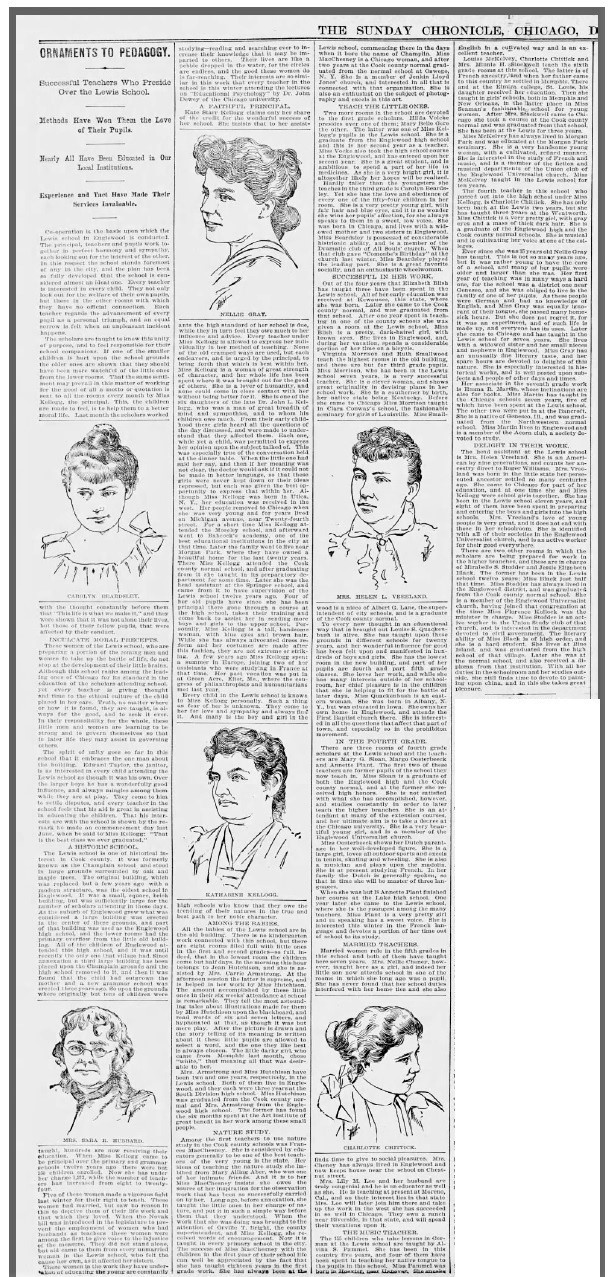
In 1895, the Chicago Chronicle newspaper ran a lengthy article about the teachers – and principal – at Lewis-Champlain. The newspaper stated: “The school stands foremost of any in the city, and the plan has been so fully developed that the school is considered almost an ideal one.”
The “plan” of the school was simple: “Co-operation is the basis upon which the Lewis school in Englewood is conducted. The principal, teachers and pupils work together in perfect harmony and sympathy, each looking out for the interest of the other. … Every teacher is interested in every child.”
The article glowed with praise for Kate as principal. While she humbly gave credit to the fine teachers under her, they said they owed much of their success to her influence and advice.
The article stated: “Miss Kellogg is a woman of great strength of character …. She is a lover of humanity, and none could come in close contact with her without being better for it.
“Every child in the Lewis school is known to Miss Kellogg personally. Such a thing as fear of her in unknown. They come to her for love and sympathy and always find it.”
As would be expected, Kate often wrote papers for and made presentations to professional education groups. She was also a popular member of and speaker at the women’s clubs in Chicago.
In 1901, she wrote a paper for the Northern Illinois Teachers Association that also received coverage by other groups The theme of the conference was “The School and Society” and Kate’s paper was on “Some Concrete Examples.”
Instilling social responsibility in children was an important tenet of progressive education. In this paper, Kate described how Lewis-Champlain approached this through “municipal civics.” Each grade level studied a component of Chicago government and services from many different angles, from how services developed and were administered to how they were paid for, as a way to incorporate many lessons.
For example, the younger grades studied the Chicago Fire Department. Other classes studied smoke “nuisance” or pollution, garbage disposition, and water and sewerage, and they were preparing to study the city’s regulations on trees. One grade studied city construction projects – they redesigned their own schoolyard and then sent a proposal to the Board of Education. Kate noted they also got a lesson in patience waiting for a reply.
They divided the school buildings and grounds into “wards” and the children acted as “aldermen” with duties defined by the “citizen-pupils” themselves.
The innovative plan was well received by educators.
Kate suggested the idea be expanded into the community. She made a presentation to the Englewood Woman’s Club suggesting that boys could develop into better citizens and more informed voters as adults if, as children, they were encouraged to become more aware of their community’s needs by monitoring such activities as garbage collection and smoke nuisances.
The next day, the Inter Ocean newspaper ran a blistering response to Kate’s suggestions.
“Miss Kellogg evidently knows little about boys. And what is more, she is palpably deficient in knowledge of the boy’s father,” wrote the paper.
The paper went on to say fathers didn’t want their sons to be busy bodies, spying on the neighbors. The boys would turn into self-opinionated, self-righteous, self-conceited, meddlesome men. Their fellow schoolboys would be against it, and instead of developing a social conscience, it would earn a boy well-deserved kicks and black eyes.
“The safety of this republic lies in the fact that the average father and mother think most of the boy who is least inclined to win favor by stooping, even as a civic duty, to the garbage-box level,” insisted the paper.
That newspaper writer might not have thought highly of trying to instill social responsibility in children, but without a doubt, his opinion did not deter Kate.
Another interesting article Kate wrote for the American Education magazine in 1906 was titled “Democracy in School Relationships.” She called for allowing children, within reason, to have a say in classroom activities. She believed independent thought should not be stifled, but directed to mutually beneficial activity, with the child understanding the effect his individual behavior was having on his “room society.”
Kate gave as an example a visit she made to one of the classrooms, where the young teacher was under “nervous strain” trying to control her class. Kate suggested a group activity allowing the children to construct or illustrate the story they were learning about. The teacher replied she was afraid if she did that “they would get away” from her.
Kate replied, “They won’t get away from you if you go with them.”
Kate returned to the classroom a half-hour later to check on the situation, and found the children “quietly and happily engaged in cutting and pasting a miniature Fort Dearborn.” They were freely sharing supplies and working together on the model. The teacher gave a sigh of relief and “the joy in the room was reflected in the teacher’s face.”
“I never would have believed it possible. An hour ago I was ready to give up,” said the young teacher.
It’s a good thing she listened to Kate Starr Kellogg.
Next post: Kate Starr Kellogg – Board of Education politics and some personal interests