The Ridge Historical Society
School Series – Profile 14: Elizabeth “Bessie” Huntington Sutherland
By Carol Flynn
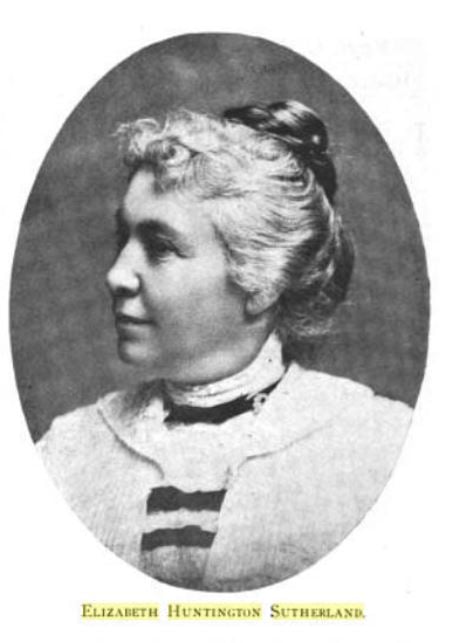
The next person to be profiled in our series about people for whom Chicago Public Schools on the Ridge are named is Elizabeth “Bessie” Huntington Sutherland (1851 – 1924).
Bessie Sutherland was a very respected and forward-thinking leader in the education field.
She was born in 1851 on the Ridge. Her parents, Samuel and Maria Robinson Huntington, were part of the earliest Ridge pioneer families. Samuel was a farmer and kept stock and also became involved with the railroads, and served as sheriff of the City of Blue Island. Maria was reputed to have been an early teacher in Blue Island, making $1.00 per week for her efforts.
Around 1854, a two-room schoolhouse was built in Blue Island, and it is probable that Bessie attended this school as a child. She went on for training as a teacher at the Cook County Normal School, established in 1867. The name “normal school” was used for teacher preparation programs because they established teaching standards or “norms.” Bessie graduated from this school in 1869. This school eventually evolved into Chicago State University.
Bessie’s career as a teacher included the Blue Island school and the Hyde Park high school. She took graduate classes at the University of Chicago. She was a member of the National Education Association.
The Washington Heights public school started in 1874 and Bessie became principal there in 1883, the first woman to be named a principal in Cook County. In 1893, this school was renamed the Alice L. Barnard School, after another Ridge native who had become the first woman principal of a Chicago school.
A 1912 History of Education in Illinois reported that Bessie had three schools under her charge, nineteen teachers, and eight hundred students.
Bessie became a teacher during the “Progressive Era,” that time of significant reform. The field of education made great advances during this time, as the philosophy of learning changed from rote memorization to exploration and experimentation. Bessie surely knew two of the movement's leaders in Chicago, Francis W. Parker, who became head of the Cook County Normal School, and John Dewey, who established the University of Chicago Laboratory School.
An anecdote about Bessie illustrates the Progressive educator. While principal at the Barnard School, one day she heard that a camel had escaped from a traveling show and was freely roaming the local woods. She gathered the entire student body and led an impromptu field trip to the woods to observe the camel “in the wild” and share a lesson on animals of the world.
Bessie was a strong proponent of kindergarten, a unique program that developed in Europe separate from the traditional grade school model. This new model, which emphasized investigation and imagination, was just starting in U.S. schools in the late 1800s.
Bessie started a program at the Washington Heights School, and is quoted in a 1900 publication, Education in the United States, that when comparing siblings from families where the older children went through school before the kindergarten program was started, the younger siblings who had the advantage of kindergarten “were brighter in every way,” which she attributed to the “early wholesome awakening brought about by the training of the kindergarten.”
[RHS did an entire newsletter in the past on kindergarten and the pioneering educators in this area who lived on the Ridge, the Hofer family, and will run a series on this in the future.]
Bessie authored professional articles, including one on a county-wide spelling contest for the Journal on Rural Education. However, in a literature search, several articles about crime are attributed to her that were actually written by another E. H. Sutherland, Edwin H., a U.S. sociologist and criminologist.
During Bessie’s lifetime, women teachers were not allowed to marry if they wished to remain employed. It was believed that married women teachers would put their energies into their home and the classrooms would suffer.
Bessie put off marriage to David Sutherland until her 43rd birthday in 1894. Sutherland, seventeen years Bessie’s senior, was a real estate developer with considerable property on the south and west sides of Chicago. They made their home at 1638 West 103rd Street. The couple had no children, and David died in 1904. A favorite niece and her family made their home with Bessie.
Bessie kept her employment during her married years. She served as the “lady principal” of Barnard School for almost 40 years. She resigned in 1923, and died in 1924. She was buried in Mt. Greenwood Cemetery.
In 1925, the new school built at 101st and Leavitt Streets was named in her honor.