
The Ridge Historical Society
The First Chicago Christmas Tree and the Ridge – Part I – Revised
By Carol Flynn
Chicago’s first municipal Christmas tree was displayed in 1913. For the first time, on Christmas Eve, viewers witnessed a giant tree ablaze with strands of electric light bulbs set up on Michigan Avenue. Ridge resident Amalie Hofer Jerome was named an honorary vice president for the lighting event.
RHS profiled the Hofer family in the Winter 2013 RHS newsletter, which focused on the beginnings of the kindergarten movement in the U.S. The Hofer sisters led the way in Chicago in the establishment of kindergartens and training programs for kindergarten teachers. And that was only one of their accomplishments.
These 2021 posts will cover more on the Hofers, and then feature the 1913 Christmas event.
The Hofer family came of age during the Progressive Era of the late 1800s – early 1900s, a time of widespread reform in just about every area of American life, from education to business to government. This will be explored when Amalie Hofer’s career is reviewed in an upcoming post.
Amalie’s father was Andreas Franz Xaver Hofer, born in 1821 in Baden, a historical territory in south Germany and north Switzerland. He took part in the unsuccessful Baden Revolution of 1848 – 49, an attempt to overthrow the ruling princes. Forced to flee the country, he came to New York City in 1849.
His future wife, Mari Ruef, was born in 1836 in Baden, and came to New York in 1852. There she met Hofer and they married in 1853. Hofer died in 1904 and was buried in Mount Hope Cemetery on the Ridge. Mari moved to California where she died in 1918. Hofer’s remains were then brought from Chicago to California to be buried with her.
The Hofers moved to Iowa from New York. Hofer fought with the Iowa Infantry of the Union Army in the Civil War. They became naturalized citizens of the U.S.
The Hofers were farmers and dry goods merchants in McGregor, Iowa. Hofer became known as a local expert on cultivating grapes and was active in the Iowa State Horticulture Society. They purchased a local newspaper, the McGregor News, which they ran for many years. The family was well known in the community.
Hofer‘s philosophy for the newspaper was “closely identified with the interests of the people and with successful government,” according to an article written in 1904 by his sons. He was involved in local politics and a leader of the temperance movement. Many of the beer breweries in the U.S were owned by German immigrants, and the newspapers made note of the divide in the German community over the alcohol issue. Hofer wrote temperance tracts in the German language which were published by the German National Temperance Association.
He used the newspaper to advance his platforms and this did not always go over well with the subjects of his commentaries. In one court case that was followed closely by the public, the newspaper and its publishers, A. F. Hofer and Sons, were sued for $5,000 by a saloon keeper claiming the paper had damaged his character. The paper had accused the saloon keeper of keeping a gambling house. The saloon keeper was backed by the local liquor league. The case went to court, and the Hofers won the case – the charges against the saloon keeper were “fully sustained.”
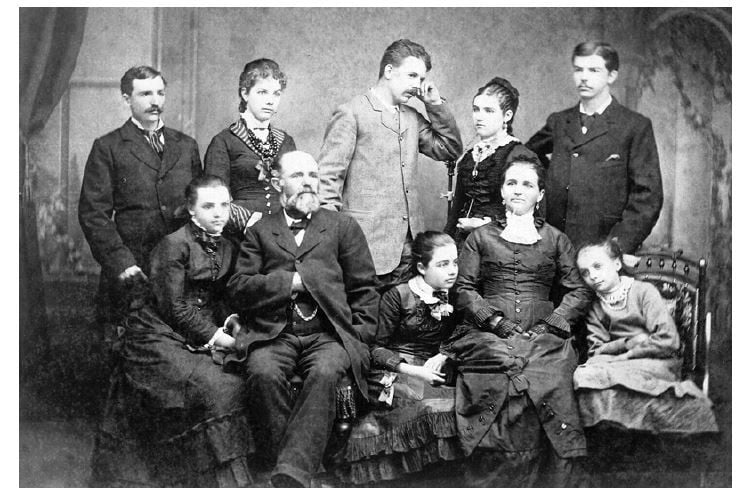
The Hofers had eight children, five daughters and three sons. They were mostly self-educated, and as youths were all involved with the newspaper, leading to careers that included writing, editing, and publishing.
The family sold the McGregor News in 1890. By then, the sons, Ernest (1855-1934), Frank Xaver (1856-1905), and Andreas F., Jr., (1861-1913), who made the newspaper and publishing industries their lifetime careers, had moved to Salem, Oregon. “E.” and “A. F.” took over the Capital Journal, an evening paper. Ernest later ran the Industrial News Review, which advocated for “policies essential to the well-being of our country.” Frank owned half of one newspaper and was the founder of another.
In the 1890s, Mr. and Mrs. Hofer moved to Chicago from Iowa. They settled on the Ridge at 1833 W. 96th Street. In Chicago, they were surrounded by their daughters, who were educators and social activists.
Next post: The Kindergarten Movement and the Hofer sisters
Photograph: Andreas Franz and Mari Hofer and their eight children. User-submitted on Ancestry.com.