
The history of Dan Ryan Woods – Part 14: More stories from the 1930s – 1940s
By Carol Flynn
During the Great Depression, few people could afford expensive vacations and outings. The Forest Preserves of Cook County (FPCC) became more popular and important than ever as a source of entertainment and recreation.
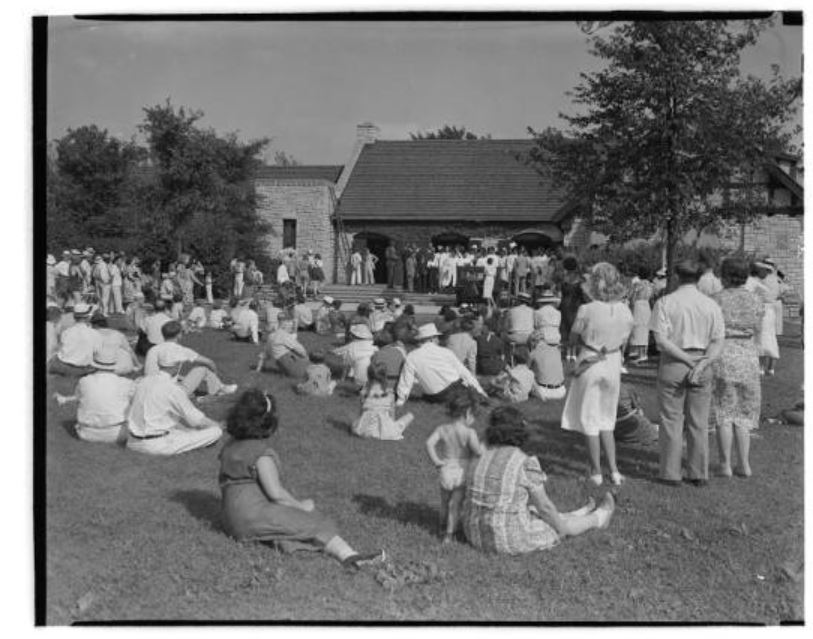
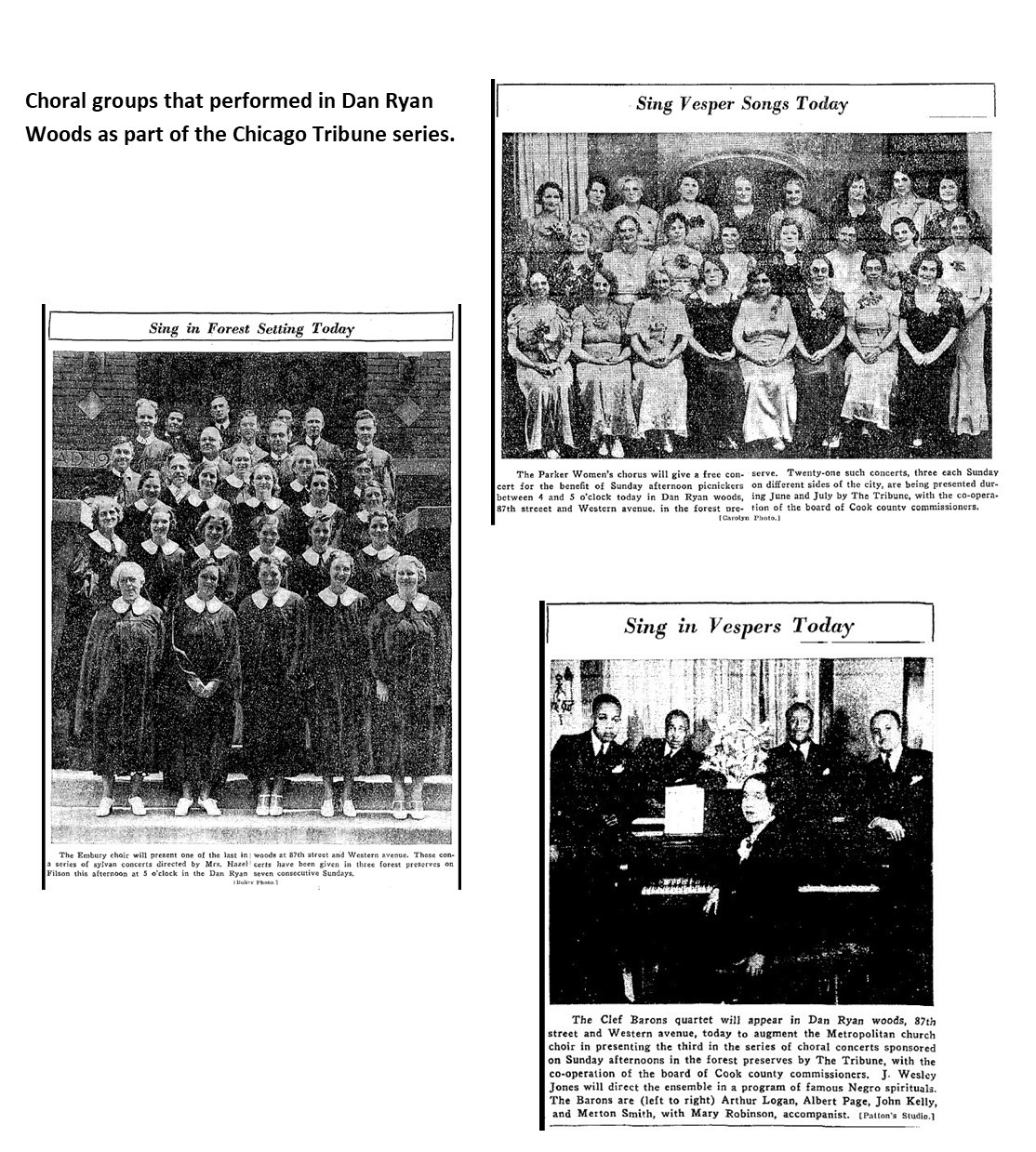
Starting in the summer of 1938, for several years the Chicago Tribune sponsored a “twilight music series” featuring choral concerts in several preserves, including Dan Ryan Woods (DRW). On Sunday evenings, choirs from around the city and suburbs, ranging from church groups to opera companies to children’s choirs, performed in the woods. Everything from spirituals to romantic light opera to popular Irving Berlin songs – “God Bless America” premiered in 1938 – was featured.
The concerts attracted thousands of attendees and were lauded by everyone from the conductor of the Chicago Symphony Orchestra to the director of Hull House for bringing free concerts to the people and making great use of the preserves.
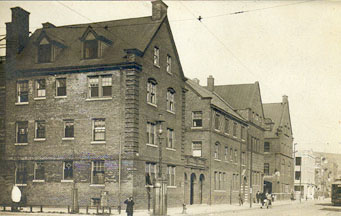
Hull House was the famous settlement house founded in 1899 by Jane Addams (1860-1935), the legendary social worker, activist, and reformer. As part of its mission, Hull House offered social, educational, and artistic programs for the working class people of the near west side.
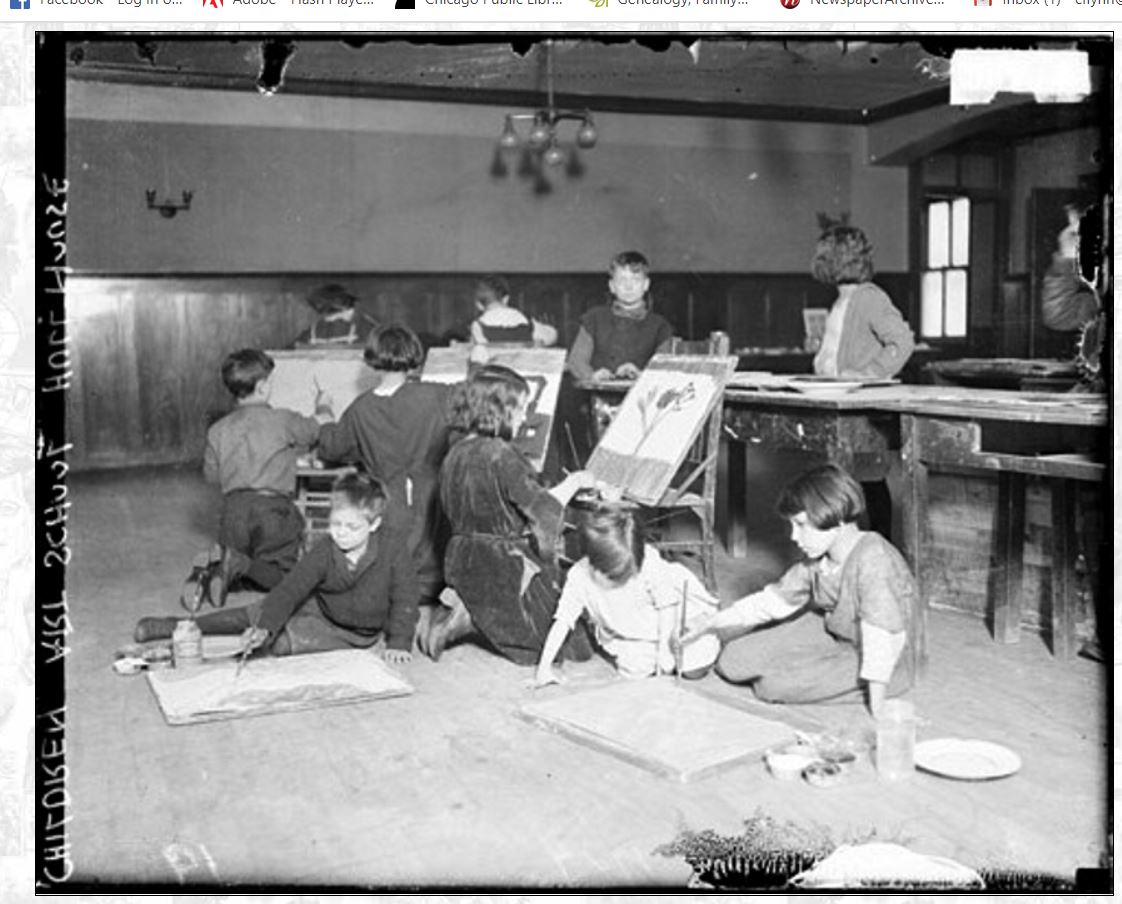
In 1941, a poignant article appeared in the Chicago Tribune: “Paint snow as black because it is to them: Hull House children are realistic.”
The inner-city children in the art program at Hull House painted winter as they saw it: sooty piles of snow on the streets, dirty gray city park skating areas. From imagination, they added trees with green leaves.
The teachers realized these children had never experienced a fresh, clean snowfall, nor had they seen a tree in winter. The excursions coordinator decided a winter outing was in order.
A day of sledding in DRW was decided upon. Summer trips to DRW regularly took place, but there were challenges to overcome for a winter outing. In summer, the children just needed carfare and lunches. But now in winter, many of the children had no warm woolen clothes, no mittens, no rubber boots – and no sleds.
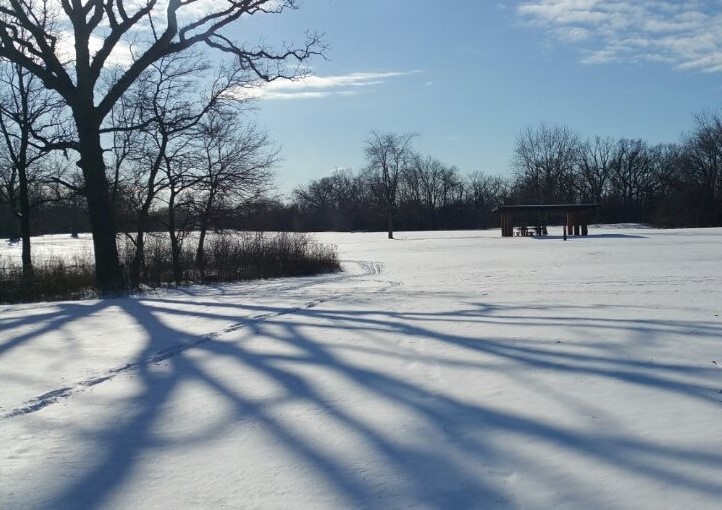
Still, the staff was determined to make this happen, so the children could see vast stretches of untarnished white snow interspersed with groves of bare trees, and could experience a sled ride down the big hill. DRW had the warming house, and that was a big plus “for hands that build snowmen without mittens and for little boys who slide down a hill without a sled.”
One hundred and fifty boys and girls signed up for the trip, including the entire art class. There were 55 sleds available among those who signed up. They scoured the neighborhood to borrow and buy second-hand sleds, and the children used their ingenuity to build their own out of whatever materials they could find – old barrels, tin cans.
Warm clothes, boots and mittens were borrowed. They managed to pull off this first winter excursion and it was pronounced a “glorious success.”
They hoped to make sledding a regular winter activity. The Hull House cabinet maker said he would fashion sleds out of used lumber. The art teachers considered ways to make mittens in the art classes. Hull House planned to start a “cooperative winter sportswear department” from which children could borrow appropriate clothes and boots for outings and return them afterwards. They already had a “cooperative swimming suit department” for summer. After a beach jaunt, the suits went into the wash tubs to be readied for use by the next group.
“All we need to do is find ways to get them warmly dressed, a way to get them there and get the sleds there, some way to get more sleds, and consistent weather which is not too harsh and not too mild,” said the excursions coordinator.
Given the dedication of those connected to Hull House, they likely found ways to arrange more winter trips to DRW in the two decades that followed, before most of the complex was demolished in the early 1960s to build the University of Illinois – Chicago Circle campus.
During World War II, rubber tire restrictions and gas rationing curtailed travel even further. Thousands of picnics, parties and rallies were held in Dan Ryan Woods (DRW).
On one typical Sunday, July 25, 1943, more than 30 groups had permits for picnics in DRW. These were just some of the diverse groups there that day: Charms and Cain, United Ukrainian Russian Organization, St. Basil’s Church; Fort Dearborn Council, Knights of Columbus, Silk Hat Club; G. Carducci Lodge of the International Order of Odd Fellows; Jewish People’s Choral Society; Edith Cavell Post of the Canadian Legion; City Installment Dealers’ Protective Association; Englewood Branch of Workmen’s Brotherhood; Central Screw Company; and the Manor Society Club.
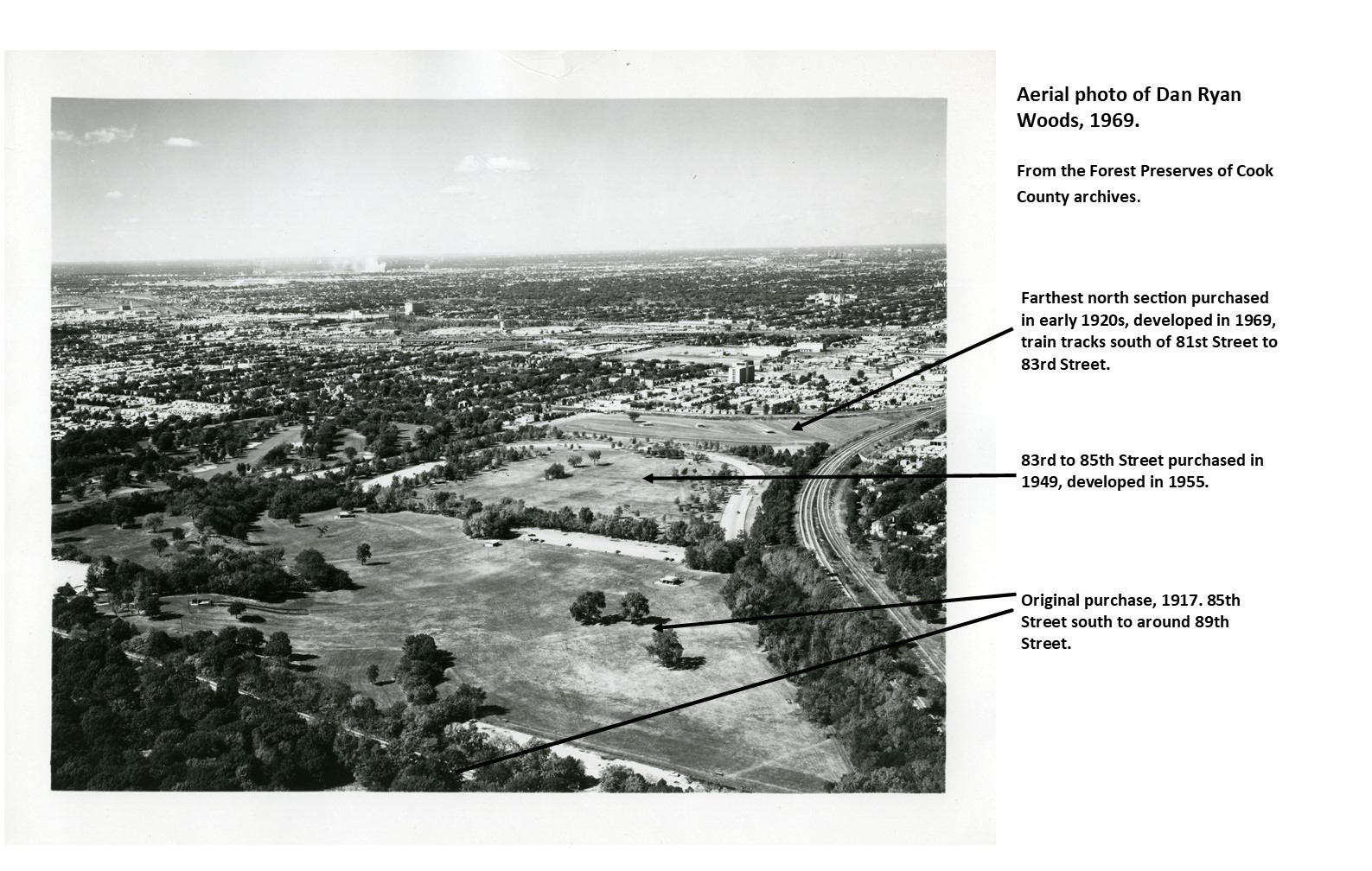
In 1949, DRW annexed 40 more acres of land, between 83rd and 85th Streets, Western Avenue east to the train tracks. This was the last acquisition of land within the preserve itself. The area was cleared and landscaped in 1955 with forest and meadow areas and picnic sites. In 1969, the parcel of land to the north, between 83rd Street and the tracks, which had been purchased in the early 1920s for a possible public golf course, was developed with grass seeding, landscaping, parking, picnic tables and bathrooms.
This now made the old Sherman Farm land continuous preserve property from the railroad tracks just south of 81st Street, to the ravine south of 87th Street. It was there joined by the old Pike estate to the east along the railroad tracks. In 1993, FPCC purchased former railroad land to the east of the woods to become the Major Taylor Trail bicycle path and that will be covered more in a future post.
Next: Events reflected the times