
The history of Dan Ryan Woods – Part 17: Dogs and Dan Ryan Woods
By Carol Flynn
The Forest Preserves of Cook County (FPCC) have always had issues with people abandoning unwanted pets and animals in the preserves. It may seem a natural place to do so, but non-native species rarely survive, especially through a harsh Midwest winter. In some cases, such as goldfish and koi dumped in ponds and streams, the animals are an invasive species that can destroy native flora, fauna, and ecosystems.
This tidbit is from a 2014 FPCC newsletter: “Some of the strangest encounters happened in the early 1980s, when someone with an illegal exotic pet collection simply opened the animals’ cages and left the state to avoid prosecution. Over the following years, staff found porcupines, bobcats and even a kangaroo roaming around in preserves.”
This brings to mind an anecdotal story about educator Bessie Sutherland, for whom Sutherland Elementary School is named. Sutherland was principal at the school which would be renamed for Alice Barnard, another pioneering Ridge educator, from 1883 to 1923. Sutherland heard that a camel had gotten loose from a traveling show and was wandering in the local woods on the Ridge. In the true Progressive spirit of learning by doing, she gathered all the students for an impromptu field trip to the woods to find and observe the camel “in the wild.”
Exotic animals aside, dogs have been a particular problem for the FPCC and Dan Ryan Woods (DRW). Not only have they been abandoned in the woods, but escaped and lost pets gravitate to the woods where they find natural shelter and food. From there, they also go out into the neighborhoods to forage. If not caught, those who survive, the strongest and fiercest, may breed and establish feral packs.
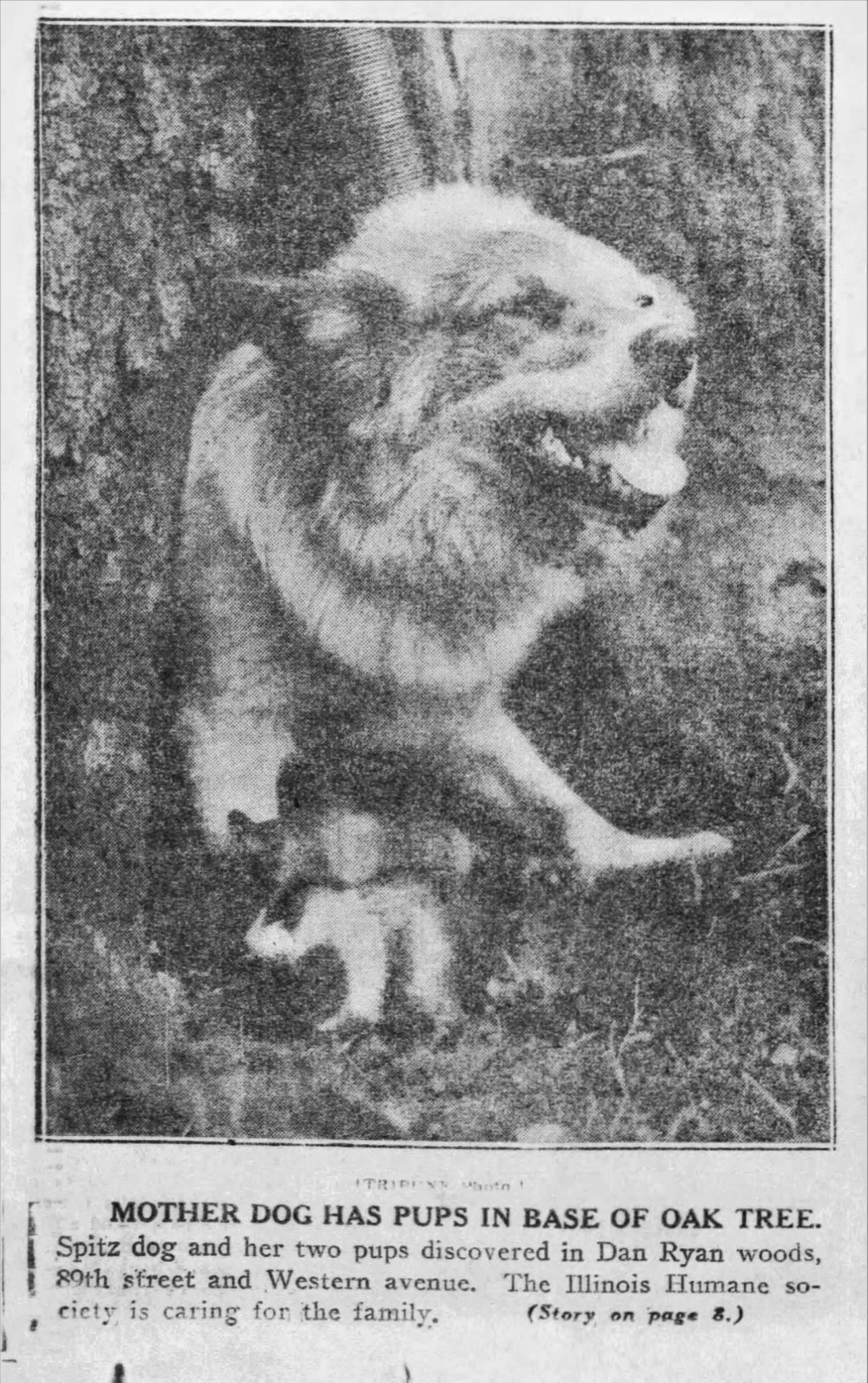
There were several early stories about stray dogs in DRW. In 1934, a mother spitz and two newborn puppies were found living in the hollow base of a tree around 89th Street near Western Avenue. She was deemed “vicious” by DRW workmen, a natural reaction for a mother dog protecting puppies, but the concern was that children might approach her and be bitten. The Illinois Humane Society captured the dog and puppies.
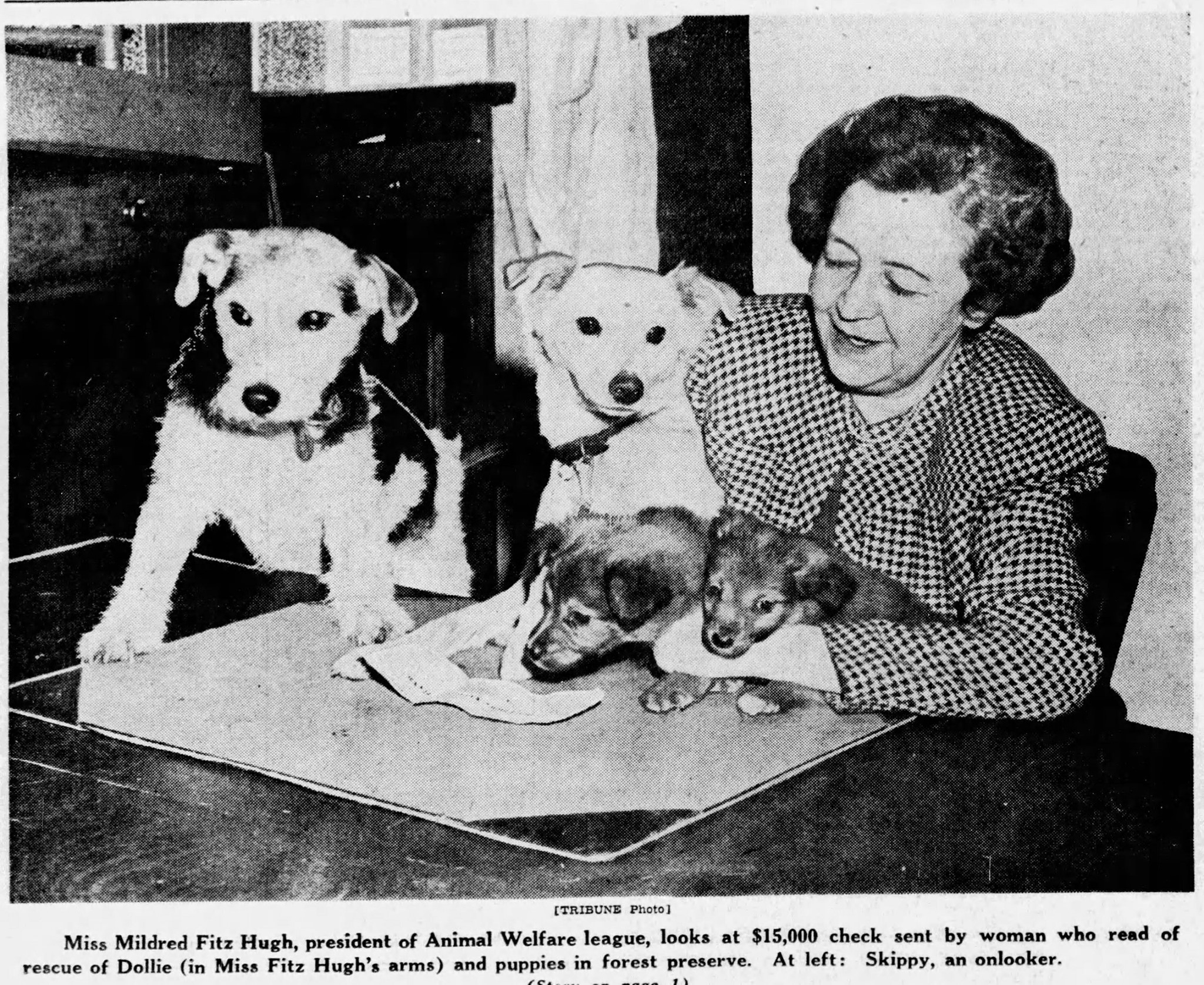
In 1945, a “brown toy shepherd” dubbed “Dollie” by the press became a media darling when she “haunted Ryan woods” for several months but was finally captured by the Animal Welfare League. Dollie led the League agent to a den she had dug under bushes where they found her newborn puppies, their eyes still unopened. The Chicago Tribune’s coverage of the rescue of Dollie and her pups led a woman from California, the honorary president of the league, to donate $15,000 for an animal shelter in Chicago.
Packs of stray dogs in the city started to be mentioned in the local news in the 1950s. In 1954, three women in Beverly/Morgan Park were reportedly bitten by a rabid dog. By the 1970s, the situation with stray dogs around the city was considered a dangerous threat. The Department of Animal Care and Control caught 60 to 100 dogs per day. People left their houses carrying baseball bats for protection.
Stray dogs were common in DRW and the woods were periodically swept to try to keep the number under control. Well-intentioned but uninformed people in the neighborhood set up feeding stations and dog houses in the woods for these stray dogs, which not only attracted more dogs but also colonies of rats.
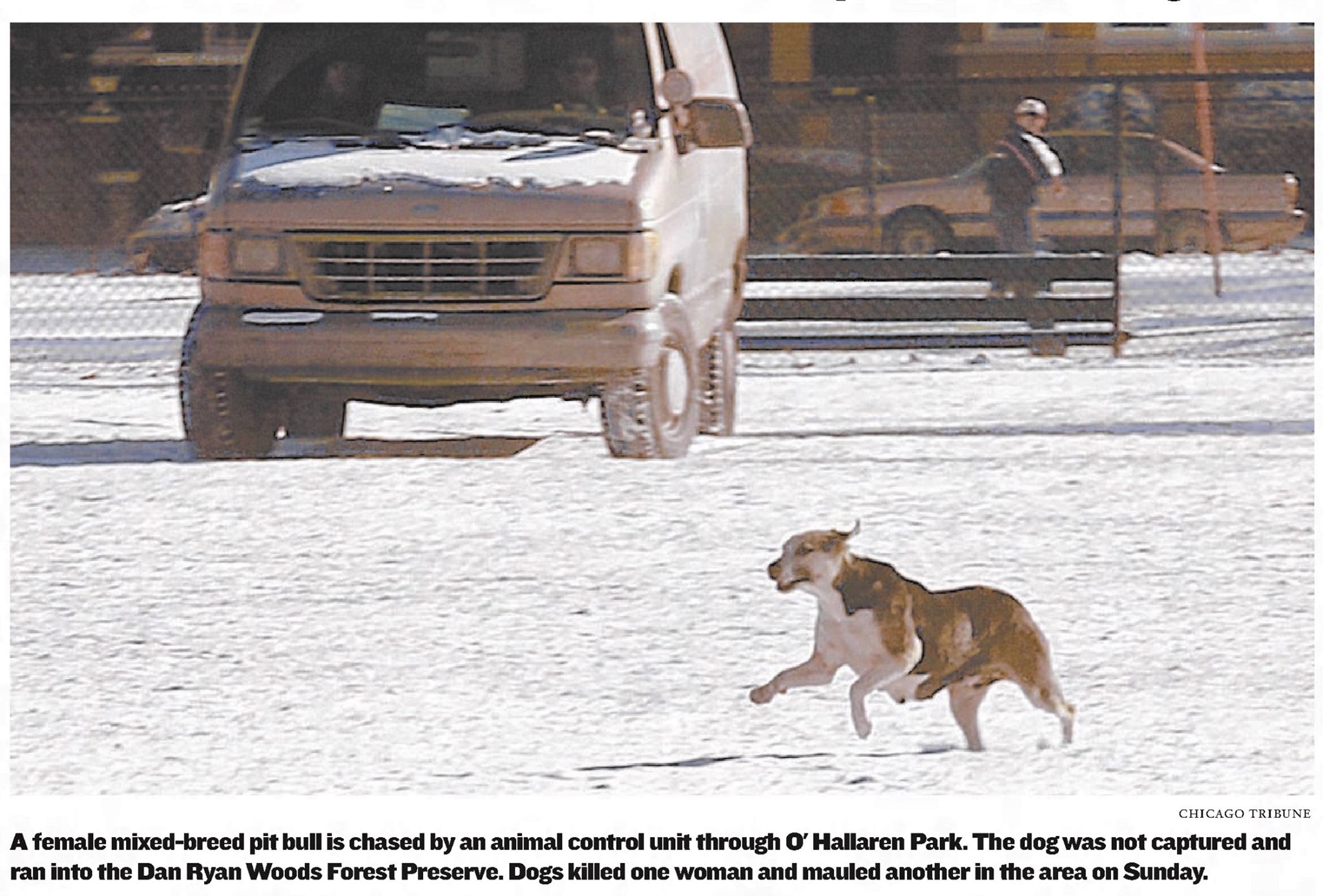
The situation festered for several decades before tragedy struck in January of 2003. Two women jogging in the far north section of DRW off 83rd Street were attacked by two dogs. One woman was killed, and the other was permanently disabled.
Before the attacks, joggers and bikers had reported aggressive dogs in DRW but FPCC only had four animal control officers to patrol the entire preserve system and unincorporated areas of the county. After the attacks, Chicago police scoured the neighborhood and killed two stray dogs that fit the description of the attackers. The DNA of only one of the dogs, a pit-bull mix, was linked to the attacks. That meant the second dog was still on the loose.
DRW was closed on and off for several months while elusive stray dogs were rounded up and their DNA tested. Several were caught, including a litter of well-fed puppies, whose mother apparently had been living off pheasants and other birds, as determined by the feathers found in the den. According to newspaper accounts, a shepherd-mix was found to be the second dog with DNA that matched the samples from the attack.
In 2012, the First District Appellate Court upheld a trial court’s judgment that the FPCC was not legally liable for the attacks because it did not knowingly permit the dogs to remain in the woods.
For the record, not all FPCC encounters with dogs are negative. Leashed dogs are allowed in approved areas of the preserves, and there are off-leash dog areas available for use through a membership program. Events with dogs have been held in the preserves. As just one example, in 2001, a 5K dog walk to raise funds to prevent blindness was held in a preserve. A blessing of the dogs, the walk, lunch, canine demonstrations and contests, and raffles were all part of the day.
FPCC is the natural home of wildlife and one original purpose of the preserves was to protect native species of mammals, birds, reptiles, amphibians, and insects. Wildlife does not confine itself to the preserves, of course, and the humans of the Ridge share their urban environment with raccoons, opossums, fox, squirrels, rabbits, skunks, coyotes, and other wild animals. The management of these animals, including removal of nuisance animals, is controlled by the Illinois Wildlife Code.
Next up: Law and order in the preserves