
The Ridge Historical Society
Wild Turkeys on the Ridge
By Carol Flynn
In the last few years, turkeys have been spotted roaming the streets of the Blue Island, from the city of Blue Island on the southern tip of the island to Beverly on the north.
Last year, a turkey was captured in Beverly and taken to an animal refuge in Indiana. There it was identified as an escaped domestic turkey.
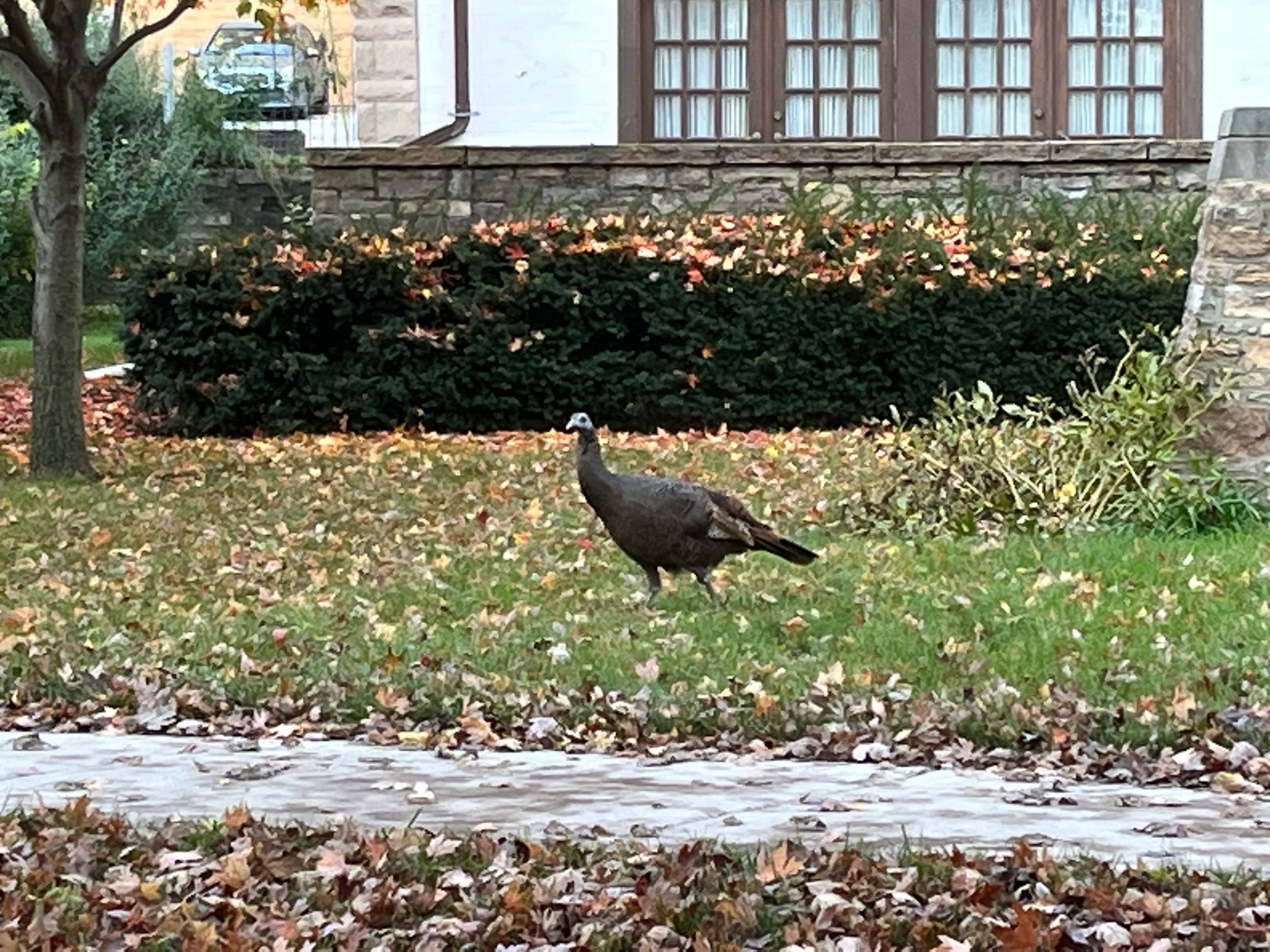
Right now, at least one turkey is walking around Beverly/Morgan Park. RHS President Debbie Nemeth caught this photo of it outside of the Morgan Park Presbyterian Church at 110th and Longwood Drive.
The history of wild turkeys in this country, and in Illinois, is very interesting.
In the mid-1800s, an English “sportsman and conservationist” named Parker Gillmore visited the northern Illinois/Indiana area and wrote up his stories in a book called “Prairie Farms and Prairie Folk,” which he published in London in 1872.
Gillmore shared this recollection:
“I had a sight which few have seen. I took the old hound with me…. Backward and forward the faithful old dog trailed his game … till at last a drove of over thirty full-grown turkeys took wing through the inundated portion of the forest. What splendid birds these were, and with what brilliancy the sun was reflected off their burnished plumage! The sight was before me for hours afterwards. Shall I ever forget it? My feelings answer no.”
Within three decades of Gillmore sharing that remembrance, wild turkeys had almost disappeared from the United States altogether.
The U.S. Department of Agriculture once stated that “the Wild Turkey is the largest and the gamiest game bird native to North America.”
Native Americans made use of turkeys long before white settlers came; they even domesticated them. They used the feathers for arrows, blankets, clothing, and ornamental headdresses. They ate the meat and used the bones for tools. Native Americans were environmentalists. They were always careful not to overhunt the wildlife so the supply was sustainable.
Starting in the 1600s, European settlers came along and became dependent upon the turkey as a mainstay of their pioneer lifestyle and diet.
Benjamin Franklin preferred the turkey to the bald eagle for use on the national seal. Franklin said the eagle was “a bird of bad moral character.” He said that “the Turkey is in Comparison a much more respectable Bird, and withal a true original Native of America… a Bird of Courage, and would not hesitate to attack a Grenadier of the British Guards who should presume to invade his Farm Yard with a red Coat on.”
Clearing the land for farms destroyed the bird’s habitat, and overhunting caused the turkey to disappear from Massachusetts by the 1820s.
A publication called “The Auk” reported in 1909 that in 1903, a man by the name of Mr. F. B. Smiley led a hunting party that killed five wild turkeys in Clinton County, Illinois. Smiley bragged that, “as far as he knew, these were the last Wild Turkeys ever seen in Illinois.”
By the early 1900s, only about 200,000 wild turkeys were left in the U.S. when once there were millions of these birds throughout the forests and prairies. The U.S. government began a program to bring them back from impending extinction.
Illinois was one of the first states to set up breeding farms for wild turkeys. One report said that a flock of thirty-five wild turkeys from an Arkansas breeder was brought to a wooded farm downstate.
Unfortunately, the early attempts were not too successful. A 1980 report shared that:
“The wild turkey was extirpated from Illinois during the early 1900s because of habitat destruction and excessive hunting. Attempts by the US Forest Service in 1935 and by the Illinois Department of Conservation in 1954 and 1955 to introduce pen-reared wild turkeys were not successful. The birds were too tame.”
Another article reported that it seemed the birds were quite able to fight off natural predators, like fox, but they did not recognize “their greatest enemy – the man with a gun.” The first releases hung out around the populated farms; it took a few generations of breeding in the woods before they “reverted back to their original shyness and cunning.”
The 1980 report went on to say that in 1958, wild turkeys live-trapped in West Virginia were released in Illinois, and this, and subsequent additional releases, began a successful increase in the wild turkey population in Illinois.
Apparently, it was best to leave the plan to Mother Nature.
Today, the eastern wild turkey is the only subspecies found in Illinois, according to the Illinois Department of Natural Resources (IDNR). They are large birds with dark, iridescent feathers in shades of bronze, red, purple, blue, and green.
The populations of wild turkeys reintroduced from 1958 to 1967 produced offspring that have now been reintroduced to all Illinois counties. They are found in woodlands and grasslands. They mainly eat plants but also insects, acorns, and berries.
In Illinois, wild turkeys are legally protected by the Illinois Wildlife Code. In urban areas, wild turkeys may not be removed except by a professional approved by the IDNR.
However, the turkeys spotted in urban areas are often escaped or released pen-raised turkeys from game-farm stock. According to IDNR, these birds often look like wild turkeys, but they lack a wariness of humans, are not adept at living in the wild, and often associate people with food. Besides leading to human–turkey conflicts, the escape of pen-raised turkeys has wildlife biologists concerned about the spread of disease to wild flocks and the loss of genetic purity caused by hybridization.
The IDNR is the organization that would oversee the identification of the turkey or turkeys roaming around the Ridge, and determine how to deal with the situation safely.