
Excitement on the Ridge in 1921 – Part 4
By Carol Flynn
Eddie Morris, accused of killing Chicago Police Officer John Mullen on January 3, eluded the police and was involved in two shoot-outs with them since that night.
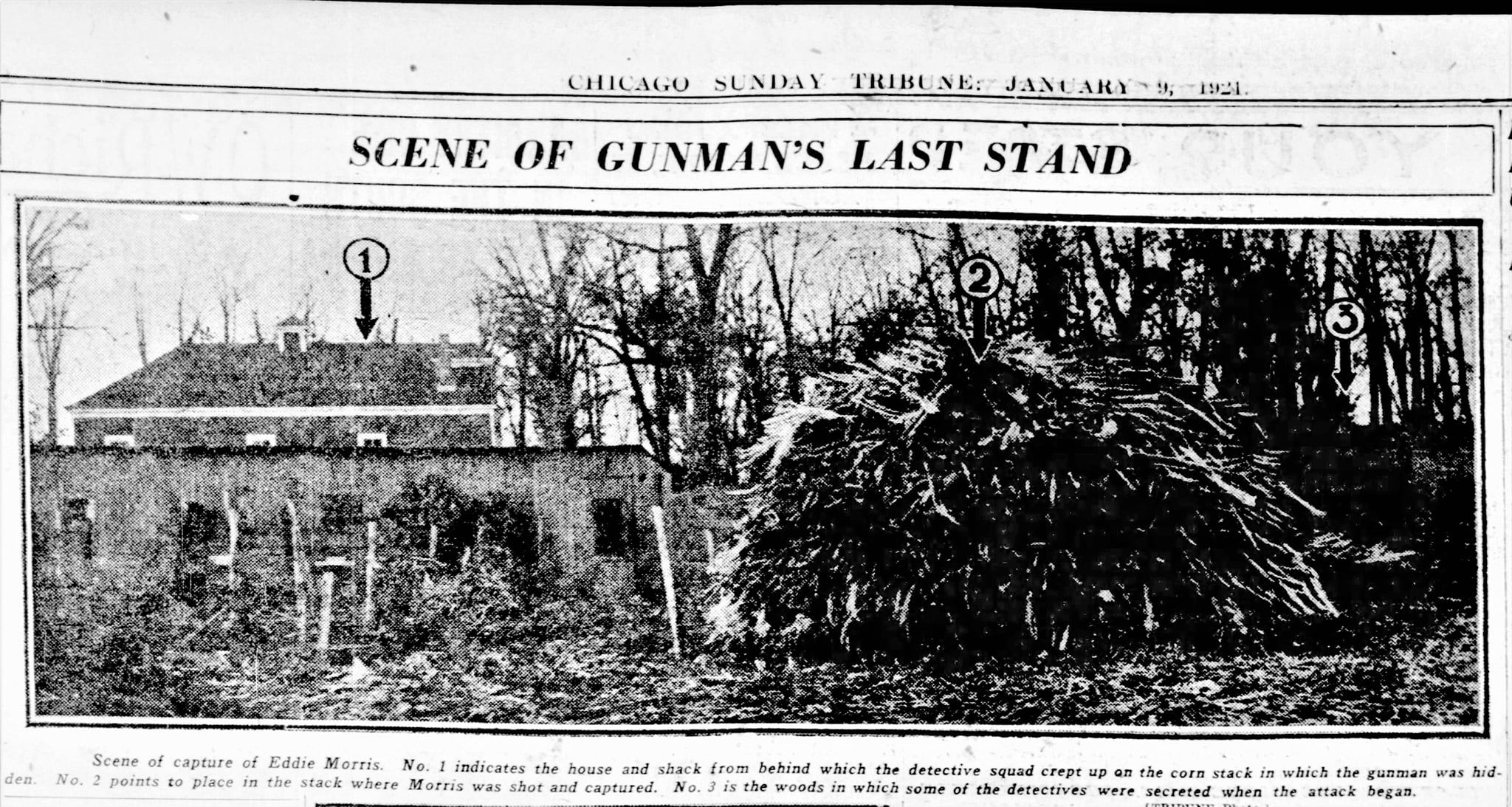
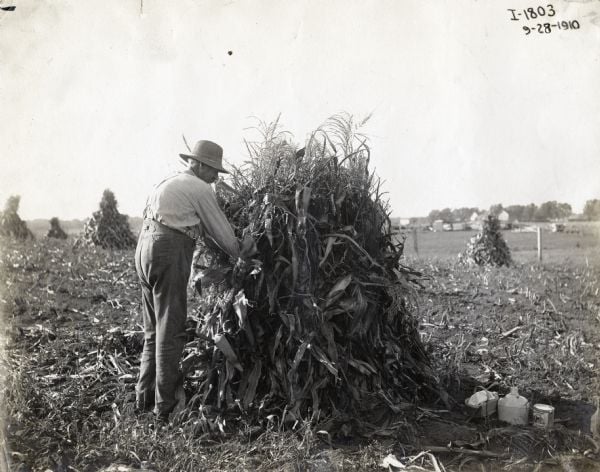
In the early morning of January 8, 1921, Morris was apprehended. He was found hiding in a “corn shock,” or mound of corn stacked for drying, on a “vegetable farm” in Beverly/Evergreen Park.
This farm was reported as about a mile west of 91st Street and Western Avenue. The owners of the farm were not identified, but note that the major farm out there for decades was the Kellogg place. The farm was the home of Kate Starr Kellogg, the educator for whom a school in Beverly is named, and her sister, Alice Kellogg, the artist, and other family members. Kate was alive in 1921; she was 66 years old. The farm is now part of the grounds of Little Company of Mary Hospital.
After his shoot-out with the police on the night of January 7, Morris made his way out to Beverly. He knew the area because he was a frequent patron of the Beverly Gardens, a “cabaret” at 91st Street and Western Ave. Morris was forced to seek a place to hide from the police as they scoured the city for him.
Detective Michael Grady, who had been posing as the bartender at the Beverly Gardens, had been tracking Morris all night. He was first on the scene at the farm, and was then joined by more officers.
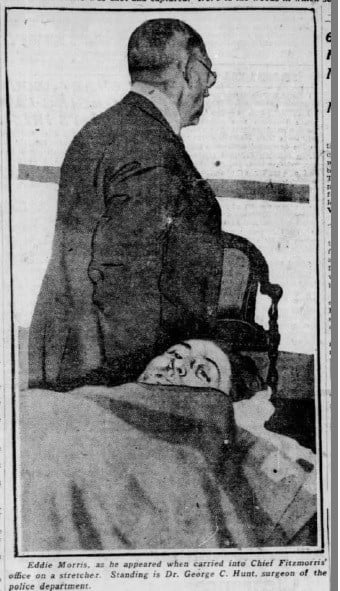
The police surrounded the corn shock and ordered Morris to come out. He did not respond so the police fired their guns into the corn. They then uncovered him in the stack, wounded.
His wounds were dressed by the police department’s doctor, and after being arrested and charged, he was taken to the hospital ward of Cook County jail.
In an interview with the press right after his arrest, Morris gave some details of the capture. Later, Grady gave his version of the events during the trial for Morris.
During that early interview, Morris said he was drunk the night Mullen was killed, and denied any involvement in the shooting. He said he did not know he was wanted for the murder until two days later and he did not turn himself in because he had no friends and no money for a lawyer. He denied knowing McBride and McEvilly, and having tried to rob the Swift collector the night before. He said he had been hiding “in the country,” that is, Beverly, on and off over the last five days, freezing and with little food, and had been in Beverly the last two days.
The interview with Morris (M), as recounted in the Chicago Tribune (T), continued as follows:
T: Did you connect with anyone when you went down in Beverly Hills?
M: No.
T: Tell us what happened when the police got you.
M: I was laying almost asleep when I heard someone holler, “Come out of there.” I just laid still. I heard someone remark, “He’s dead now,” after some shots. Pretty soon some one stepped on me, and one of them put his foot on my head and shot me twice.
T: How do you figure they happened to get you down there?
M: Well, some old man came out to feed the cattle this morning and he saw me in the haystack. He said, “Are you sick?” And I said, “Yes, cover me up again, will you,” and he did. I suppose he notified the police.
T: How did you pick out that place?
M: I was cabareting out that way once and I knew it was a lonely place.
Morris refused to answer any questions throughout the arrest and trial period about the people who helped him during his five days as a fugitive.
Grady’s testimony at the trial, as recounted in the Chicago Tribune, was:
“I located him in a corn shock. After placing eight men around the place where he was hiding, I called to him to come out. I told him I’d fill him full of lead if he refused. We fired about eighteen shots, and then called again. He still refused so we fired again. Later two men climbed on the shock and found him buried in the corn. Morris said he had been in the garden on the night of the murder. He also admitted firing a revolver while in there.”
Det. Michael Grady received several monetary rewards for the capture of Morris. He shared the money with the other policemen involved in the effort.
Of course, the event received coverage in the media.
One publication reported: “The line kept closing in. There was only one avenue of escape for Morris and that was into the prairies of the south. All night the police kept drawing the line tighter and this morning they took their man, who was hiding in a cornfield.”
Another paper reported: “Throughout the night 200 policemen stalked the bad lands in search of Morris. …[H]e was finally cornered … in a cornfield on the outskits of the city. Haggard and worn out from loss of blood received from a wound in the left arm, Morris gave up without protest.”
From a third: “Morris is in the hospital ward at the county jail, desperately wounded. Morris was wounded in a volley of revolver and rifle fire when he disregarded calls to surrender.”
On the Ridge, the event was mentioned by Pauline Palmer, the local reporter for the “Ridge and Morgan Park News” column in the Englewood Times. On January 14, 1921, she wrote “Our quiet Ridge district has been brought into the limelight (again) the past week. A gunman who was in hiding was captured by surprise. The news was indeed exciting.”
Next: The trial of the accused killers.