
The Ridge Historical Society
Jean Hetherington – Part 2
By Carol Flynn
The Ridge Historical Society (RHS) recently premiered a new exhibit on the Hetherington family of architects that will run through 2022. The exhibit is in honor of the 100th anniversary of the Graver-Driscoll House, RHS Headquarters, which was designed by John Todd Hetherington. This series of Facebook posts augments the exhibit.
John Todd (1858 – 1936) was born in Canada but was raised and educated in Scotland. He came to Chicago in 1881 and entered the architecture profession. In 1888, he wed Jane C. Welsh, from the same village in Scotland.
They had four children. The first, Grace, lived less than a year in 1889. Alec was born in 1890 and Murray in 1891, and these sons will be covered in later posts. Daughter Jean was born in 1895. The family moved to Beverly around 1901.
Jean graduated from the Art Institute of Chicago Normal Program, which trained teachers, in 1917, and began a career as a “draftswoman.” A “drafter” produces drawings for architecture projects that are primarily used in construction. On the 1920 U.S. Census, Jean is listed as living at home with her parents and brothers at 9236 South Winchester Avenue and working for a railroad company as a draftswoman.
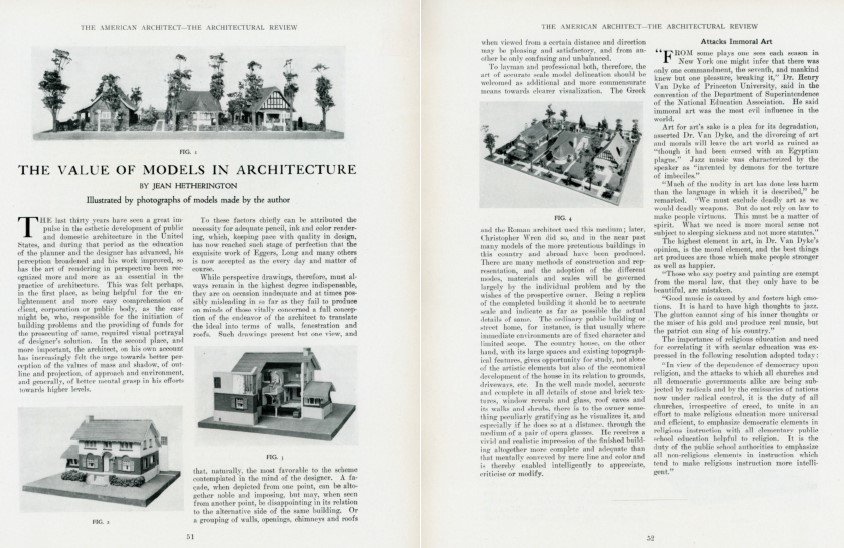
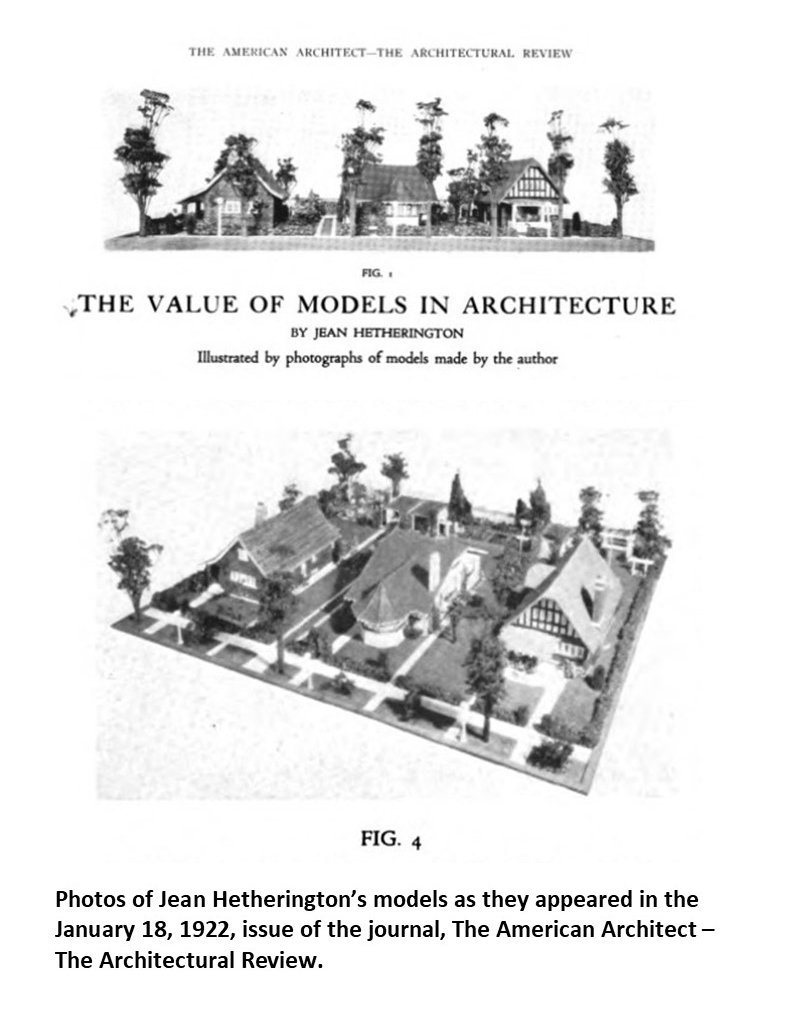
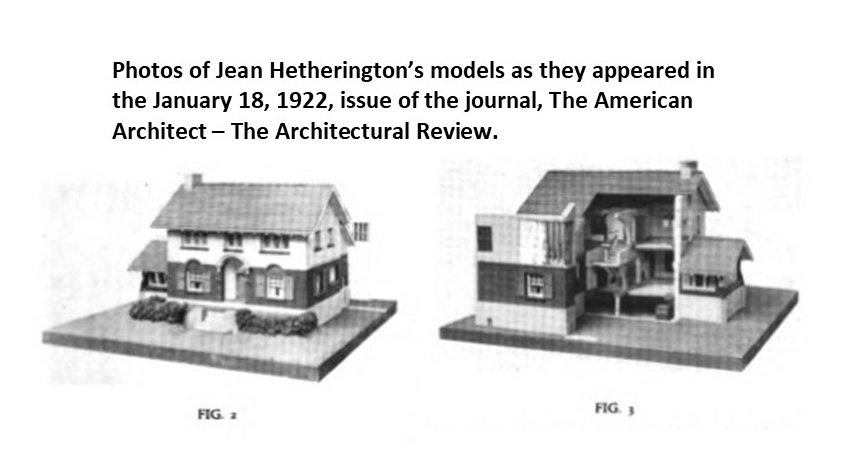
Jean took the illustration process one step further to create actual miniature models of buildings. In January 1922, she published an article titled “The Value of Models in Architecture” in the journal, The American Architect – The Architectural Review.
In this article, Jean noted that architectural drawings remain indispensable, but models can help people visualize the translation of the ideal plans “into walls, fenestration and roofs.” She noted that the ancient Greek and Roman architects used this technique, as did the revered British architect Christopher Wren. She stated that the model should be built to scale, be accurate and complete in details such as stone and brick texture, and include the relationship to landscaping, driveway, and other topographical features.
To paraphrase Jean in her article, this enabled the owner to intelligently appreciate, criticize or modify the scheme contemplated in the mind of the designer, as what looked good on paper might be confusing and unbalanced when built.
The article included photographs of some of her models. In 1919, son Murray had joined with John Todd in practice, and RHS researchers have identified Hetherington-designed houses in the Ridge communities that resemble Jean’s models. It’s likely they were made for her father’s and brother’s clients, meaning Jean had a vital role in visualizing and marketing the family’s designs.
In 1922, five of Jean’s models were included in an Art Institute of Chicago Alumni Association exhibit. Two were of the Barrington Heights Golf Club, the details of which are still being tracked down.
The other three models were of the Prior de Cranden’s (or Crauden’s) Chapel, a famous structure in Ely, Cambridgeshire, England.
Research shows that Jean visited England, Scotland, Ireland, and France in 1926 with two of her cousins, but whether she visited England previously or worked from illustrations to create the Chapel models is not known.
The important point is that not only did she make architecture models for her family’s or other architectural business clients, she apparently made models for her own interests also. At the 1927 Women’s World Fair in Chicago, the exhibit of the Women’s Architectural Club included a wooden model of Prior de Cranden’s Chapel, and it is probable this could have been Jean’s model. Unfortunately, what became of the models is not known, and no pictures have yet been found.
Next post: Jean Hetherington – Part 3