The Ridge Historical Society
History of the Chicago Wards – Post 3: Annexation of Washington Heights to Chicago
By Carol Flynn
The villages and towns around the City of Chicago, the “suburbs,” generally annexed to improve services, especially water and sewers. In addition, police and fire departments, schools, libraries, and other public services were expensive for small communities to maintain on their own.
The suburbs began to see real growth in the 1870s. The Great Chicago Fire of 1871 displaced a lot of city residents and broke up old neighborhood associations. Businesses encroached on the remaining residential neighborhoods to reestablish themselves. Moving outside of the city offered homeowners the advantages of cheaper homes and less congestion. For those who lost everything in the fire, it was a chance to start over, away from the conditions and constant reminders of the trauma they had experienced.
According to the Chicago Tribune in 1873, one of the hottest suburban areas for speculation and growth was Washington Heights and Morgan Park on the Blue Island Ridge. Land prices in the area had doubled in the past year.
Even before the Fire, the Washington Heights area was being lauded in the Tribune. In 1869, the paper wrote that “among the many suburban places …, there is none more attractive than the new one … called Washington Heights.” The article mentioned the “high and beautiful wooded land, which commands a fine view of the city and Lake Michigan.” It also mentioned the work that was in progress by the Blue Island Land and Building Company, the construction of “beautiful, wide avenues” and the laying out of five- and ten-acre lots, that would be marketed in the coming year as Morgan Park.
In 1870, the “dummy line” bringing the Rock Island Railroad west to Washington Heights was established. This played a major role in increasing accessibility to the area, allowing for the rapid growth that began in the 1870s. Not just homes for the wealthy and middle-class were being built; laborers bought up small lots along the railroad lines and built cottages.
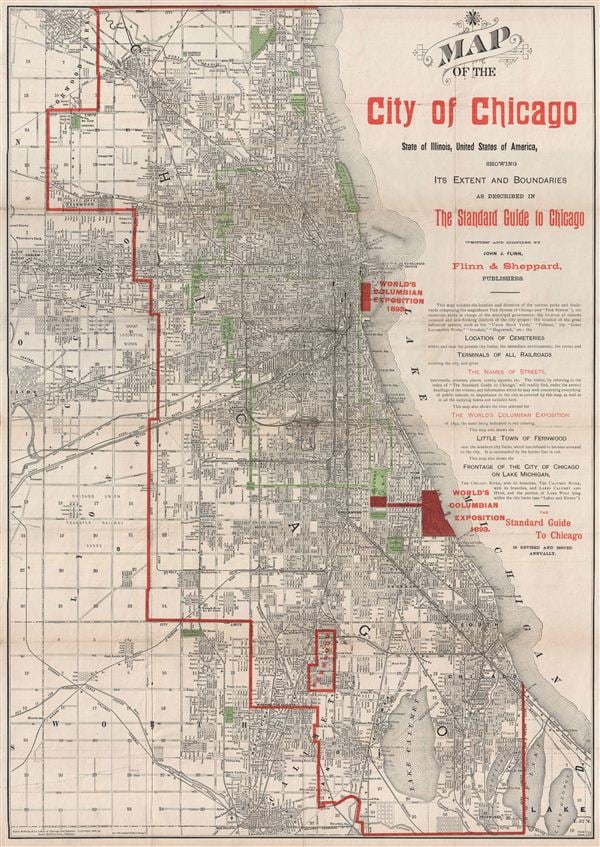
The largest annexation to the City of Chicago occurred in 1889 when 125 square miles of territory was added to the city. This included all of Hyde Park Township and Lake Township on the south side, and Jefferson Township and Lake View Township on the north side. New wards were formed, bringing the total for the city to thirty-four wards.
This annexation almost brought the city to the boundaries of the Village of Washington Heights, which included today’s Beverly area, and Morgan Park.
The residents of Washington Heights were mostly in favor of annexation to the city. The major issue for the village was dealing with sewage, and the sewer system of the city, which then ended at Halsted Street, could be extended west.
Prominent people such as Robert Givins, real estate developer and builder of the Castle at 103rd Street and Longwood Drive, and William Barnard, owner of the largest tract of land in the community, petitioned in favor of annexation. There were reports of some initial resistance, although minor, from some of the older farmers in the area.
There was one snag in annexing Washington Heights, however. A three-square-mile stretch of land from 87th Street to 95th Street west of State Street, which included today’s North Beverly and Dan Ryan Woods, was not incorporated as part of any municipality, including the City of Chicago or the Village of Washington Heights. This land lay between the city and the village, and due to the way the annexation laws were written, prevented annexation because the land would not be continuous. The City of Chicago took legislative action under an old law to annex this parcel to the city in April of 1890, opening the way for a vote to annex the Village of Washington Heights.
In November of 1890, the voters of both the city and the village approved the annexation of Washington Heights to Chicago.
The annexation of the small town of Fernwood to the east of Washington Heights was also on the ballot, and although the city voters approved it, the Fernwood voters did not. However, the following year, Fernwood voters did approve annexation.
It was assumed by just about everyone that the annexation of Washington Heights meant that Morgan Park would follow within a year or two. However, annexation to the city became a real political issue for Morgan Park, and the decision to annex was not agreed upon for another twenty-four years.
This 1890 map of Chicago includes the new territory of Washington Heights. A bigger version of it can be accessed through Google.
Next post: Assigning Washington Heights to the Ward System