
The Ridge Historical Society
Part 9 on the Hofer Family – Political Involvement
By Carol Flynn
The Hofer family connected with the Ridge came of age during the Progressive Era of the late 1800s – early 1900s, a time of widespread reform in just about every area of American life, from education to business to government.
The rights of women and children were important issues of the day. For women, voting, property ownership, and education and employment opportunities headed the list. For children, child labor laws, the juvenile justice system, public education, and health services were priorities. It was the members of the women’s clubs who did most of the advocating for children’s rights.
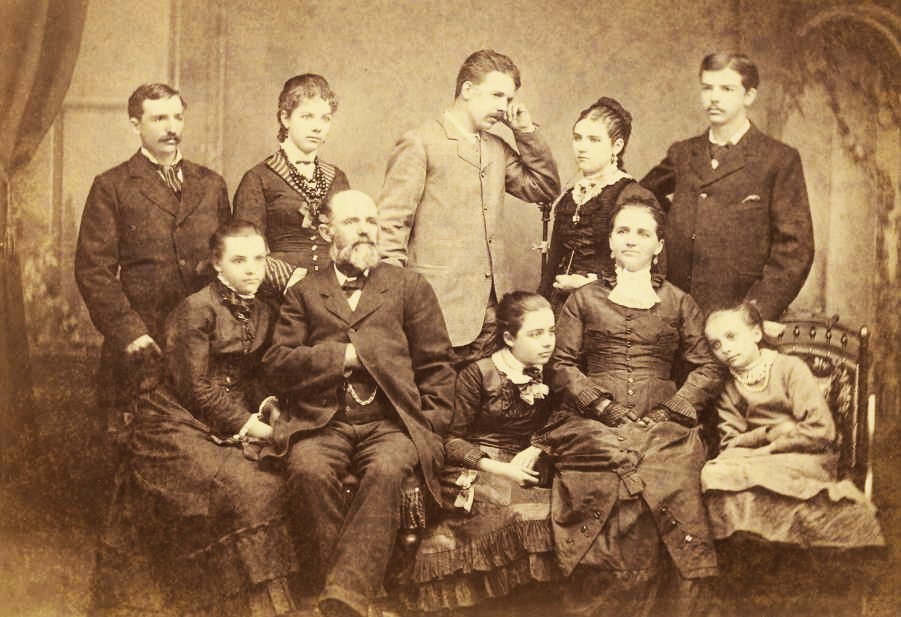
The family patriarch was Andreas Franz Xaver Hofer, born in 1821 in Baden, a historical territory in south Germany and north Switzerland. He took part in the unsuccessful Baden Revolution of 1848 – 49, an attempt to overthrow the ruling princes. Forced to flee the country, he came to New York City in 1849.
His future wife, Mari Ruef, was born in 1836 in Baden, and came to New York in 1852. There she met Hofer and they married in 1853. [Hofer died in 1904 and was buried in Mount Hope Cemetery on the Ridge. Mari moved to California where she died in 1918. Hofer’s remains were then brought from Chicago to California to be buried beside his wife.]
The Hofers moved to Iowa from New York and began their family, which would grow to five daughters and three sons. Andreas Hofer fought with the Iowa Infantry of the Union Army as a lieutenant in the U.S. Civil War. Andreas and Mari became naturalized citizens of the U.S.
The Hofers became farmers and dry goods merchants in McGregor, Iowa. Hofer became known as a local expert on cultivating grapes and was active in the Iowa State Horticulture Society. They purchased a local newspaper, the McGregor News, which they ran for many years. The family was well known in the community.
Andreas and Mari Hofer had a passion for social justice and reform that they passed down to their children. Through their newspaper, they shared their “progressive” views, and all the children were trained in the newspaper and printing fields.
Andreas Hofer‘s philosophy for the newspaper was “closely identified with the interests of the people and with successful government,” according to an article written in 1904 by his sons. He was involved in local politics and a leader of the temperance movement. Many of the beer breweries in the U.S were owned by German immigrants, and the newspapers made note of the divide in the German community over the alcohol issue. Hofer wrote temperance tracts in the German language which were published by the German National Temperance Association.
He used the newspaper to advance his platforms, and this did not always go over well with the subjects of his commentaries. In one court case that was followed closely by the public, the newspaper and its publishers, A. F. Hofer and Sons, were sued for $5,000 by a saloon keeper claiming the paper had damaged his character. The paper had accused the saloon keeper of keeping a gambling house. The saloon keeper was backed by the local liquor league. The case went to court, and the Hofers won the case – the charges against the saloon keeper were “fully sustained.”
The involvement of the Hofer children with the newspaper led to careers for all that included writing, editing, and publishing.
The family sold the McGregor News in 1890. By then, the sons, Ernest (1855-1934), Frank Xaver (1856-1905), and Andreas F., Jr., (1861-1913), who made the newspaper and publishing industries their lifetime careers, had moved to Salem, Oregon, to seek their fortunes on the west coast. “E.” and “A. F.” took over the Capital Journal, an evening paper. Ernest later ran the Industrial News Review, which advocated for “policies essential to the well-being of our country.” Frank owned half of one newspaper and was the founder of another.
As covered in the last posts, the five daughters and parents moved to Chicago to allow the women better education and employment opportunities. They rented a house on 96th Street in Beverly. The house, long ago demolished, stood where the entrance to Ridge Park is today.
The daughters became leaders in the kindergarten, social settlement, and playground movements. All of these were “progressive” initiatives, with strong political overtones.
The preceding posts on the Hofer sisters’ careers and this introduction to the family’s political involvement brings us to the Hofer sisters’ roles as social and political activists, which will be covered in the next posts.