
The Ridge Historical Society
July 4, 1925 – Fireworks
By Carol Flynn
One hundred years ago on the Ridge, the community held a July 4th festival at Ridge Park at 96th Street and Longwood Drive.
Included were sporting competitions, awards for a house-decorating contest, a historical pageant, and family picnics.
The day started early with the “explosion” of a fireworks “bomb” calling people to the festivities. Fireworks also were displayed in the evening.
Fireworks are a significant part of the United States Fourth of July holiday – “the rockets’ red glare, the bombs bursting in air…,” and all that.
However, in Chicago and in Illinois, there are strict regulations on the possession and use of fireworks – which largely go unheeded.
Fireworks have created controversy since the earliest days in Chicago. The issues mainly relate to safety and fire prevention, of course.
As early as the 1860s, there were city ordinances banning the storage and use of fireworks without permits in the city. Following the Great Chicago Fire in 1871, the city increased its efforts to establish and enforce controls, but especially at the time of July 4, the ordinances were largely ignored.
And the members of the Chicago City Council themselves did not always support the ordinances.
In 1883, for example, the City Council lifted the ban on fireworks and shooting off firearms just for the 4th of July. They had given way to the demands of their “friends” who were sellers of fireworks.
The result was numerous deaths and injuries. The Chicago Tribune had taken a stance against lifting the ban for even the one day, and after the holiday, challenged Mayor Carter Harrison, Sr., on the decision, given the damage that occurred.
“I don’t think it would have made any difference. Five thousand policemen could not have prevented them from shooting,” said the mayor. “The Lord takes care of the boys. Some of them may get banged up a little, but they will come out all right. I do not believe in taking away the Fourth of July from them. It is a day that they should commemorate and hold sacred.”
The Tribune reported on the people who “got banged up a little.”
They included Thomas Kelly, a railroad man, who was shot in the abdomen by “a wild pistol shooter” and languished for several days before dying in the hospital.
There was also Charles Heradek, killed by a 13-year-old boy, whose mother told him to put the gun away and keep his mouth shut about what he had done.
Nine-year-old Katie Willard was killed by a bullet that lodged in her spine; young sisters Lizzie and Rosa Younk were “maimed” by a large firework; John Anderson was shot in his hand by his little boy; Thomas Garrity, 18, received a “large ragged wound in the face near the left eye” from a “toy pistol in the hands of a friend.”
A court ruling in 1903 caused cities across the U.S. to look at the fireworks situation with a new seriousness.
A fireworks explosion at an election night event in November 1902 in Madison Square Garden, New York City, resulted in a death and other serious injuries. The city’s aldermen had suspended the ordinance banning fireworks to allow the political parties to hold such events.
The court found that the city could be held liable for the deaths, injuries, and damage. New York City was successfully sued by several parties.
This caused cities to renew their commitments to enforcing bans and requiring permits for fireworks.
By 1925, selling and using fireworks and shooting guns within the Chicago city limits were banned by city ordinances. Fireworks could be used at events by experienced handlers with permits.
In late June 1925, the city vowed to “rigidly enforce” the laws on illegal fireworks. There had already been 14 deaths and two major fires from fireworks explosions leading up to the July 4th holiday.
An 8-year-old boy, Daniel Perry, had died from eating a firecracker. Another woman, Sophia Oxstein, walking down the street carrying her baby, had been hit by a charge from a “toy cannon” built by a 17-year-old neighbor.
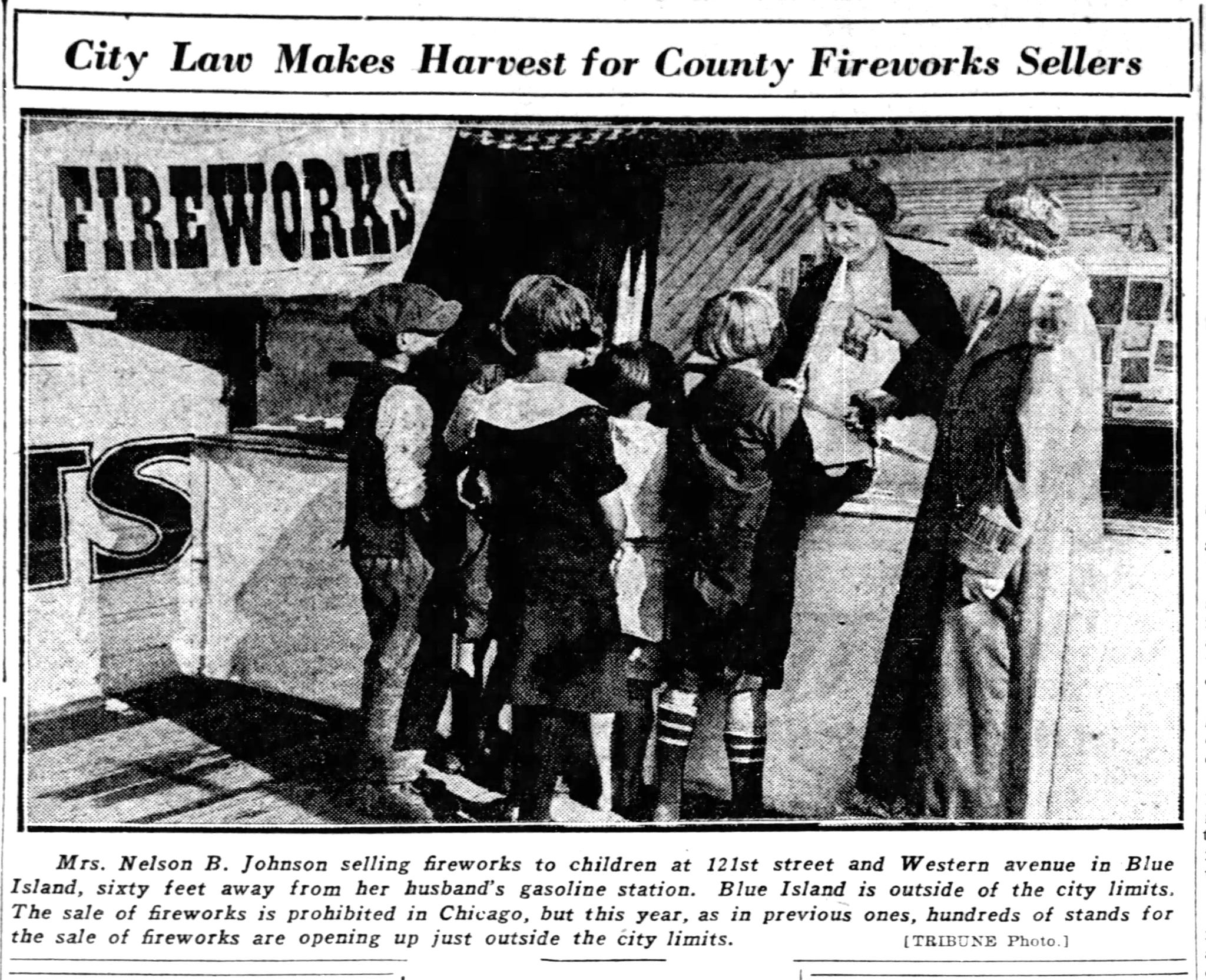
But fireworks could still be legally purchased in the rest of Illinois, and Chicago residents only had to walk across the street into a suburb to find roadside stands.
Ridge residents could cross 119th Street into Blue Island and find a fireworks stand just two blocks away. Chances are they could also find them in Evergreen Park across Western Avenue.
The Chicago Fire Commissioner had contacted 65 nearby municipalities to ask for their help in stopping illegal sales of fireworks, but not all had replied.
The purveyors of illegal fireworks caught in Chicago were given three options: “Put the fireworks in a water barrel, take them outside the city limits, or be arrested.”
On January 1, 1942, Illinois implemented a law to prohibit the sale and use of fireworks within the state. City and county officials would be allowed to grant permits for supervised displays, with a “competent individual” handling the display.
Today, Illinois has one of the most restrictive laws controlling the sale and use of fireworks, and even some of the items the state allows, like sparklers, are prohibited in the City of Chicago. Other states have various restrictions, and a few states have no restrictions at all.