
The Ridge Historical Society
Lost or Found? – FOUND – Building #2 (Part 2)
By Carol Flynn
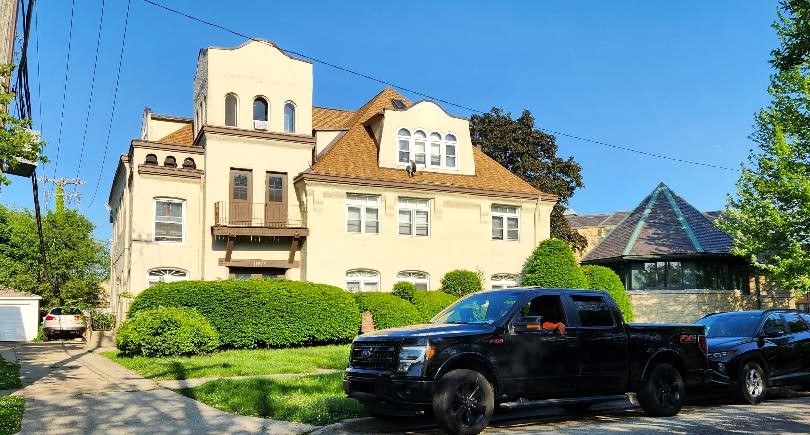
Building #2 in the “Lost or Found?” series was identified as the current Casa del Loma apartment building at 11057-59 S. Hoyne Avenue.
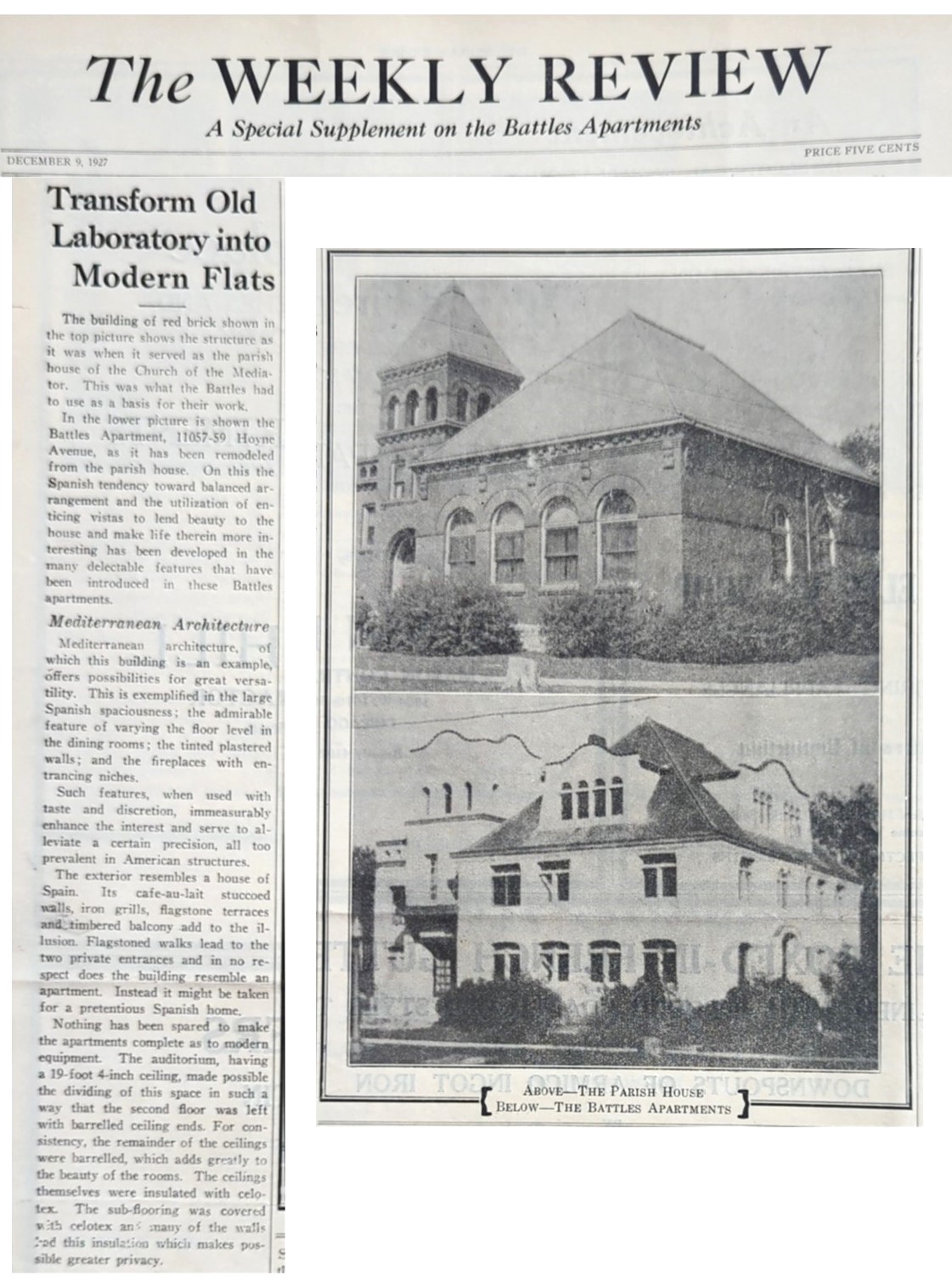
From the last post, the building was constructed as the physics laboratory for the Baptist Theological Seminary in the late 1800s. After that institution closed in 1892 to join with the University of Chicago Divinity School, the building was purchased by the Church of the Mediator, moved across the street to its present location, and used as a parish center.
Eventually the church was enlarged to include a parish center on site, and the old laboratory/parish center was sold to Charles Curtis and Blanche Dunlap Battles, who repurposed the building into modern apartments in 1927.
Charles Curtis Battles (born 9/12/1878) and Blanche Dunlap (born 10/20/1879) were both born in Iowa, and knew each other growing up in Perry, Iowa.
Charles was the son of a well-known and well-liked farmer who was a U.S. Civil War Union Army veteran, and Blanche the daughter of a dry goods merchant who was also the postmaster. Both families were members of the Methodist Episcopal (M.E.) Church. An 1896 newspaper article has Charles and Blanche both listed as guests at a surprise 18th birthday party for a friend. By 1903, Charles and Blanche were married.
Charles was employed as a messenger, or agent, of the United States Express Company, a shipping and delivery company. During World War I, the government urged the consolidation of the numerous express services into one company to aid the war effort. Charles became an employee of the new American Railway Express Co., where he worked his entire adult life. He would have traveled quite a bit in that job.
A newspaper article reported in 1906 that Charles was the first man to arrive in San Francisco with a relief train following the San Francisco earthquake. The day after the natural disaster, he left Chicago in charge of a train full of supplies, accompanied only by a newspaper reporter and a member of the Chicago relief committee.
The paper reported that Charles started with the company as an agent out of Des Moines and was later assigned to Chicago, likely a promotion.
Blanche was known for her drama and music talents, and volunteer work with churches. She had a notable career as a performer, pageant director, drama coach, lecturer, columnist, and critic in the field of religious drama and music.
In 1894, at the age of 15, Blanche won first place in a “declamation contest” in which contestants deliver speeches that have been written and delivered before, usually from a famous source. The subject of her presentation was not mentioned. The prize was a $50 scholarship to the Soper School of Oratory in Chicago. It was stated then that “she possesses genius of a high order, and if her talent is developed will make a bright record.”
Blanche went on to many other accomplishments.
One example of her work was the production at multiple venues of a concert, “The Challenge of the Cross,” in which she starred and directed, and which included singing disciples and angels descending from the balconies.
A review of one of the concerts stated, “Those who attended had nothing but the highest praise for the offering,” and that Mrs. Battles’ “work and personality stamp her as an artist of unusual accomplishment.” At another venue, the reviewer wrote, “So impressive was the visual presentation … that tears fell from the eyes of people. It will always be remembered as a great spiritual uplift to all present.”
Another undertaking she was known for were “ladies’ kitchen bands,” where pots and pans and utensils were adapted into musical instruments. The concerts she arranged got good reviews, not only for the ingenuity of the band members but because they produced good music.
Some of Blanche’s work was as a volunteer, often for church fund raisers, but there were professional endeavors, also. For example, she was a columnist of repute for the “Musicians’ Magazine” published out of Chicago. The assumption is made that at least some of these had to be paying jobs, but curiously, the U.S. Censuses always listed her as not being employed.
In 1910, Charles and Blanche lived at 9907 S. Prospect Avenue and by 1920, they lived at 11336 S. Lothair Avenue.
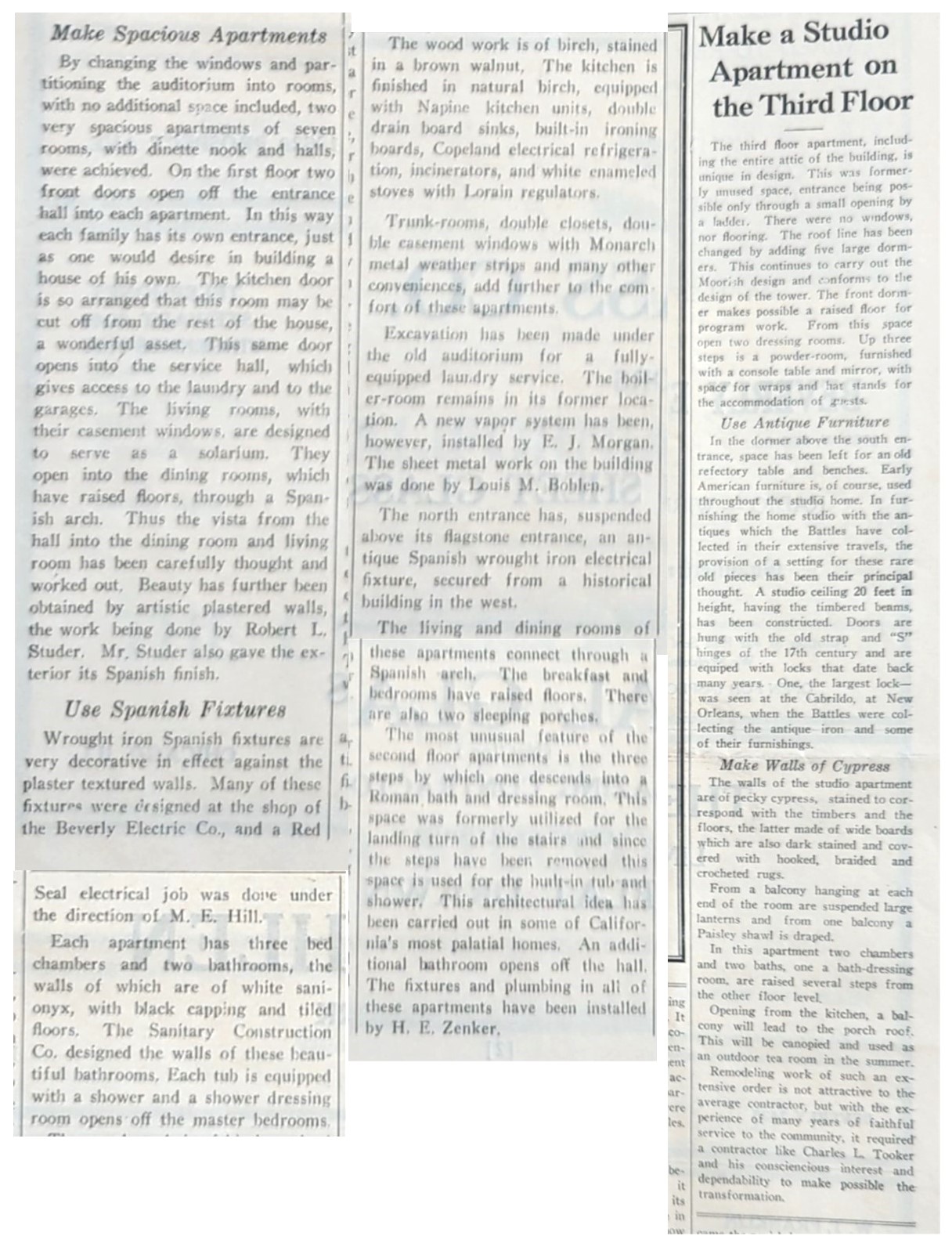
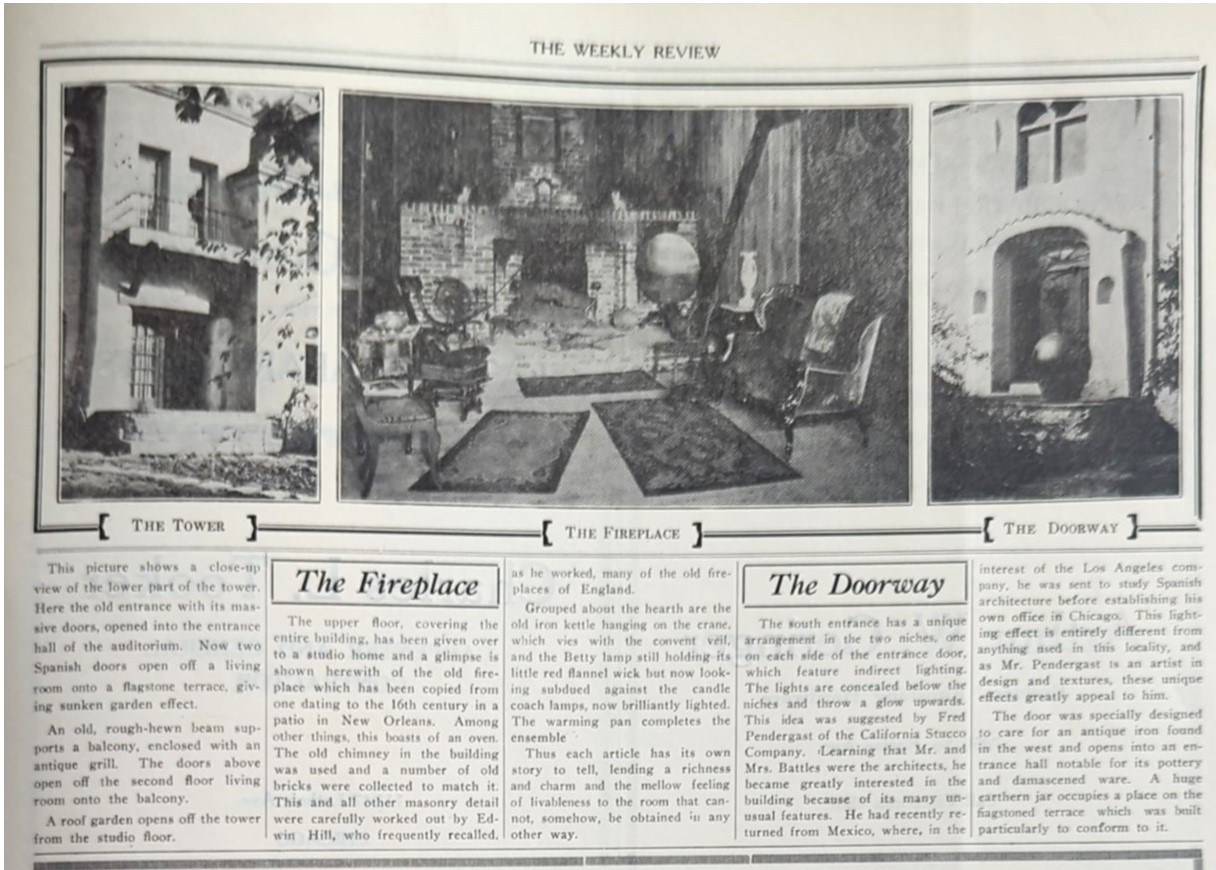
They bought the old parish house, and a special feature in the 1927 Weekly Review, the local newspaper that eventually became the Beverly Review, described its repurposing into the “Battles Apartments.” Those articles are shared here. [This is a quick electronic “cut-and-paste” job in Publisher from the scanned newspaper. Note that the old newspaper is very fragile and faded.]
Charles and Blanche Battles lived in one of the apartments, and Blanche opened her studio on the third floor. She used it for both professional and social purposes. It was full of antiques, which she had collected.
They operated a “tearoom” in the building, which was used by many groups for events and programs, from luncheons to artist exhibits. An event was often followed by a tour of Blanche’s studio to view the antiques. It was a very popular place in the early 1930s.
By 1940, the Battles moved to 1400 Lake Shore Drive, and by 1950, they retired to San Diego, California.
In 1941, it was announced that new residents of Casa del Loma were Dr. Noor R. Beshir and Dr. Nellie A. Beshir. They were chiropractors and used the space as a dwelling, office, and clinic. They lived there for several decades, and their son Alton was a graduate of the Morgan Park Military Academy.
Many other tenants called Casa del Loma home through the years. The building on the hill, with its Spanish facade shining in the sun, contributes to the interesting variety of architecture found in the Beverly/Morgan Park community. It's a good example of repurposing an old building, which possibly would have been demolished otherwise.