The Ridge Historical Society
Louise Barwick – Part 3
By Carol Flynn
The Ridge Historical Society’s new exhibit, “Louise Barwick’s Lost Ridge,” may be viewed on Tuesdays and Sundays from 1:00 p.m. to 4:00 p.m. or by appointment. RHS is located at 10621 S. Seeley Avenue in Chicago. The exhibit is free.
This exhibit focuses on life on the Ridge from 1893 to 1905 as seen through the watercolor paintings of Louise Barwick, an artist and educator who lived on the Ridge. Other components of the exhibit include a section on aerial photography taken by cameras attached to kites, and “lost and found” architecture – historic photos of buildings, some of which remain and some of which are gone from the Ridge.
This Facebook series on Louise Barwick complements the exhibit, but does not repeat it. More information on Louise herself, her family and her history, is being presented in this series. The exhibit concentrates more on visual images of the Ridge in the late 1800s.
This post will continue to look at Louise’s maternal ancestors.
Louise Barwick’s maternal grandmother, Mary Brookes Cleaver, was the daughter of Samuel Brookes, the first florist in the City of Chicago. He was described as “an old-fashioned English gardener” by the American Florist magazine in 1912.
However, Brookes was so much more than that.
Before deciding to bring his family over to the New World, he was a distinguished botanist, florist, horticulturist, and carpologist (one who studies fruits) who owned and operated one of the largest London nurseries, where he studied and dealt in exotic imported plants. He introduced the azalea, the chrysanthemum and the Chinese cherry, among other plants, into Europe, from cuttings from China. He won numerous awards for his plants.
Brookes came to Chicago via Canada in 1833, bringing along his family, servants, various pets, and rootstock to establish a new business. Charles Cleaver claimed that Brookes also brought the first piano to Chicago.
Brookes built Chicago’s first commercial greenhouse in 1845. He eventually moved his business and his home to Cleaverville. He was as respected in America as in Europe for his horticultural knowledge. He was called the “Father of the Chrysanthemum” in the trade because no one had as much experience with the flower as he did.
Besides daughter Mary, who married Charles Cleaver, two of the Brookes sons, Frederick William (F. W.) Brookes and Samuel Marsden Brookes, are notable for this story.
F.W., who seemed to always be referred to by his initials, started a career as a printer and worked with the Chicago Tribune, but eventually joined his father in the greenhouse business. He spent his later years as a resident of Morgan Park, and his home for many years was a showplace for some of the original Norway pines from the first greenhouse.
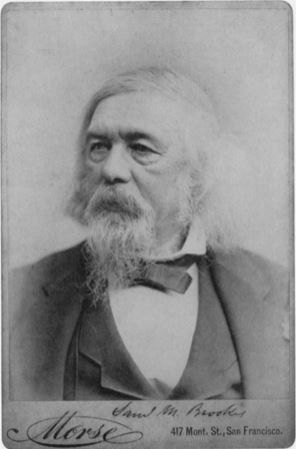
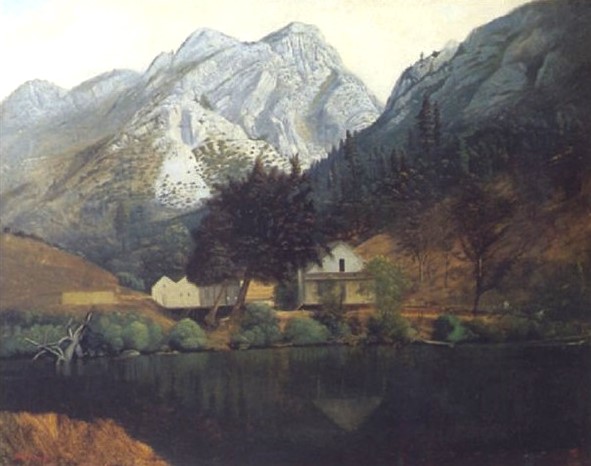
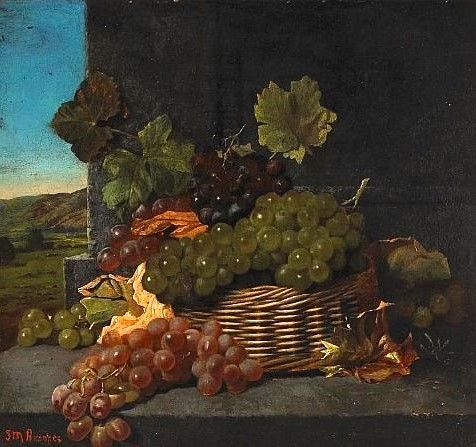
Samuel Marsden Brookes was 17 when his family left England, a graduate of a private school, and a budding artist. Once in Chicago, although his father disapproved, young Samuel continued his pursuit of studying art anywhere and anyway the opportunity presented itself, eventually giving art lessons himself. He moved to California, where he became a well-known artist in San Francisco, specializing in portraits, landscapes and still life paintings.
Perhaps Louise Barwick’s artistic leaning was a family gift.