
The Ridge Historical Society
Native Americans and the Blue Island Ridge – Part 18: Conclusion – Land Acknowledgement Statement
By Carol Flynn
A suggested Land Acknowledgement Statement for an organization, business, or individual on the Ridge (like the Ridge Historical Society) would be:
“We acknowledge that we are located on the ancestral homelands of the Potawatomi tribe, a member of the Council of Three Fires with the Ojibwe and Odawa Peoples. Other tribes that lived in the Blue Island area include the Miami and the Illinois Confederation. Many additional tribes including the Fox, Sauk, Winnebago, Menominee, Meskwaki, and Kickapoo lived nearby and accessed the area for trading and portage routes.”
The rationale for this statement is that the Potawatomi were the dominant Native Americans living around the Blue Island area in 1833 at the time of the signing of the Treaty of Chicago. The Council of Three Fires, a confederation of the Ojibwe, Odawa, and Potawatomi tribes, ceded the land to the U.S. Government at that time. The Miami tribe also had a presence here, concurrent with the Potawatomi, and before that, until the late 1700s, tribes from the Illinois Confederation lived in the area until driven out by the Miami and Potawatomi.
Many other tribes lived nearby. This land is located on the Vincennes Trace and Calumet waterways, and the land and water routes were used for trading and transportation/migration. These tribes included the Fox, Sauk, Winnebago, Menominee, Meskwaki, and Kickapoo.
Just this month, a research article in the journal Science reported that fossilized footprints found at White Sands National Park, New Mexico, date back 21,000 to 23,000 years. This puts humans in North America thousands of years earlier than thought.
However, Native Americans are not relics of the past. The 2020 U.S. Census reported 9.7 million American Indians and Alaska Natives in the U.S. population.
Understanding the history of Native Americans is critical, and sharing information like this series to educate the community is the role of an organization like RHS. Other organizations, businesses, schools, churches, and individuals share the responsibility to evaluate their commitment to the present and future issues of this group of American citizens.
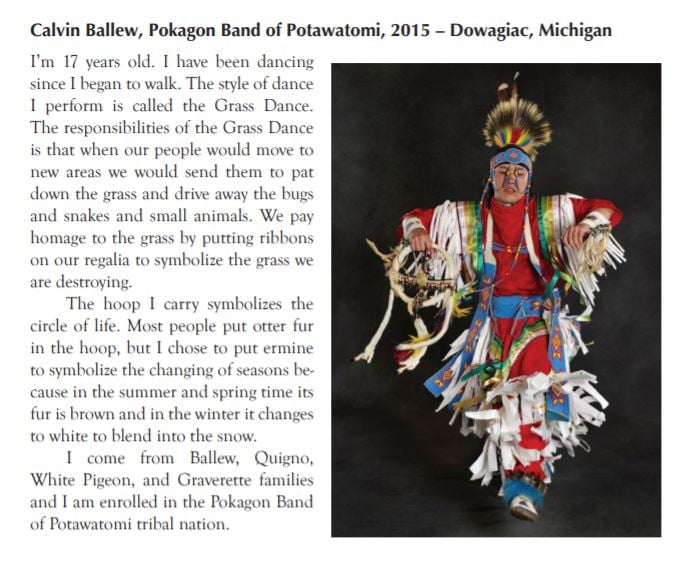
Image:
Sharon Hoogstraten, a professional photographer who now lives in Chicago, is a tribal member of the Citizen Potawatomi Nation. Through her exhibit “Dancing for My Tribe” she documented and preserved Potawatomi culture.
The exhibit, made up of individual portraits of contemporary Potawatomi in their regalia, conveys the story of a modern people preserving the traditional dress of their ancestors. Regalia is traditional tribal dress that identifies a person and tells his or her individual story, not a costume for pretense. No two examples of regalia are alike.
The exhibit premiered in 2014 at Rockefeller Memorial Chapel at the University of Chicago.
This is one entry from the exhibit, from the Artist’s Statement. The Pokagon Band of Potawatomi in Michigan is the group living closest to Chicago.