The Ridge Historical Society
Happy Thanksgiving
By Carol Flynn
Hoping to help reunite a country torn by war, Thanksgiving became a fixed holiday under President Abraham Lincoln in 1863.
There is a lot of information out there about early harvest and thanksgiving celebrations on American soil by the European colonists, but generally, when we think about the event that influenced today’s celebration, we’re looking at the celebration that occurred in 1621 in Plymouth, Massachusetts, as a harvest feast. The celebrants were the English Protestants called Puritans, known in American history as the “Pilgrims,” who had split from the Church of England and come to the New World on the ship called the Mayflower; other Englishmen such as the crew who also came on the ship; and the Wampanoag people, the Native American tribe that had lived in the area for over 12,000 years.
Note that there was already a colony of settlers in Jamestown, Virginia, dating to 1607. Most likely they also held harvest feasts, but the Plymouth celebration is the one for which detailed records exist.
The Pilgrims intended to go farther south than Massachusetts. Delays caused them to not leave England until September, and they arrived in America in November. Bad weather forced them to land where they did and remain there for the winter. They were not at all prepared for the freezing cold and snow they encountered in the New World, which had a much harsher climate than that of England. The one hundred settlers and fifty crew members stayed on the ship in Plymouth harbor that first winter. Many of them, weakened by the trip and suffering from scurvy from lack of Vitamin C, and some already suffering from tuberculosis, came down with pneumonia. About half of them died on the ship, most without ever setting foot in their new country.
They were finally able to come ashore and build huts in March 1621. They were greeted by the Wampanoag people. Early relations between the Native Americans and the European settlers were cordial. The Wampanoag showed the Pilgrims how to fish and hunt in the area, and how to cultivate the native food plants and gather fruit. Without the generosity and hospitality of the Native Americans, the settlers had a much poorer chance of surviving.
As far as what was available for a harvest feast that fall, many items we take for granted now were not available then. There were no sweet or white potatoes. It would be another hundred years before potatoes came up to North America from South America. The Pilgrims had not yet planted wheat fields so there were no pies and no bread. The sugar rations they brought with them had quickly been depleted on the journey over, so there were no jellies or sweet desserts. They brought no large livestock with them on the Mayflower, only chickens, and a few pigs and goats, so there were no dairy products except maybe goats’ milk. No ovens had been constructed yet for baking, so all cooking was done over open fires.
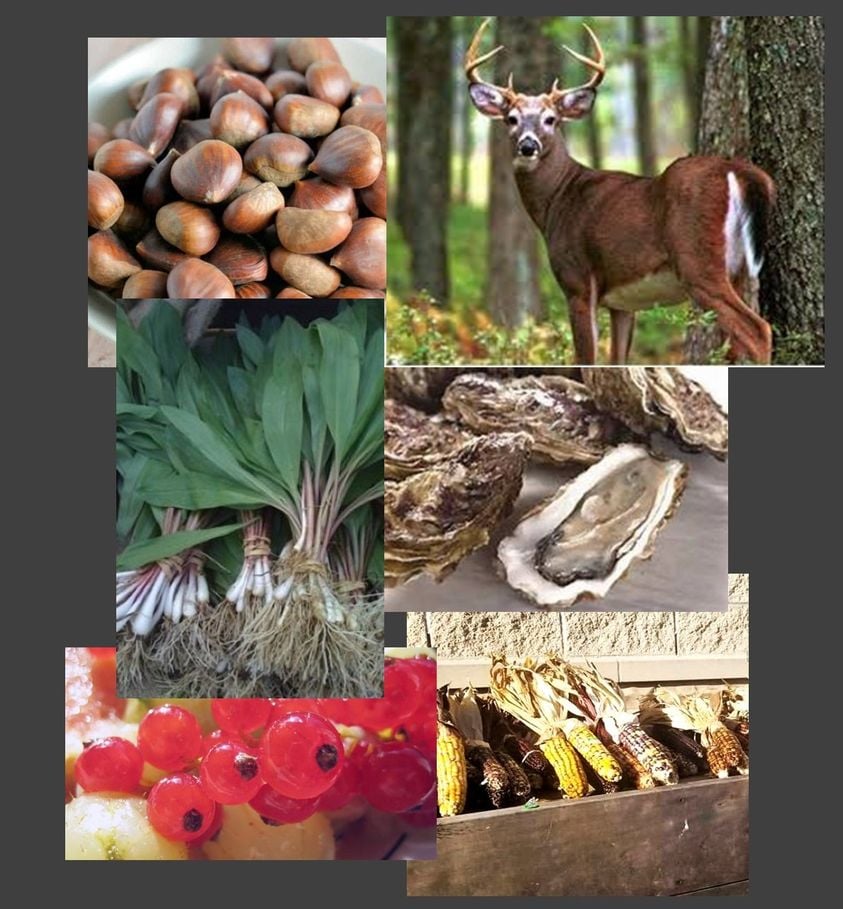
A journal kept by Puritan William Bradford reported the colonists went fowl hunting for this harvest feast. Duck, geese, swans, and turkeys were all plentiful. The Wampanoag guests brought a gift of five deer to the celebration, so venison, probably some roasted and some served in a hearty stew, was without doubt on the menu. Historians also believe that seafood was a major component of the feast, this being New England by the coast. Mussels, lobster, bass, clams, and oysters were readily available. The first Thanksgiving was very heavy on animal protein.
The vegetables the Wampanoag cultivated at the time included corn, pumpkins, squash, turnips, garlic, onions, beans, carrots, lettuce, spinach, and cabbage. The pumpkins were roasted. Fruits available for gathering included blueberries, plums, grapes, and gooseberries. Cranberries were there but it was another fifty years before there were reports of boiling them with sugar to make a jelly.
Flint corn, the multi-colored “Indian corn,” was plentiful at the first harvest. Most likely, the corn was ground into cornmeal, which was boiled and pounded into a thick corn mush or porridge. This was called Indian pudding, a take on the English fondness for “hasty pudding.” Later this dish was sweetened with molasses, made from sugar cane brought up from the Caribbean islands.
Herbs, and nuts like chestnuts, walnuts, and beechnuts, were plentiful from the forests. Along with onion, these would have been used for stuffing the fowl and flavoring dishes.
The celebration itself was a three-day event, with feasting, ball games, singing, and dancing. “Grace” was likely said before meals, but it was several years later that an official prayer service was added to the annual harvest celebration to give thanks for rain after a two-month drought.
Within a few years, the Pilgrims planted wheat and other crops. Other settlers came, bringing dairy cows and honeybees. But it is the native foods that make the day what it is – pumpkins, white and sweet potatoes, corn, cranberries. At least 60% of the food crops grown throughout the world today originated with the Indigenous People of the Americas. And of course, turkeys are native only to the Americas.