
The Ridge Historical Society
Native Americans and the Blue Island Ridge – Part 7: The Calumet Region
By Carol Flynn
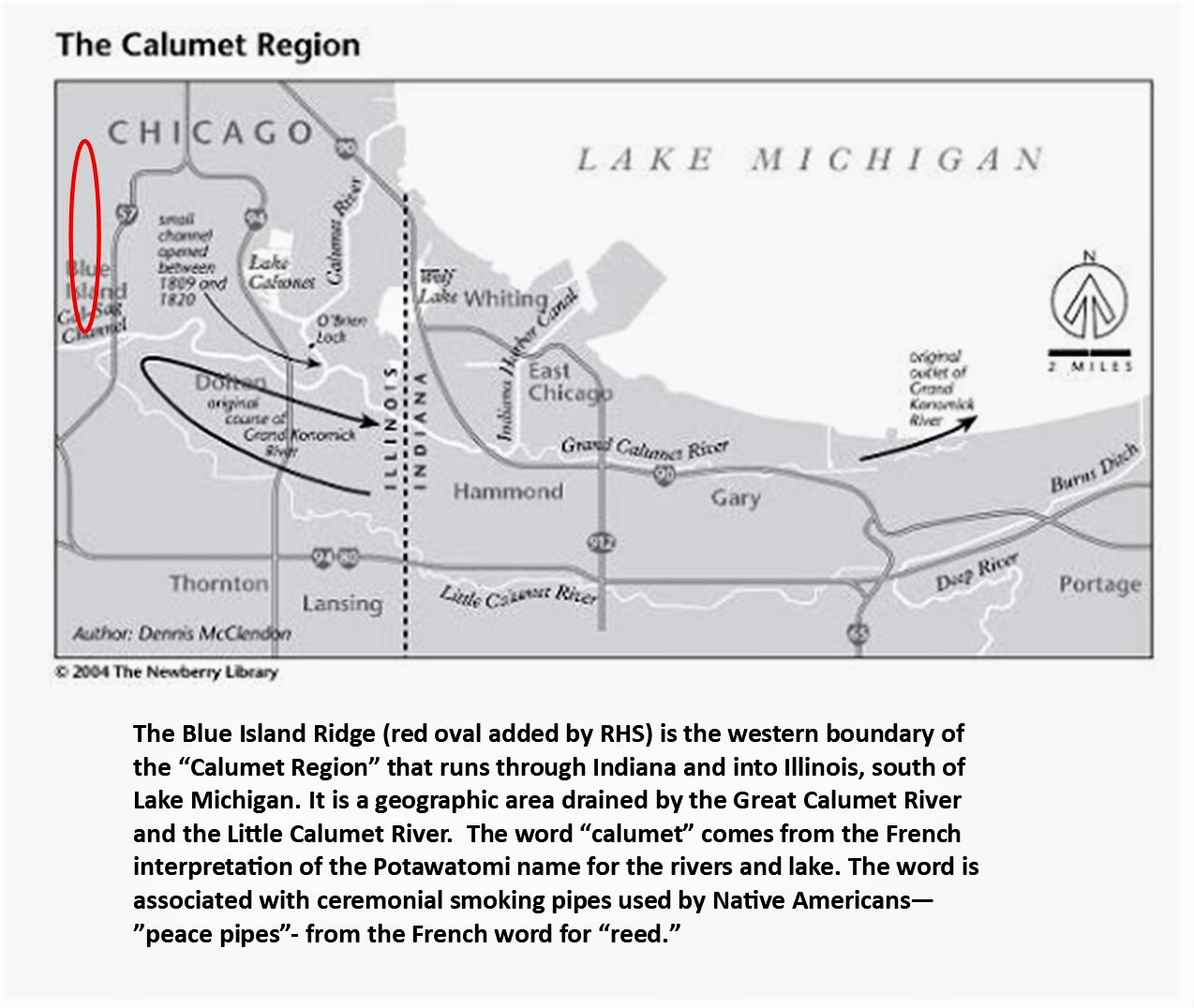
The Blue Island Ridge, a prehistoric landmass formed by glacier activity thousands of years ago, and the surrounding land, is part of the Calumet Region at the southern tip of Lake Michigan. The geography of the area made it important for Native Americans and later European settlers for several reasons.
First, there was an abundant supply of fresh water, and the area abounded with a natural diversity of plants and wildlife, especially during seasonal migrations. Included were buffalo and deer and many small species of game animals, and birds and waterfowl. Fur-bearing animals such as beaver, muskrats, and mink were numerous. Bears were in the area, and predators such as wolves, lynx, bobcats, and the occasional mountain lion.
Wild fruit and nut trees and bushes were plentiful – plums, berries, walnuts, etc. Forests of trees, primarily oak, provided wood, and elm and birch bark made good shelters and canoes.
In addition to Lake Michigan, the system of small lakes (Calumet, Wolf) and rivers and streams (the Calumet rivers, Stony Creek) in the southern section of what is now the city of Chicago teemed with fish – trout, white fish, pike, etc.
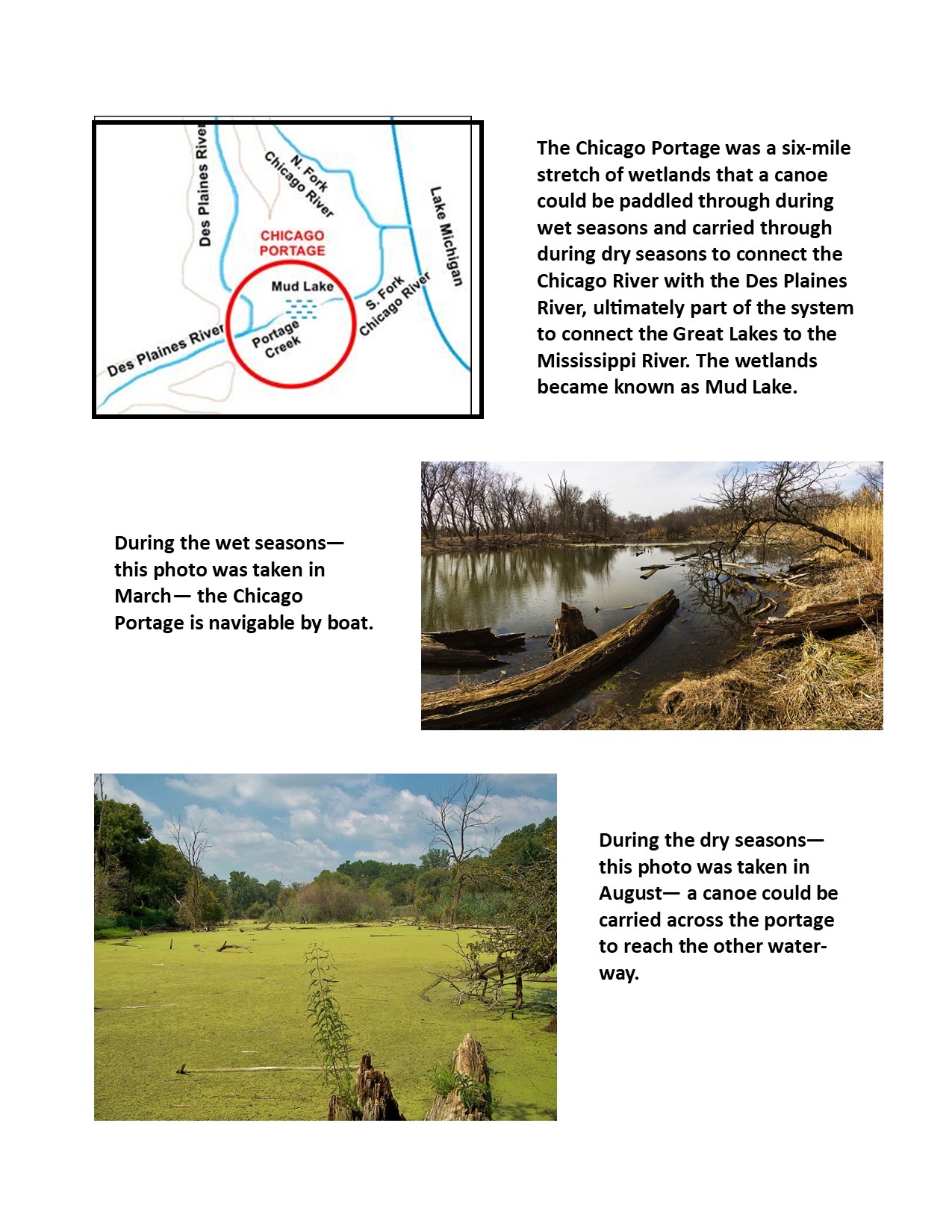
The second important purpose was its vital location for transportation and trade. The system of waterways and seasonal wetlands west of Lake Michigan offered portages between the Great Lakes and the Mississippi River to the west. This was vital in connecting the East Coast to the Midwest, and then the Mississippi ran south all the way to what we call the Gulf of Mexico.
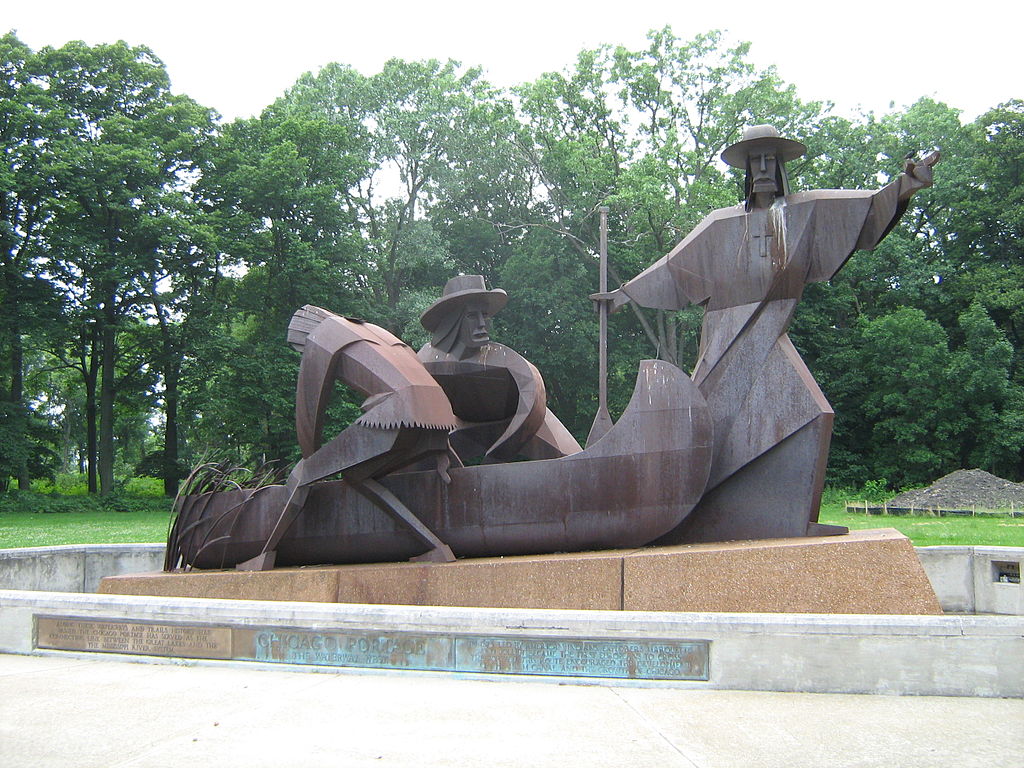
One of the most important early portages was the Chicago Portage.
Also, the Cal-Sag Channel was built to give a boost to other waterways in the system and that will be discussed further in a future post.
In today’s world of air travel, these systems may not seem so important. But in the past, when shipping ruled, long before there were even railroads, a route like the Chicago Portage or the Cal-Sag Channel was very critical.
Of course, the Native Americans knew about the Chicago Portage and used it for thousands of years, and were the ones who showed it to the European explorers. The idea that white settlers “discovered” the portage system is not accurate. They exploited the system shown to them by the Indigenous People to further settlement and development.
And it was a Native American who recommeded the building of the Cal-Sag Channel.
Many overland trails also passed through the area. Geographers have identified seven major trails that ran through the Calumet region, and many smaller trails have been lost to development. Some of the trails intersected right at the southern tip of the island, which is now where Western Avenue crosses the Cal-Sag Channel. Many of these trails developed into major roadways today.
The Calumet region was inhabited by multiple Native American groups, predominantly the Illinois and Miami, who were then replaced by the Sauk, Fox, and Kickapoo, and ultimately the Potawatomi established the dominant presence, and were the major inhabitants in the 1830s when the land was turned over to the U.S. government and the Indians left the area.
An important point to consider is the Native American concept of “land ownership” and we will discuss this in the next section, and begin to explore the life of the indigenous people of the Calumet region, which is incredibly complex and fascinating.