
The Ridge Historical Society
The History of Brood XIII Cicadas in the Chicago Area – Part 2
By Carol Flynn
The missionaries, explorers, traders, and settlers who came from Europe to the Americas had varying degrees of experience with cicadas in their home countries.
There are over 3,390 species of cicadas identified today, and they are found on every continent, except Antarctica, in habitats with deciduous trees. Cicadas prefer more tropical climates, and there are at least 800 species of cicadas in Latin America, but only sixty species are found in the Middle East, North Africa, and Europe.
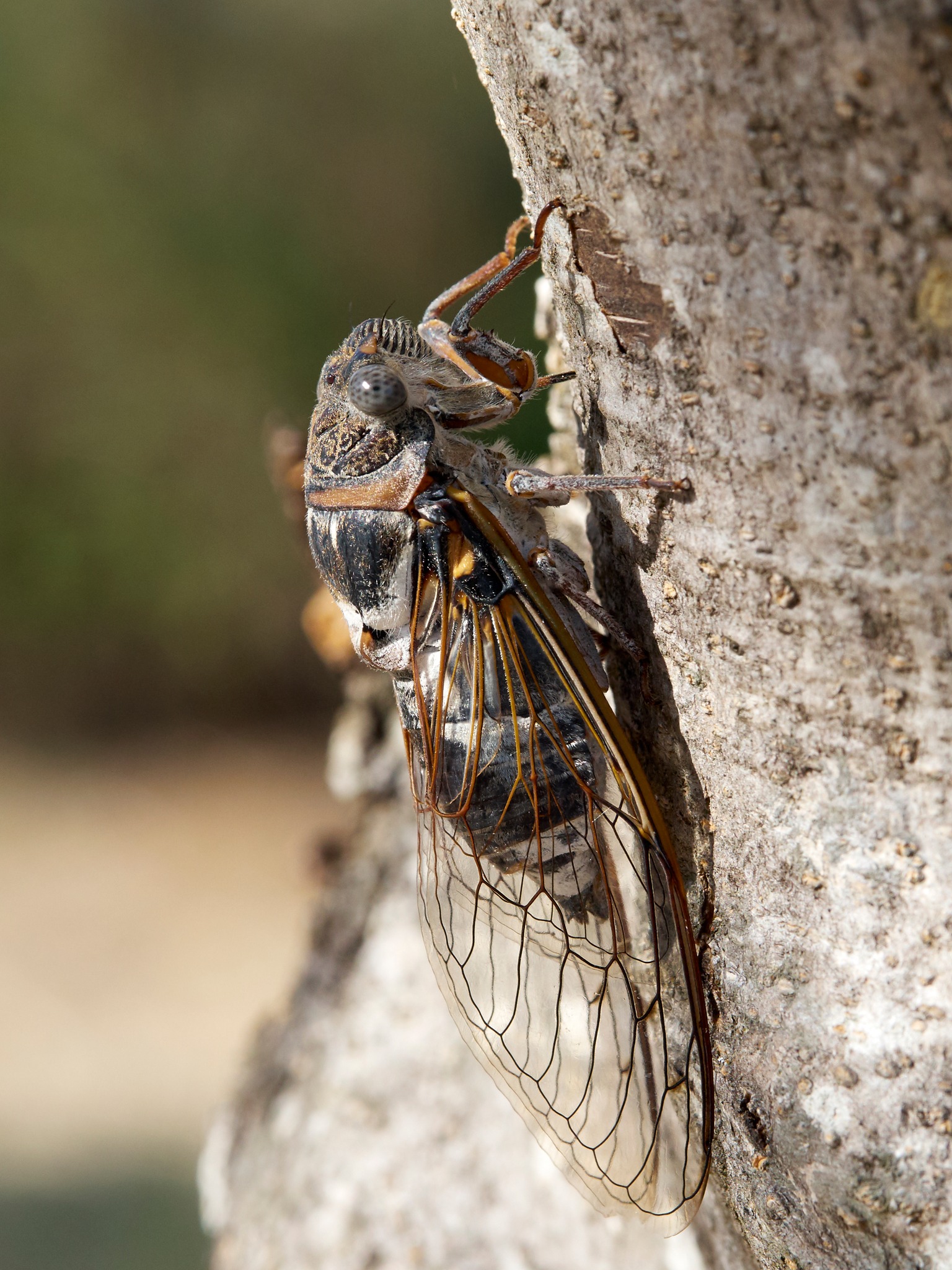
The common, or ash, cicada, which often lays its eggs in ash trees, is one of the most familiar species in central and southern Europe. It was officially named in 1758. It is found in Italy, France, and Spain, countries of origin for early travelers to the Americas. The ash cicada has a three-year lifespan underground, with some specimens maturing and emerging every year.
Farther north in Europe, cicadas are scarcer.
In England, where many of the early colonists came from, only one species of cicada is found. This is a different species from the ash cicada, and like many other species of these insects around the world, this one has a very limited geographic range. It is confined to the New Forest in the southern part of the country, a 71,000-acre tract of forest, heathland, and pasture, declared a royal forest more than 1,000 years ago.
This same species was once found throughout Europe as part of a complex of species, each one distinguished by its “song.” Now it is considered endangered. The New Forest cicadas haven’t been seen or heard in England since 2000, a source of worry and study for the experts. The species does still exist in limited places in East Europe.
No species of cicadas appear to be listed as native to Ireland, which has a cooler climate than many insects and reptiles can tolerate.
Although some Europeans who came to the “New World” might have had some experience with cicadas in their countries of origin, many, including the English, likely did not. They had to learn about and adjust to the native flora and fauna in their new country.
The periodic cicadas found only in North America were new to them. The unique characteristics of the periodic cicadas is that distinct species and combinations of species, called broods, have evolved 13- or 17-year lifecycles, and they emerge almost all at once in synchronization.
Cicadas were commonly identified as “locusts” in the beginning. They were viewed as the biblical pests who appeared in large swarms, traveling across an area and devouring crops. Cicadas are not in the locust family, and do not behave like locusts. There are true locusts in the Americas, however, and the size of the periodic broods of cicadas and their clumsy flying resulted in their being considered together at first.
The first known account by an English settler that referred to cicadas was a 1633 report by William Bradford, the governor of the Plymouth Colony, in which he stated: “… there was a numerous company of Flies which were like for bigness unto wasps or Bumble-Bees; they came out of little holes in the ground, and did eat up the green things, and made such a constant yelling noise as made the woods ring of them, and ready to deafen the hearers; they were not any seen or heard by the English in this country before this time ….”
During the 1700s, the details of the lifecycles of the periodic cicadas, that is, the 13- and 17-year lifespans underground and the emergence en masse of large numbers from holes in the ground, started to be recognized and documented.
In 1775, Thomas Jefferson reported on one brood’s 17-year cycle, mentioning that an acquaintance remembered “great locust years” in 1724 and 1741, and Jefferson recalled one in 1758, and now they were emerging at his estate at Monticello in 1775. He noted the females laid their eggs in the small twigs of trees.
In 1800, a Black tobacco farmer in Maryland, Benjamin Banneker, who was a self-taught naturalist and mathematician, wrote in his journal about experiencing the emergence of cicadas in 1749, 1766, 1783, and 1800.
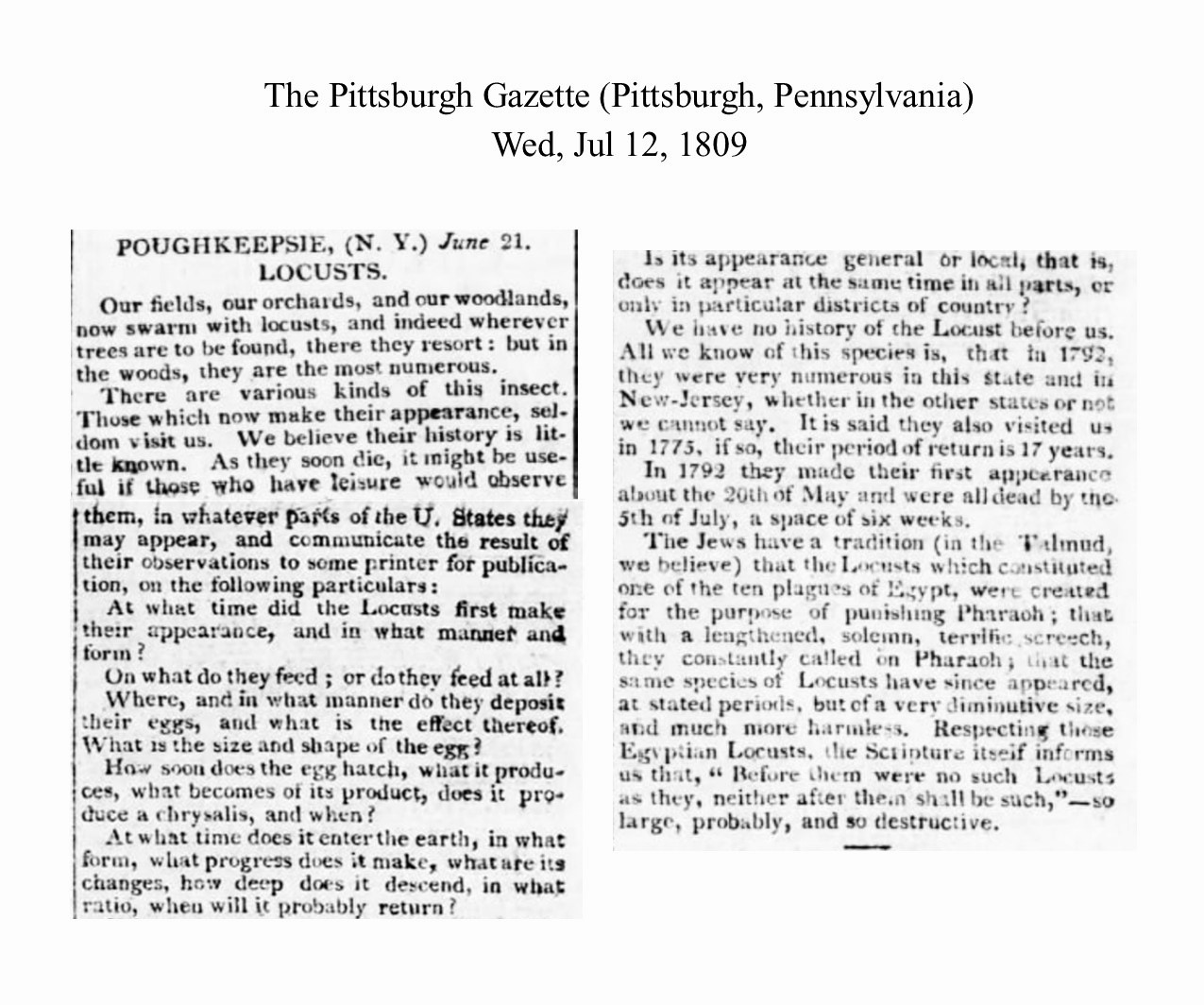
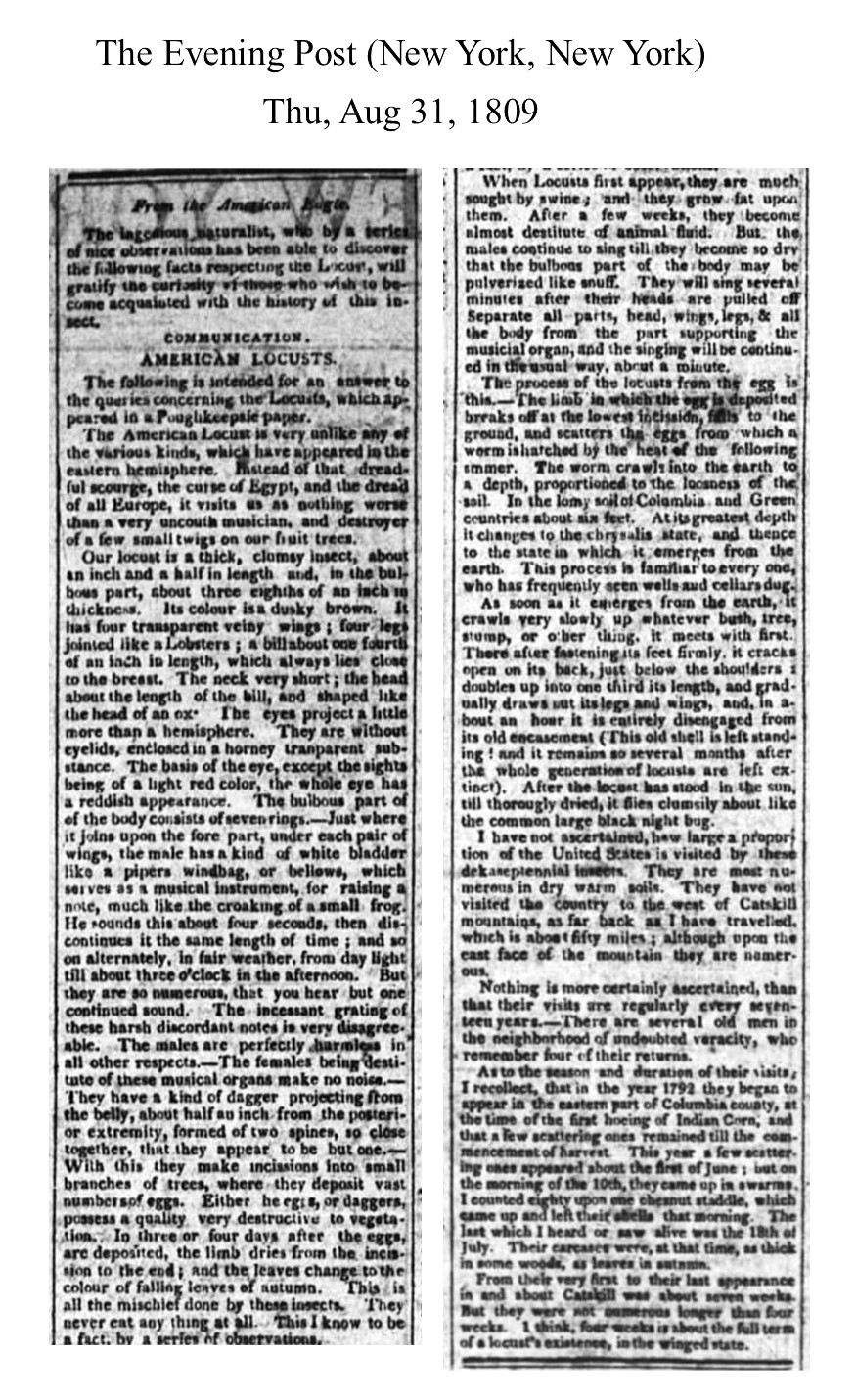
Articles that appeared in 1809, attached to this post, described the current knowledge about these “American locusts.”
As early as 1715, it was also observed that these insects were a favored dietary course for animals. One Philadelphia-based minister reported that “swine and poultry ate them, but what was more astonishing, when they first appeared some of the people split them open and ate them.”
Settlers started putting down roots in the Chicago area in the late 1700s, and on the Blue Island Ridge in the 1830s. They encountered what today is known as Brood XIII of the 17-year cicadas, also known as the Northern Illinois Brood, the largest group of cicadas in the world.
The next post in the series will look at how Chicago embraced this natural phenomenon through the years.