
Ridge Historical Society
Save the Pike House – Post 2: Architectural Significance and Current Condition
By Carol Flynn
The Pike House at 91st Street and Longwood Drive was built in 1894 as part of the private estate of Eugene S. Pike, the real estate developer and financier. Pike’s primary residence was a mansion on the exclusive Prairie Avenue, but he bought land on the Ridge for personal use and to develop lots for sale.
Pike was an avid horticulturist. Before coming to Chicago from Ohio, he established and operated as a business a nursery for fruit and ornamental trees, rose bushes, and grape vines he exported from France. His customer base was largely the Southern states, and unfortunately the business ended with the U.S. Civil War. On the Ridge, he found the perfect place to continue this passion while he developed “skyscrapers” in downtown Chicago and residential/business areas mostly on the southside of the city.
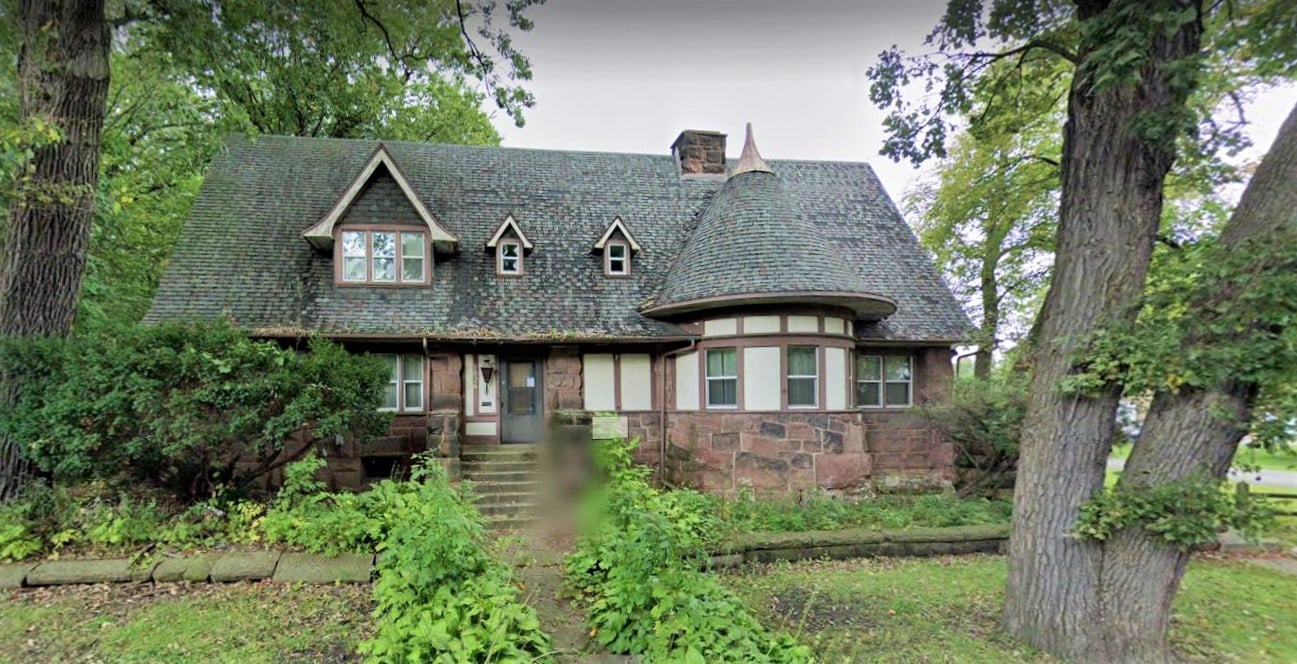
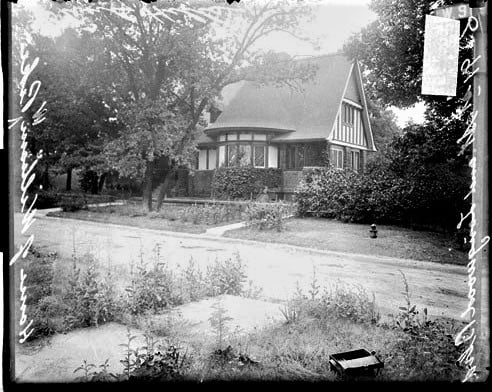
The Pike House was designed as a “gardener’s cottage” by architect Harry Hale Waterman in the Tudor Revival style. The house has a base and lower exterior walls of red sandstone, and upper walls of wood beams and stucco. Architectural elements include a round tower and a steeply pitched roof with tiny dormers with flared ends. The round tower adds a French Norman look to the building.
An important architectural feature of the house is how well it is designed for its setting. The house sits on the edge of the Dan Ryan Woods, a part of the Forest Preserves of Cook County (FPCC). The house blends in with the natural environment of the wooded area so well that the American Institute of Architects stated in its AIA Guide to Chicago (2014), “Expect Hansel and Gretel to come tripping past this house set on the edge of the woods.”
Although the existing building appears as if it were constructed at one time, it was actually completed in two stages. The west side was added sometime between 1898 and 1921, and the entrance was moved from the east side to the center front of the house, repositioning the tower to the right of the entrance.
In 1921, 32 acres of the Pike estate, including the house, were purchased by the FPCC to be added to the existing preserves land that FPCC owned to the north of the Pike estate. According to newspaper accounts, FPCC intended to use the house as a superintendent’s headquarters. The house eventually became known informally as the “Watchman’s Residence” when it was adapted for that use in the 1960s. It was used as a residence during its history, and that will be covered in a later post.
The building is significant to the community for several reasons. It has long been a landmark due to its location on the edge of the forest preserve, engaging the interest and imagination of those who pass by it. The Pike House is designated as a contributing structure for the Ridge Historic District, one of the largest urban historic districts listed on the National Register of Historic Places.
For 100 years, the house has been under the stewardship of the FPCC. In 2017, the FPCC shared a Conversion Feasibility study prepared by Kuklinski and Rappe Architects that includes information on the current condition of the house.
In 1962, the interior of the house was completely gutted to convert it into a “watchman’s residence.” None of the original historic features inside the house, except for a sunporch, remain. The house has been vacant for years and is described in the feasibility study as “in poor condition with masonry issues and a damaged roof.” The plumbing, electrical, and heating systems need replacement.
It is understood that it will take considerable resources to restore this building and adapt it for reuse.
Next post: Architect Harry Hale Waterman