The Ridge Historical Society
The Paranormal Ridge: Part 7 – The “real” ghost stories from the Givins Beverly Castle
By Carol Flynn
The last post covered the two ghost stories from the Castle that appear most often in print – the Irish fiancé and the influenza victim. The origins of these stories are not known, and neither is supported by historical facts. They fall into the realm of folklore or urban myth.
But while it may be disappointing that those two old stories are probably not true, there were – and continue to be – many other experiences at the Castle reported by “real” people that keep things interesting. The next few posts will cover some of those stories.
In an earlier post, it was mentioned that several factors come together on the Ridge that appear to encourage paranormal activity. Three of these factors – limestone, flowing water, and railroad tracks – are considered conductors of paranormal energy, and
they certainly come together at the Castle.
First, the building blocks of the Castle are limestone quarried from the banks of the DesPlaines River in Joliet, Illinois. This limestone formed in the reefs of shallow seas that covered the area 400 million years ago. Joliet limestone was used for many buildings in the 1800s, including the Castle built by Robert C. and Emma Steen Givins in 1886-7.
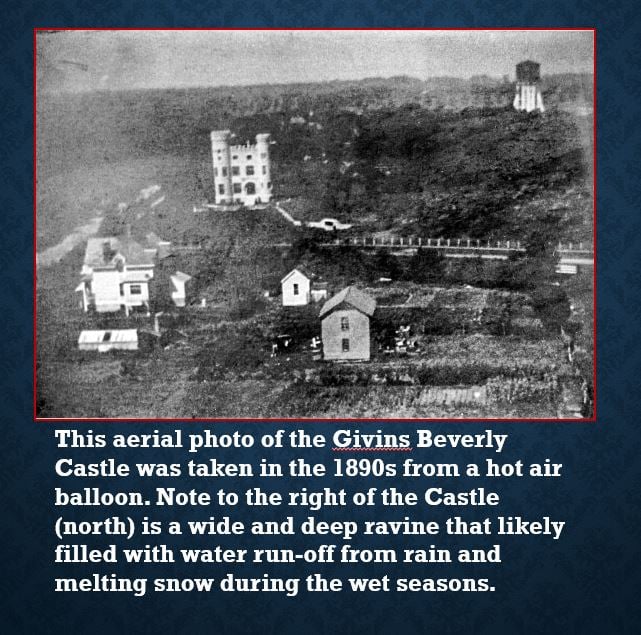
Second, just north of the Castle building was a large and deep ravine which likely included a stream at least during the “wet” season. This geological feature is evident on U.S. survey maps and in early pictures, and was mentioned in an article when Givins first built the Castle. The article stated that “stretching down the ravine from the house is a woodland park where the squirrels still bob up the big oaks and the rabbits have their warren.” The land was originally set up as a garden. The Beverly Unitarian Church (BUC), which has owned the Castle since the 1940s, built its school annexation in that section of the property.
Railroad tracks, the third factor, are just a few blocks to the east of the Castle. Bob Givins was often observed hurrying down the hill in the morning to catch the train on the Rock Island line at the Tracy stop (103rd Street) to go to his office downtown.
The first ghost stories on record for the Castle date to the 1920s. A man, who grew up on the Ridge 100 years ago, and was involved in the Ridge Historical Society but has now passed away, was asked in a newspaper interview about the Castle being haunted. He said he remembered stories, going back to his childhood in the 1920s, of people seeing ghostly lights floating in the windows. This is a common story for haunted houses. Such lights are usually dismissed today as reflections of streetlights or passing car lights, but 100 years ago, there were few streetlights, much less traffic, and no cars with high-beam headlights. The newspaper article is the only mention of these lights that has been found.
Some of the ghost guidebooks mention a story dated to the 1940s in which a caretaker at the Castle encountered a young woman with an Irish brogue dressed in old-fashioned clothes in the main room. She asked him what he was doing in her house. She then vanished. This would have been around the time that the Castle was purchased by the BUC and started being referred to as the “Irish Castle.” Unfortunately, no verification or further elaboration of this story for this time period has been found.
The earliest stories for which people can still be located for interviews start in the 1950s. The families hired by the BUC to be caretakers of the property lived on the second and third floors in the Castle. The ministers and other church personnel lived offsite.
One son from the family of caretakers who lived in the Castle from 1951 to 1962 is in his 80s now and lives in the southwest suburbs. He was 12 years old when the family moved into the Castle. In October 2019, he shared his memories for the “Phantoms and Folklore” program that was given at the Castle. The next post will relate his experiences.