
The Ridge Historical Society will be open today, Sunday, March 5, from 1 to 4 p.m. The address is 10621 S. Seeley Avenue. Admission is free.
The Ridge Historical Society
March: Women’s History Month and Irish American Heritage Month – Part 1
By Carol Flynn
March is both Women’s History Month and Irish American Heritage Month so for the next few weeks we’ll alternate in exploring these topics in relationship to the Ridge.
Many remarkable women have had connections to Beverly/Morgan Park. The Hofer family stands out because all five daughters – Mari, Bertha, Amalie, Andrea, and Elizabeth – were pioneers in the kindergarten movement and other social causes at the beginning of the 1900s.
The kindergarten movement helped to revolutionize the way children’s education was viewed. The work of the Hofer sisters helped establish kindergarten as the foundation of the American school system.
In the traditional model for educating young children, they were taught at home how to read and write and do simple arithmetic. They learned by lecture and memorization, and they were expected to be quiet and industrious to prepare themselves for the working world.
In the late 1700s, Johan Heinrich Pestalozzi, a Swiss educator and reformer, shared his observations that children learned best by investigation, imagination, and doing. He started experimental schools with activities like drawing, writing, singing, physical exercise, model making, collecting, and field trips. He allowed for individual differences and grouped students together by ability.
In 1837, Friedrich Froebel, a follower of Pestalozzi, opened a program in Prussia/Germany he called “kindergarten,” or child garden, to signify children should be nourished like flowers in a garden.
Froebel sought to teach children how to think, not what to think, and used the natural play of children to enhance learning. He developed learning experiences using educational toys, stories, songs, games, and crafts.
He trained women as teachers for his program, believing they had superior nurturing ability for working with young children.
Froebel’s work was banned in Prussia for being too radical, causing those trained in his methods to leave the country to establish programs elsewhere.
Famous "graduates" of early revolutionary kindergarten programs included Albert Einstein and Frank Lloyd Wright.
The first kindergarten in the U.S. was started in Wisconsin in 1855 by one of Froebel’s students, and was conducted in German. The first English-language kindergarten opened in Boston.
The kindergarten movement became closely tied to two other social reform movements of the Progressive Era of the late 1800s, settlements and playgrounds.
Settlement houses were organizations set up to provide services to help alleviate poverty. They were usually found in large buildings in urban areas heavily populated by recent immigrants. Social workers, teachers, ministers, and other service providers lived or “settled” in the facility to be closer to the people with whom they worked.
The most famous settlement house in this country was Hull House in Chicago started by Jane Addams. Other Chicago settlement houses included the Chicago Commons Social Settlement and the Fellowship House.
The first outreach at the settlement houses was to children and mothers, with daycares, kindergartens, and playgrounds; classes in English, crafts, and homemaking; and mothers’ clubs.
The playground movement was started in the 1890s by reformers who advocated that supervised play could improve the mental, moral, and physical well-being of children. Private athletic clubs had always been around for the wealthy, but now city parks and playgrounds, swimming pools and fieldhouses were built, and trained play leaders were hired to plan and conduct activities. This soon expanded to include adult activities as well.
The Chicago park system developed as one of the largest and best in the country.
The Hofers were leaders in all of these movements.
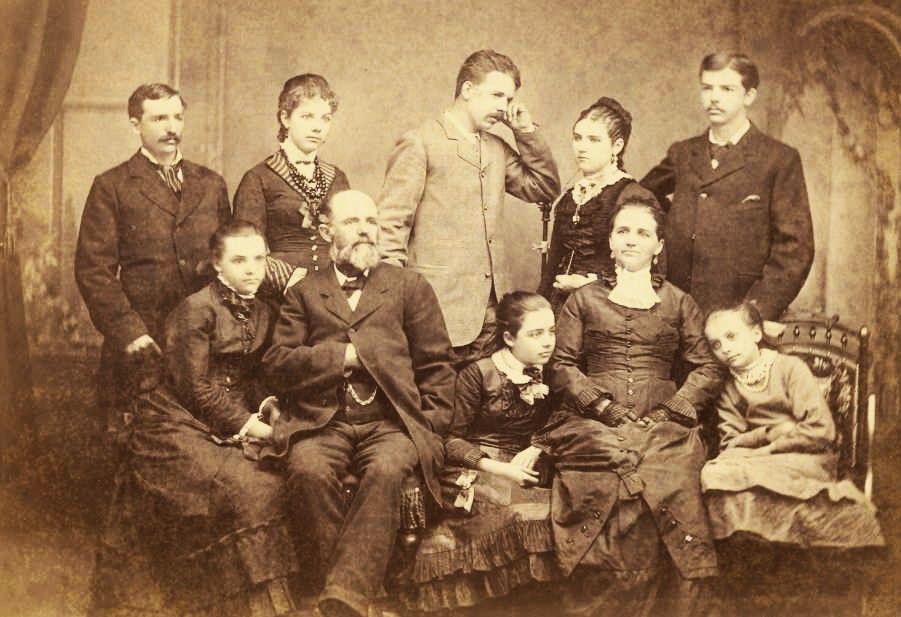
The five Hofer sisters and their three brothers were the children of Mari Ruef and Franz Xaver Hofer.
Born in 1821 in Baden, a state in Germany bordering France and Switzerland, Hofer fled to the U.S. in 1849 after participating in a failed revolution. He and Mari Ruef, born in Baden in 1836, married in 1853 in New York. They moved to Iowa where they farmed. He served as a lieutenant in the Union Army during the U.S. Civil War.
The Hofers had a passion for social justice and reform that they passed down to their children. They bought a newspaper in Iowa through which they shared their “progressive” views, and all the children were trained in the newspaper and printing fields.
The sons left to seek their fortunes on the west coast and started several newspapers. The daughters worked at the family newspaper and attended colleges to become teachers.
Two of the daughters moved to Chicago, and were soon followed by the parents and the other three sisters. They made their home at 1753 West 96th Street, where their house still stands on the edge of Ridge Park.
One of the sons wrote in his newspaper out west that his parents “are now comfortably settled in a cosy (sic) home in one of the most charming and healthful suburbs – Longwood.”
In the next posts we will look at the amazing work of the Hofer sisters. This picture of the Hofer family was user submitted on Ancestry.com.