
The Ridge Historical Society
Women’s History Month – Part 5 on the Hofer Sisters
By Carol Flynn
This continues the story of Amalie Hofer Jerome started in the last post.
In addition to their kindergarten endeavors, Amalie and her sisters were active members of many women’s clubs, including the Chicago Woman’s Club. In 1916, Amalie co-authored the Annals of the Chicago Woman’s Club for the First Forty Years of Its Organization 1876 – 1916, used today as the primary authority on this historically significant club.
Although women could not vote – and as expected, all of the Hofers including the parents and sons were suffragists – they were still very interested and involved in politics. Amalie was ward leader through one of the clubs.
As enlightened citizens, the Hofers paid attention to global politics. Their father had been a revolutionary in Germany, and the kindergarten movement was an international endeavor. The Hofers were progressive in their politics and advocated for international understanding and peace.
In 1905, Austrian pacifist Baroness Bertha von Suttner won the Nobel Peace Prize. In 1912, the Baroness reached out to the women of the U.S. to work for international peace. Amalie and her oldest sister Mari led the Chicago Woman’s Club to vote to invite the Baroness to come to the U.S. to present her cause to the American public. The Hofer sisters secured funding for the lecture tour from the World Peace Foundation, and helped arrange for the baroness to speak to 120 educational, civic, and church societies across the country.
In 1909, at the age of 45, Amalie married Frank Jerome, a furniture merchant. Jerome was a widower with several adult children.
Marriage did not cause Amalie to “settle down.” In fact, from 1910 to 1916, she was head resident of the Fellowship House Social Settlement at 831 West 33rd Street, in the stockyards, established in 1895 with Amalie’s help. She was active with the settlement’s women’s club, and even after stepping down as head resident, she stayed on the settlement’s board, managing the settlement house activities.
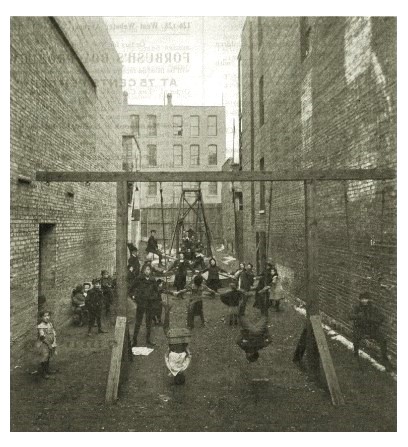
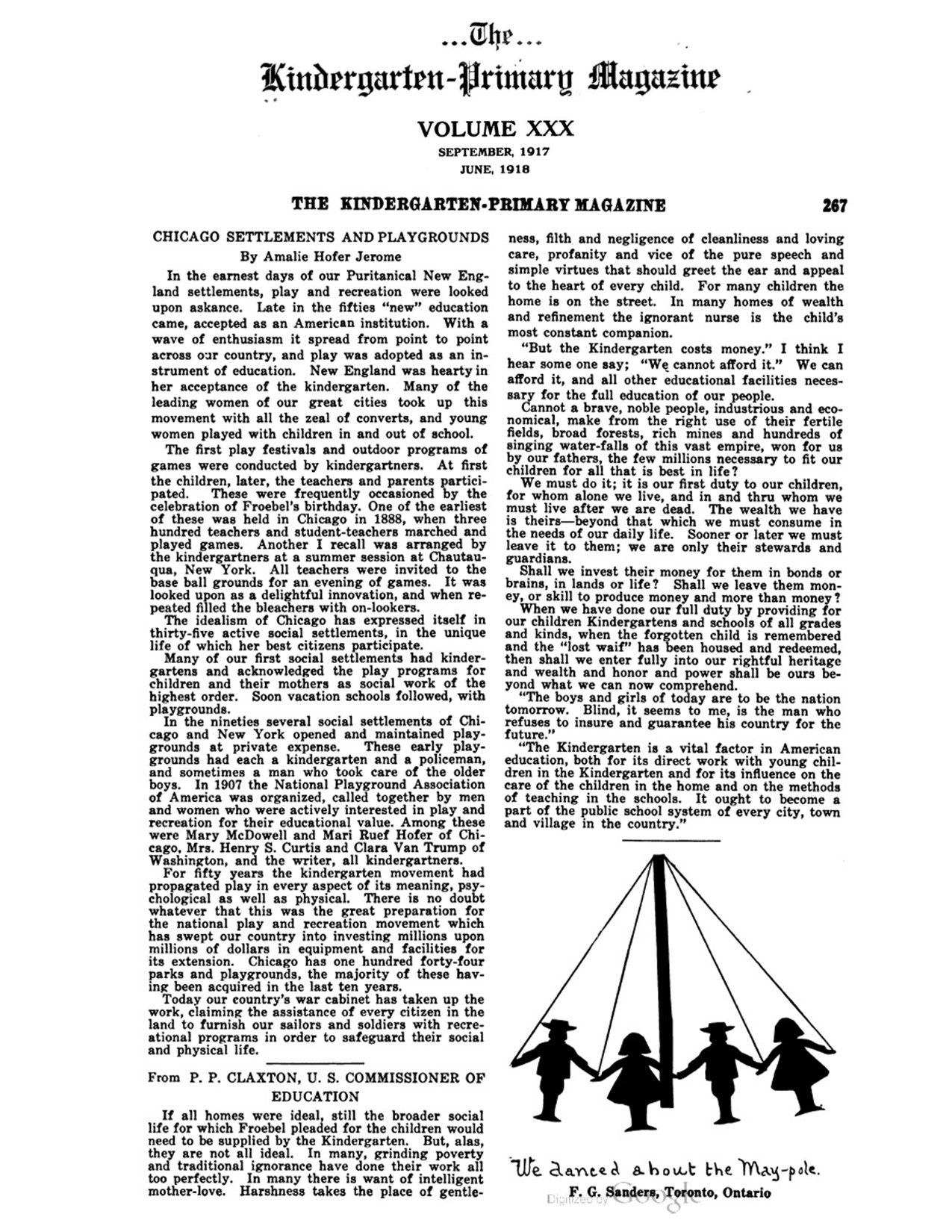
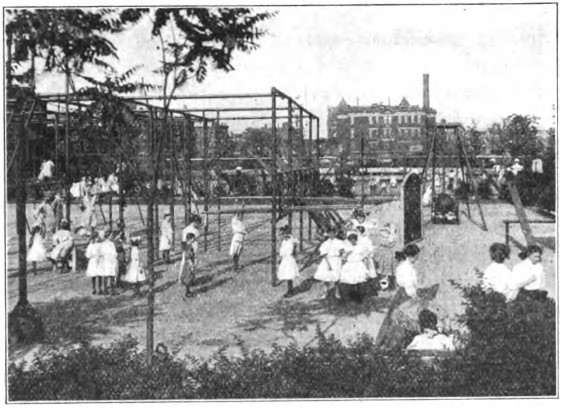
In addition to the settlement movement, which was discussed in the last post about Bertha Hofer Hegner, the kindergarten movement was closely connected to another reform movement of the Progressive Era, the playground movement.
The playground movement was started in the 1890s by reformers who advocated that supervised play could improve the mental, moral, and physical well-being of children, and this expanded to include adult activities as well. City parks and playgrounds, swimming pools and fieldhouses were built, with trained play leaders and planned activities.
In 1907, the Playground Association of America was started, with President Theodore Roosevelt as honorary president and Jane Addams of Hull House as a vice president. Amalie and Mari Hofer were founding members. They also helped start the Playground Association of Chicago, and Amalie sat on the board of directors and was later president. She worked with people like Jens Jensen, the landscape architect for Chicago parks.
The group arranged “great play festivals” like one in Garfield Park in 1909 that featured gymnastic and athletic drills, and folk games and dances. It was attended by 30,000 people. Amalie was on the planning committee.
In 1910, Amalie published an article in The Annals of the American Academy of Political and Social Science on “The Playground as Social Center,” which became a classic in the profession.
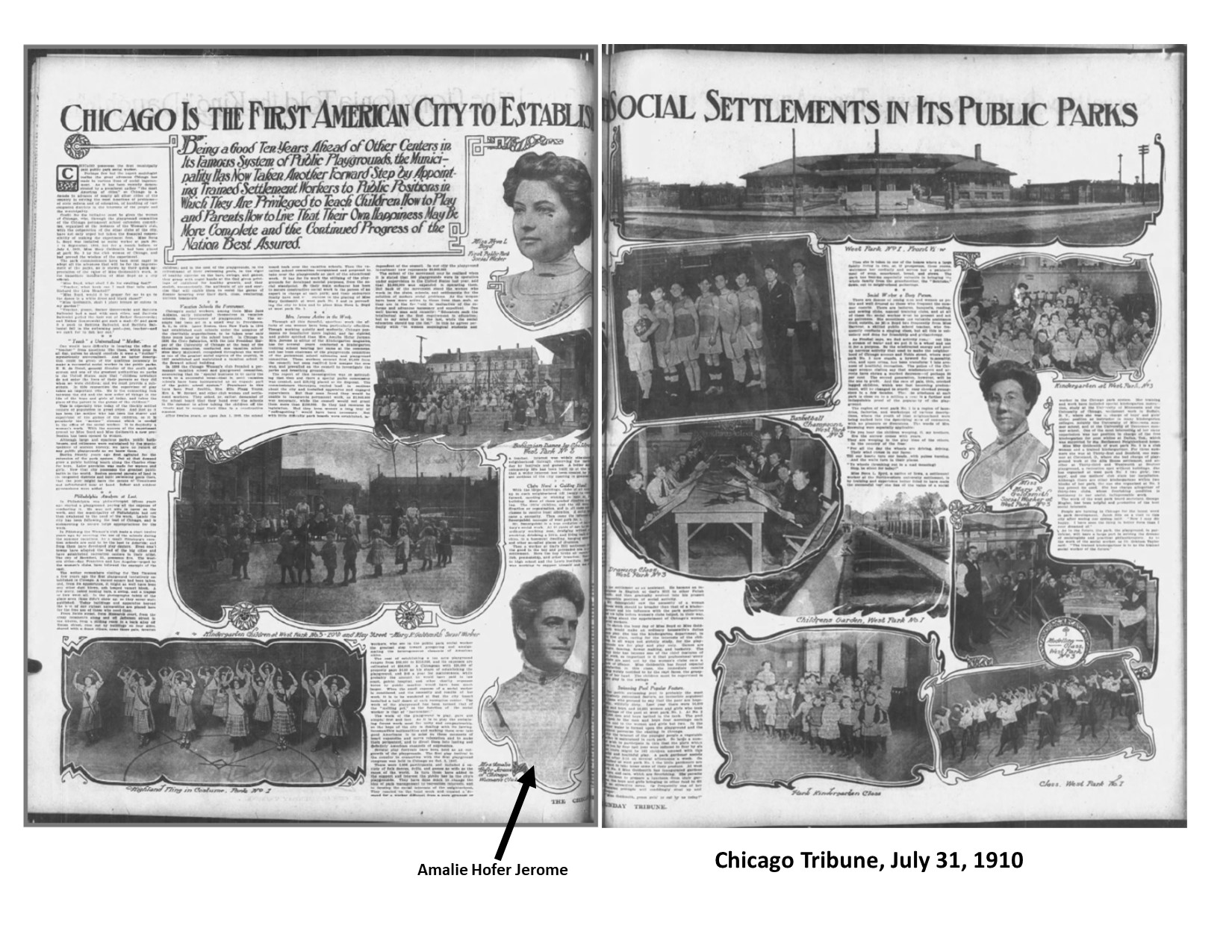
The 1910 Chicago Tribune article (quoted at the beginning of the last post) was a two-page spread on the playgrounds of Chicago, which had just hired social workers to oversee play activities, the first city in the country to do so.
In 1913, Amalie was a founder of the Civic Music Association in Chicago. For several years, in the evenings and on Sunday afternoons, free concerts and community songfests had been given in the field houses of the city’s parks by notable musicians, and the time had come to better organize the activities. There was no one more qualified to do this than Amalie Hofer Jerome.
As a leader of the Playground Association and the Chicago Woman’s Club, Amalie had been instrumental in arranging the concerts. She now took on the role of chairman of the executive committee of the new organization. With her guidance, numerous groups, such as the Northwestern University choir and the Illinois Theater orchestra, provided free concerts in the parks, bringing enjoyment of the arts to groups of people who could not afford pricey concert tickets.
In her role with this music association, Amalie was named an honorary vice president for the lighting ceremony for the first Chicago municipal Christmas tree in 1913. The 35-foot tree on a 40-foot base was set up just north of the Art Institute and was covered with electric lights donated by the Commonwealth Edison Company. Over 100,000 people attended that first lighting ceremony.
People like the Hofers never really “retire,” and Amalie continued her work well into her senior years. As an example, in 1929, as a member of the Board of Directors of the Park Ridge School for Girls, she presided at the ceremony for the corner-stone laying for a new dormitory designed by Beverly architect John Todd Hetherington.
The Hofers have a family burial plot in Mount Hope Cemetery on 115th Street, and Amalie and Frank Jerome were laid to rest there.
Next posts: The youngest Hofer sisters, Andrea and Elsa.