
The Ridge Historical Society
National Women’s History Month: Dorothea Rudnick
By Carol Flynn
March would not be complete without acknowledging National Women’s History Month.
There is no shortage of accomplished women in the Ridge’s past, and most of those we have profiled have filled the traditional women’s roles of educators, artists, and “club women” social activists.
This year’s subject, Dorothea Rudnick (1907-1990), takes us in another direction, the sciences. Her “historical” and analytical brain, as she described it herself in 1964, led her to become a noted embryologist.
Dorothea grew up in Beverly. Her family lived at 10640 S. Seeley Avenue, then later moved to 10407 S. Leavitt Street. Her father Paul was head chemist for Armour & Co. and both of her brothers became physicists.
Dorothea, however, did not start out interested in the sciences – her interests were in history, journalism, and languages.
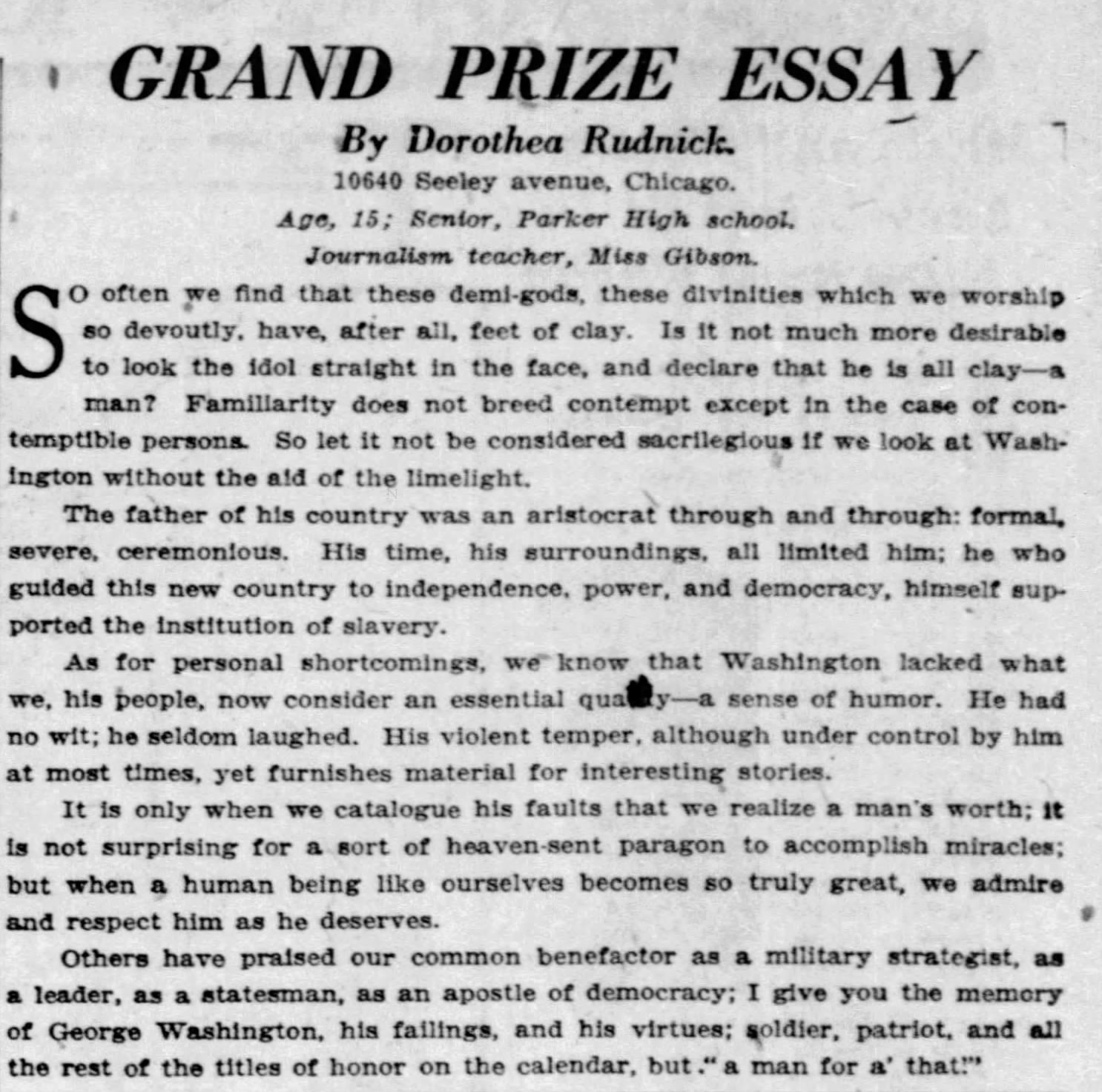
As a high school student at the age of 15, she won a Chicago Tribune essay contest on George Washington. Her essay is attached. It was a different take on George Washington: he was a flawed man, like all of us, making it that more notable that he rose to greatness.
Dorothea enrolled at the University of Chicago to study languages, but she really wanted to take some time to travel in Europe. She quit school and took a job downtown as a bookkeeper to earn money for a trip.
At the age of 18, she took off on her own with her own money to travel abroad. She enjoyed experiences like climbing mountains and living in Paris.
When she returned home, she realized she had to consider her future, and decided her best course of action was to go into the sciences.
Re-enrolling in the U. of Chicago, a course in zoology fascinated her, and she became interested in embryology, studying differentiation – why did certain cells develop into certain body parts – a lung, an ear, a feather.
With a Ph.D., completed in 1931, advanced scholarships and fellowships took her to Yale University, the University of Rochester, the University of Connecticut, and Wellesley College.
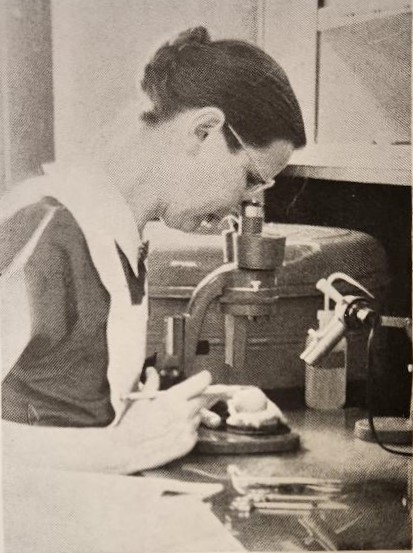
During these years, Dorothea perfected the delicate techniques for transplanting parts of one embryo into another that brought her distinction in the field. This was in the 1930s, and experiments were done by hand. She used tiny saws and forceps, glass needles, and binocular dissecting microscopes.
In 1940, Dorothea joined the teaching faculty at Albertus Magnus College, a Catholic women’s college in New Haven, Connecticut, near Yale, and spent the rest of her career there. She continued to have laboratory privileges at Yale, where she spent evenings, weekends, school breaks, and summers.
Dorothea enjoyed teaching and mentoring students as much as she did research.
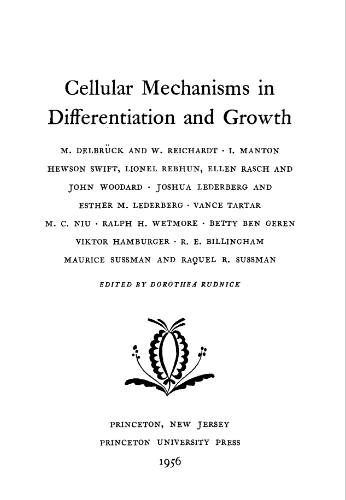
She also made time to continue her love for writing and languages. She published her own studies, of course, and translated research articles from other languages into English. For many years she served as editor of the proceedings of symposia conducted by the Society for the Study of Development and Growth.
Not much is known about Dorothea's private life, which was described as “reclusive.” One fact, though, is that in 1956 – 58, she had King-lui Wu, an architect from China who was on the faculty at Yale, build a house for her. The modern-style "Dorothea Rudnick House," described by one architecture historian as “an open-plan house tucked into the side of a hill in Hamden” is considered architecturally significant of Wu’s work.
Dorothea retired in 1978, after many years of teaching, conducting experiments on chicken and rat embryos, and publishing. She joined her brother in Los Alamos, New Mexico, where she died at the age of 83.
Great strides have been made in sciences like embryology in the last thirty years, and some opportunities have become available for women. However, the Society of Women Engineers reports that in 2023, only 16.7% of the science and engineering work force was made up of women.
This year the theme of Women’s History Month is recognizing women who advocate for equity, diversity, and inclusion.
Some women become advocates through example because their accomplishments show the contributions women can make if given opportunities to let their knowledge and skills develop and thrive.
Dorothea Rudnick, a Beverly native who became a noted
embryologist, is an example of a woman whose career “speaks” for inclusion of women as equals in the sciences.
A more thorough article on her can be found at: https://www.beverlyreview.net/news/community_news/article_11eec2de-eb8c-11ee-8773-fbfc415430c4.html