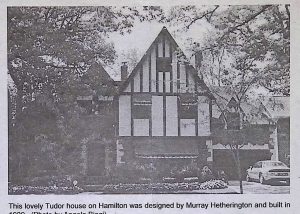
Murray Hetherington (1891-1972) was the second generation of a family which has been associated with the architecture of the Ridge since his father, John Todd Hetherington (1858-1936), moved to Beverly/Morgan Park in the early years of the 20th century.
The son graduated from the Armour Institute of Technology (now the Institute of Technology) in 1914, had his own practice in Beloit, Wis., for a few years, and then joined his father’s office. It is not clear when the major burden of their joint practice shifted from father to son, but by the early 1930s the firm was known simply as “Hetherington,” and even before the father’s death due to complications from an automobile accident in 1935, almost all of the work was done by Murray.
Murray’s obituary in the Beverly Review pointed out that his most well-known designs were English manor-style homes, and certainly a standout among them is the Henry H. Schumacher House at 9951 S. Hamilton Ave., erected in 1929.
“English Manor” is a term coined by students of American architecture for houses within the Tudor Revival tradition which do not have cross-timbering. (I prefer to call these houses Tudor myself, simply because the distinction doesn’t seem to have existed at the time most of these homes were built, so that a separate name segregates a group of houses which ought to be treated together.)
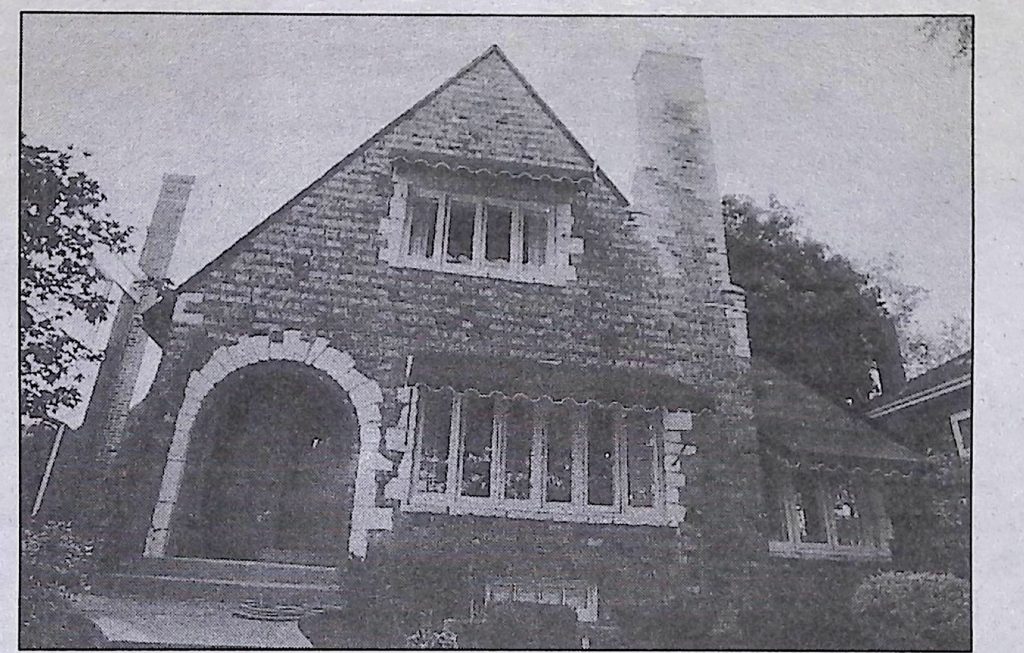
However one chooses to label the Schumacher House, it is certainly picturesque. The attention of the viewer is equally gripped by its materials and by its lines. The fabric of the house is clinker brick, a favorite material of Murray Hetherington, probably because of the texture the pitting and impurities in the brick lend to the surfaces. The brick is laid in English bond, a row of bricks laid lying with their ends out alternating with a row of bricks laid lying on their sides with their tops exposed to view. Since the tops of the bricks are twice as wide as the sides, the alternating courses of brick are low and high.
The brickwork is relieved, at virtually every point of interest, by limestone flags, also laid in courses. These occur where the wall meets the chimney, atop a chimney, at the junction of the porch buttress and the wall, and in all the door and window surrounds. The chimney also has carved limestone copings at the points where it widens.
The main entrance is reached through an arched vestibule at the north corner of the front of the house, and there is an additional arched opening in the north wall of this porch. The porch leads to a handsome oak door with medieval hinges and a window with a grill pattern of panes, five of which contain circles of yellow glass. As if to suggest that the house at this corner is in need of additional support for the walling above the porch opening, Hetherington has located a buttress with a curved slope which juts out from this corner at a 45 degree angle. This buttress is of brick rather than stone, to signal its allegiance to the wall rather than to the stone arched porch entry.
Hetherington has given this house balance rather than symmetry. Seen from above, it would appear cruciform in plan, with a large front gable and two gables nearly as large extending from the main roofline to either side. There is a smaller gabled dormer on the south side of the house at the second floor, balanced by a shed dormer on the north side. In front of the shed dormer is a flat-roofed inset dormer for further variety.
In addition to the arched entry, the front of the house is enlivened by the great chimney on the south corner, which rises more than two stories, becoming more stone-flagged the higher it gets. It is topped by two cylindrical chimney pots. Behind it, a small porch extends into the side yard. The front windows, and indeed all the windows above the basement, are casement windows with small panes, and, happily, the owners have resisted the temptation to replace any of them with picture windows.
Murray Hetherington had a special talent for giving individuality to all of his houses, and certainly it has not failed him with the Schumacher House. The balancing of the entry porch and the great chimney are calculated to a nicety, without seeming to have been imposed at all. This house has such a deceptive grace that only as we are appreciating its harmony does it dawn on us that serious scheming went into making the composition work.