
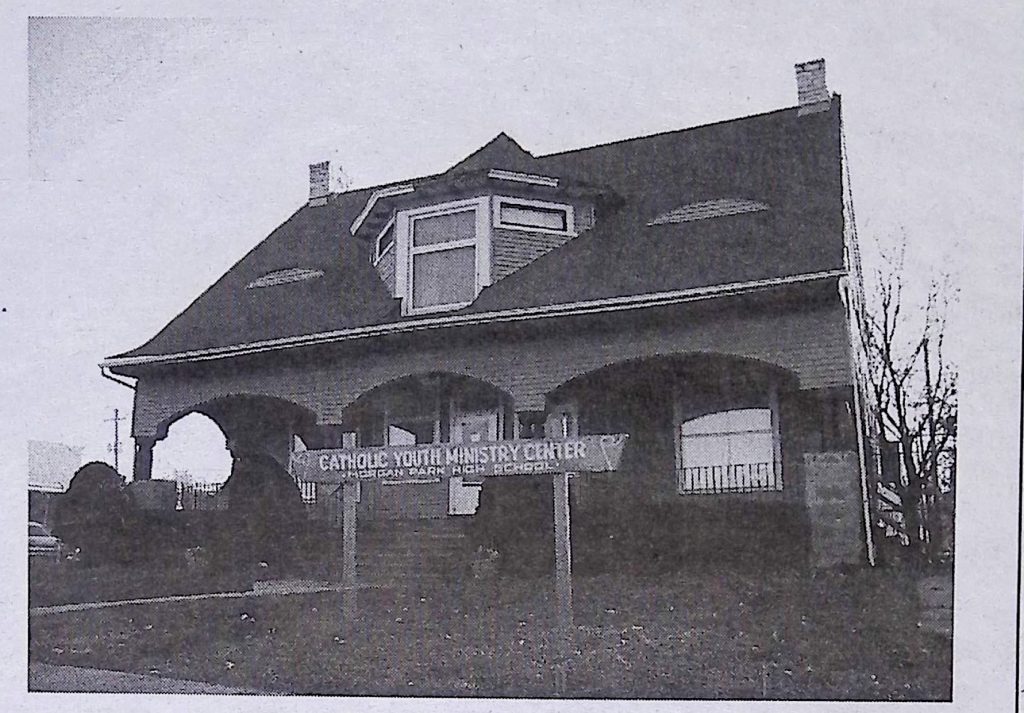
Throughout the 1890s, local architect George A. W. Kintz authored a column on house design for Chicago newspapers, particularly the Chicago Inter Ocean. He would provide a sketch of a house, a floor plan and a description. His column in the Feb. 21, 1891, issue of Inter Ocean entitled “A Frame Dwelling” is accompanied by a sketch which, in overall massing and appearance, is so similar to the house at 1825 W. Monterey Ave., it is reasonable to attribute the design to him.
Though he is an important figure in the architectural history of the Ridge, George A. W. Kintz was not in any sense of the word a famous architect — indeed, he apparently never worked full time at his own practice. But, in an age when it was possible to obtain a perfectly adequate house from a builder without using an architect, having a house designed by Kintz represented a step up from copying one’s house from one’s neighbor’s, and his practice presented local buyers the opportunity to personalize their residences.
Kintz was born in Ohio in 1861, and was brought to Chicago while still an infant. In 1885, he was living in Washington Heights. In 1910 he moved to East Beverly and lived at 10341 S. Prospect Ave., then 10341 S. Prospect Ave.
It was in the late 1880s that Kintz joined the architectural staff of the Board of Education, for whom he continued to work until about 1901. From 1902 until his death in 1912, he was a traveling salesman for the American Luxfer Prism Company.
Unfortunately, we do not know when George A. W. Kintz began to design houses on the side. His newspaper columns occasionally appear in the Inter Ocean as early as 1890, and the LaGrange Area Historical Society has an issue of the Suburban News dated July 22, 1898, in which there is an article titled “Art in Architecture” written by him. Thus he considered himself competent to offer architectural advice from 1890 on.
Kintz’s name begins to appear in the real estate and construction journals in 1897, in connection with houses designed for various clients, but particularly for the developer Frank F. Oviatt. Oviatt specialized in infill housing. He would acquire miscellaneous lots as cheaply as possible and put houses on them, since this was the only way they could be sold after the boom in the lot trade collapsed during the depression of 1893-1896. By 1906, Kintz designed houses and apartment buildings for which he himself acted as the developer.
Most, perhaps all, of his work on the Ridge was located east of Longwood Drive, particularly in what were known as Walden and Tracy, but he did do work in other neighborhoods. Kintz does not seem to have attempted to develop a style of his own, and his houses follow the fashions of the day: Queen Anne in the 1890s and Colonial Revival or American Foursquare in the following decade. He built a number of the Colonials in the vicinity of 104th Street and Prospect Avenue.
Kintz felt that the porch was the chief charm of the house. The porch shown in the newspaper article is quite simple, but that on the house has been greatly elaborated, with cut stone work piers with cubical openings (mostly concealed from view by the shrubbery) and supporting groups of columns which in turn support the porch roof. These short columns, carved in wood to represent cut stone, are capped by blocky capitals which taper inward at the base and are carved in vegetation patterns in the Romanesque style. They support arches on which the porch roof rests. The arches have elaborate carved beading on their inner and outer rounded edges, almost like necklaces.
The house on Monterey was originally built in 1891 for Freeman J. Short and his wife Nellie, who had acquired the property in May, 1891, so we must assume Kintz’s newspaper article inspired the house. The Shorts, who had financial problems, hung on to the house until 1895, when their bank took it. In 1899, it was sold to Benjamin and Sara Roberts, who owned it until 1942 when it was sold to Dr. Luther Lorance, who had his offices there. He sold it to the city in 1978, and, with the help of the former Beverly Bank it was transferred to Catholic Youth Ministry Center in 1981 and now houses programs for students at Morgan Park High School.
The most prominent features of the house are the steep side gables of the main roof and the octagonal front bay projecting from the second floor roof, which Kintz calls “the tower.” Both the roof of the bay and the main roof of the house are carried on oblong brackets. The bay is flanked by two eyebrow windows intended to supply additional light to rooms on the second floor. The overall massing of the house is simple, suggesting a Shingle-style structure rather than a Queen Anne design.