
By Harold T. Wolff
Ridge Historical Society
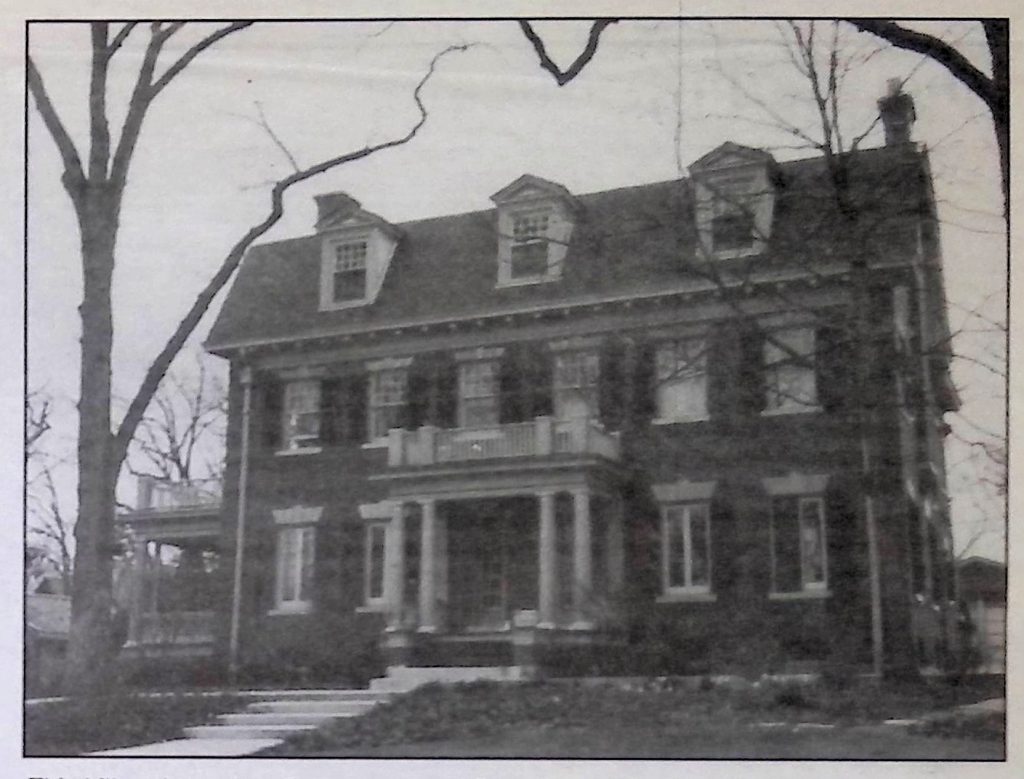
Among the most distinguished examples of Georgian Colonial Revival houses, not only in Beverly/Morgan Park but across the city, is the home at 9822 S. Longwood Dr., built in 1908 for Frederick C. Sawyer, a department manager for Swift & Company.
This house is probably the only example on the Ridge of the work of Horatio R. Wilson (1858-1917). Wilson was born in Livingston County, New York, and came to Chicago about 1878. He worked as a designer for the architect Charles J. Hull until 1885, thereafter practicing in his own firms. His best known partner was Benjamin Marshall, designer of the Blackstone, Drake and Edgewater Beach Hotels.
At his death, The Western Architect tried to use Wilson to typify the “average architect:” “His visible work, like his active life style, is honest, substantial, constructive, giving the best that is in him to the expression of his ideals. In its totality it is representative. By it, and not by the works of greatest renown is the status of his profession determined, and by his ethical professionalism the false impressions created by the mediocre or the venal are rendered innocuous.” His work was not in fact average, but of the highest quality.
The Sawyer House is an especially elegant example of Georgian Revival architecture, in that it captures the most delightful features of the colonial buildings upon which the style is based. Georgian was the dominant architectural mode of the American colonies from 1700 to 1780, and is characterized by a formal symmetry relieved by classical details contributed by the Italian Renaissance.
The success of the style, both in the colonial and revival versions, depends not only on the decorative details, but on the proportions and mathematical relationships of the parts to the whole.
The Sawyer House has a gambrel roof — that is, seen from the side, it has the profile of a barn. Such gambrels are often supposed to characterize Dutch Colonial houses, but even in colonial times were often seen in Georgian residences. It is six-ranked, which means there are six sets of upper and lower windows arranged one above the other. (Most colonial examples had odd numbers of ranks.) The windows all have simple keystone lintels and, wonder of wonders, the shutters are all there, which bespeaks the efforts of conscientious owners. There are also three dormers with period windows on the front roof.
The main entrance is through a classically-detailed porch with a balcony above, the porch supported by Ionic columns. There is a similarly-detailed south porch. The corners of the house are ornamented with brick quoins, in which blocks of brick are grouped so as to appear to brace the ends of the walls against strains.
Perhaps the most unexpected feature of this house is the west front, too striking to be labeled the rear wall. Here a few shallow broad steps descend from the house to the yard between two wings, one semicircular, the other composed of two floors of square classically-detailed porches. These wings are of wood, and the curved wing is paneled with curved siding boards. The effect is almost like entering or leaving the back lawn and garden between two pavilions.
Through very clever landscaping of the front yard, a virtually invisible driveway actually rises from the street at the south end of the lawn and curves across the entire front to reach the garage at the rear north end of the property. It is attention to details like this that say as much about the attitude of the current owners as about the original architecture.