
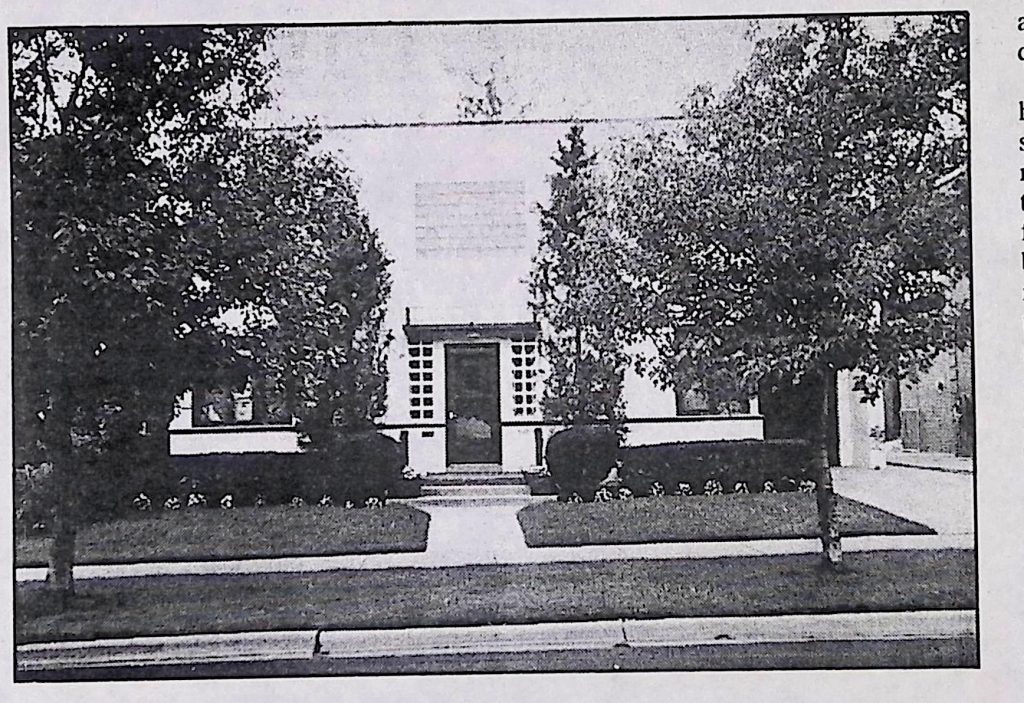
When Paul McCurry set about building the house at 9350 S. Hamilton Ave. for himself and his wife Irene, he must have wondered whether there would be more to his career as an architect than this residence. Born in Chicago in 1903, McCurry finished his collegiate training and his professional experience serving under older architects only to find the Great Depression closing down almost all building in the country.
He became a drawing teacher at Tilden High school to support his family, and was able to construct his house only by borrowing $10,000 from his father-in-law, a dentist. Building this house in 1936 was as much an act of faith in his architectural future as an effort to provide shelter.
Paul McCurry attended Lane Technical High School, and after graduation was almost lured into working for a developer of small houses, but resolutely chose to attend the Armour Institute (now the Illinois Institute of Technology). Armour was then the only school of architecture in the city. At the end of his freshman year, McCurry was elected to the Scarab architectural fraternity, whose members were fans of Louis Sullivan. The group would take Sullivan to lunch at Carson, Pirie and Scott (which Sullivan had of course designed) every other Friday, and McCurry was privileged to sit at the junior end of the table and listen while the senior fraternity members drew Sullivan out.
Following graduation in 1926, McCurry began his career with the firm of Tallmadge and Watson, where he had been employed while still a student. He passed the examinations for his architectural license and, in 1928 and 1929, made a tour of Europe. Upon returning to the United States, he worked for Andrew Rebori, D.H. Burnham, Holabird and Root, the Cook County Architect's office, and for the State of Illinois Architect's Office in Springfield. In the Burnham office he worked on buildings for the Century of Progress, and for the State Architect he worked on the restoration of Lincoln's New Salem.
And then there were no more architectural jobs.
The McCurry house on Hamilton Avenue is one of the small number on the Ridge done in the International Style. Such houses are distinguished by asymmetrical facades superimposed on a regular structural system, flat unornamented wall surfaces, flat roofs, and windows, usually casements or of glass block, set flush with the outer wall. To a certain extent the interest in the façade of an International Style house is maintained by varying the spatial volumes rather than by decoration. In the McCurry house the garage is set back from the front line of the building, which also allows the rooms on that side of the living quarters to have side windows.
McCurry softened the impact of the house by introducing a few touches outside of the International Style canon. The roof line has decorative dentils just below the top, and the principal entrance is framed by glass block windows recessed behind a screening brick lattice. In other respects, however, the house is very true to International Style conventions, with its simple windows and entrances and white-painted walls. (There was originally a dado of charcoal-colored brick from ground level up to the bottom of the first-floor windows, intended to hide any rain-spattered mud, but this has been painted over.)
The rear of the house originally had a second-floor porch off the master bedroom but within the volume of the house. This porch gave onto the open air through a slot which continued the casement windows of the adjoining bedroom, and this opening, coupled with the glass block wall beneath, gave a very International Style appearance to the back side of the house.
Paul McCurry took care to give his house wide exposure before the public, publishing it not only in a Chicago Daily News article but in a national magazine called The American Home. This does not seem to have resulted in other residential commissions, but at least it kept his career alive. In 1946, after 12 years of high school teaching, McCurry joined the firm of Schmidt, Garden and Erickson, where he worked for 30 years, eventually becoming a partner, and earning a few AIA honor awards for design in the process.
He left Beverly in 1955, moving to Lake Forest, where there are a few more houses designed by him. None of these homes, however, could possibly have been for him the career landmark that his Beverly/Morgan Park house was in 1936.