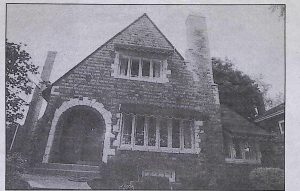
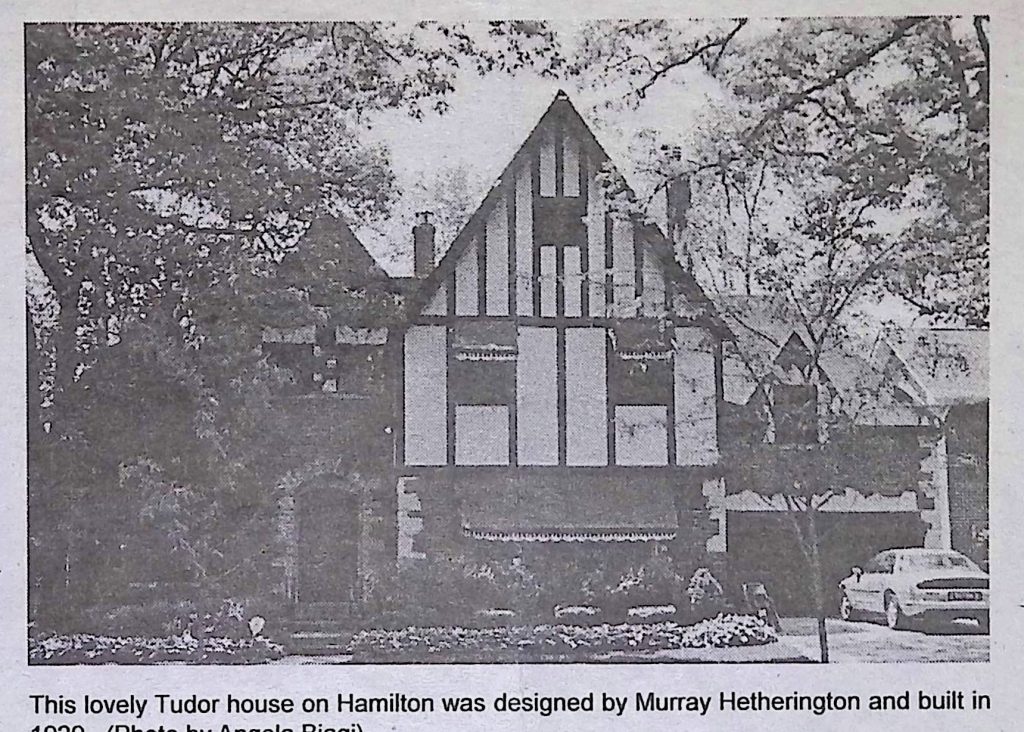
When we speak of Tudor houses in this country, we always mean houses from the revival of that style between 1890 and 1940. The house at 8854 S. Hamilton Ave., for Arthur A. Byers, president and treasurer of the Central Motor and Repair Company, is an excellent example.
The Byers House was erected in 1929 from designs by Murray Hetherington. Hetherington (1891-1972) was the second generation of a family which has been associated with the architecture of Beverly/Morgan Park since his father, John Todd Hetherington (1858-1936), moved to the community in the early 1900s. The son graduated from the Armour Institute of Technology (now the Illinois Institute of Technology) in 1914, had his own practice in Beloit, Wisc., for a few years, and then joined his father's office. Murray Hetherington's son, John Murray Hetherington (1926-2004), was also an architect and helped design the Morgan Park Academy's Barker Hall and the first Beverly Art Center.
The Byers House, like all products of the Tudor revival, has the advantage over the English Tudor houses of having been actually planned by someone. Of course, some planning was required in the construction of buildings of the Tudor era, but this chiefly involved arranging for the transport of an adequate supply of bricks and stone to the site and the purchase of lead—this was the expensive item—for the roof, if it was to be flat, and for the windows. A master builder would be engaged and the project more or less left to him, though sometimes he would be instructed to duplicate some picturesque detail from someone else's house. Indeed, for twentieth-tury architects, the real challenge was to capture the spontaneity of design that comes of having no design at all.
The facade of the Byers House is unequally divided into four sections. The garage wing is built chiefly of brick with a stone surround for the long door. To its south is a bay with brick on the first floor with half-timbering on the second floor and attic. Above the main entrance, which has a stone surround capped by a keystone arch, are two small windows with such heavy stone lintels that they call to mind Murray Hetherington's bushy eyebrows. The gable of this bay is capped with coping strips. Finally, the south wing is tucked so far back that its main-floor window is almost concealed by a buttress extending south from the main entrance bay. All of the brick bays have stone at the corners, laid in the Tudor revival equivalent of quoins, with large and small stones alternating one above the other.
The attention-getter on this facade is the half-timbering and stucco of the large bay. Curiously, there was no set formula for stucco, and individual plasterers often treated it as a trade secret. The formulas varied depending on which of the three coats was being concocted. In general, there should have been one part Portland cement, one part lime, and three or four parts sand. Often, an additional ingredient was included so the mixture wouldn't solidify before the plasterers finished smoothing it — such materials included ox blood, eggs or beer in England, and molasses in the American South. Portland cement has an uninspiring gray color, so yellow ochre or mineral coloring is often worked into the outer layer, but this must be done with care because it can weaken the cement mixture. Incidentally, stucco does not stick; before it sets, its back side must be forced into wire lath attached to the building's framework to hold it up.
All of the roofs of this house are steep, but the half-timbered bay is capped by a steep roof from which beam ends of a distinctive pattern protrude. This end pattern is also found on the brackets at which the vertical timbers embedded in the stucco terminate below the second floor. Of course the principal chimney, which climbs the north side of the half-timbered bay, displays such Tudor decorative touches as stone sides, two slots that pass through the chimney high up, and chimney pots on top.
In the Byers House, Murray Hetherington has managed to blend modern conveniences such as a two-car garage and a front room which overlooks the main entrance with the random charm of the Tudor style in a house that meets the needs of its occupants 75 years after its construction.