
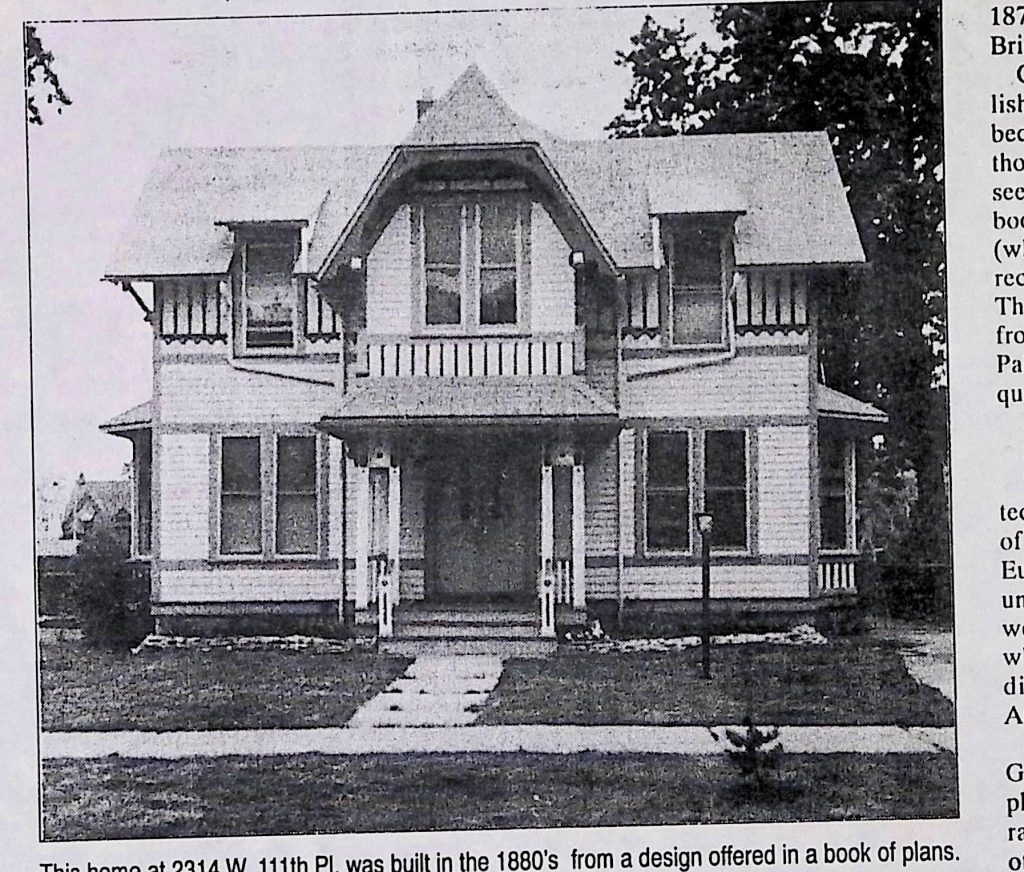
When the new owner of the house at 2314 W. 111th Place pulled the alterations off of his front porch, he revealed a chapter of Morgan Park history that no one even suspected existed. The wonderful dwelling he brought to light documents an almost forgotten chapter in the development of a native American architecture and recalls the extraordinary life of its first owner.
Johan Alexis Edgren (1839-1908), who with his wife Annie commissioned this house, was born in Ostana, Sweden. Early in his life he displayed a desire to go to sea, and at 13 he abandoned his schooling to ship out on a timber brig bound for France. Despite being nearly shipwrecked on this voyage and then robbed of his savings on the way home, Edgren returned to the sea in the following season.
He undertook several sea voyages, one of which brought him to New York. There a letter was waiting for him at a Methodist missionary ship, and while collecting it, Edgren was so impressed by the ardent prayers offered for his salvation that he began to think about religious matters. In the course of a terrible storm on his next voyage, he pledged himself to the service of the Lord as a missionary.
He returned to the school of navigation in Stockholm and earned a captain's diploma. In 1861 in Charleston, North Carolina, he directly experienced the curse of slavery, which he would later lend a hand to help eradicate. He was aboard a vessel in Charleston harbor when the first shots of the American Civil War broke out.
Making Choices
Edgren went through a period of considerable uncertainty as to his life's calling. He returned to Stockholm to take an advanced course at the school of navigation, but he also preached sermons now and then. He then returned to the United States, obtained a commission with the American Navy, and eventually served with a battery at Charleston harbor, and was able to witness the hoisting of the same Union flag that he had seen hauled down at Fort Sumpter at the beginning of the war.
Edgren pursued theological studies in New York and married Annie Abbott Chapman of Becket, Massachusetts. He returned to Sweden as a Baptist missionary, but, as his wife was unable to endure the climate, he came back to America and came to Chicago, where he was offered a position with the Scandinavian department of the Baptist Theological seminary in Morgan Park. He headed this department for 15 years, moving to Morgan Park in 1877.
Settling in Morgan Park
In 1882 he obtained a lot from the Blue Island Land and Building Company. The cost, as spelled out in a deed dated July 5, 1882, was “the sum of one dollar and the agreement to erect and occupy a dwelling on the premises conveyed, before January 1, 1883.” Small wonder that he turned to mail-order plans for his residence rather than trying to select an architect and wait for plans to be drawn.
For his house plans Edgren selected design 35 from plate 25 of “Palliser’s American Cottage Homes,” published in 1878 by George and Charles Palliser of Bridgeport, Connecticut.
George Palliser made a specialty of publishing planbooks, which won approval because he priced them far cheaper than those of his competitors. Interested home seekers could fill out a questionnaire in the booklet, mail it in with the appropriate fee (which ranged from 50 cents to $40), and receive plans and specifications in return.
The Edgren house differs in some details from the published version, but since the Pallisers would modify drawings upon request, this is not particularly significant.
An American Style
The house is in the Stick style of architecture, one of the first tentative attempts of American architects to move away from European models towards something more uniquely their own. Stick style dwellings were frequently featured in planbooks, which were an important vehicle for the diffusion of architectural taste across America.
This style, while transitional between Gothic and Queen Anne, also tends to display the structural framework of the house rather than covering it with towers and other decorative embellishments, and so presages a principle of modern architecture.
In the Edgren house, the Gothic arch of a second story over the porch has become a flattened, or hipped, gable, and the second-story windows peep up through the roof rather than from beneath Gothic arches. The side-by-side boards, or stickwork, parallel the framing of the house and compliment it.
Inside, the rooms on both floors flank a central hall with stairway. Originally most of the rooms were heated by chimneys, one on each side of the hall and so located as to provide fireplaces in the corners of adjoining rooms.
The Edgren house, besides providing a spectacle both unusual and delightful to the street, serves as a monument both to the man for whom it was built and to an important phase in the development of architectural taste in America.