Legend has it that when John H. Madigan set out to have a house built in 1902, he bragged that he was going to have one just as nice as his boss’s. Since Madigan was Superintendent of Bridges for the Chicago Bridge and Iron Company, his boss was Hiram E. Horton, whose house at 10200 S. Longwood Dr. still gets the ooohs and ahhs on the Home Tour bus ride each year. This boast was a challenge for Madigan’s architect, to say the least.
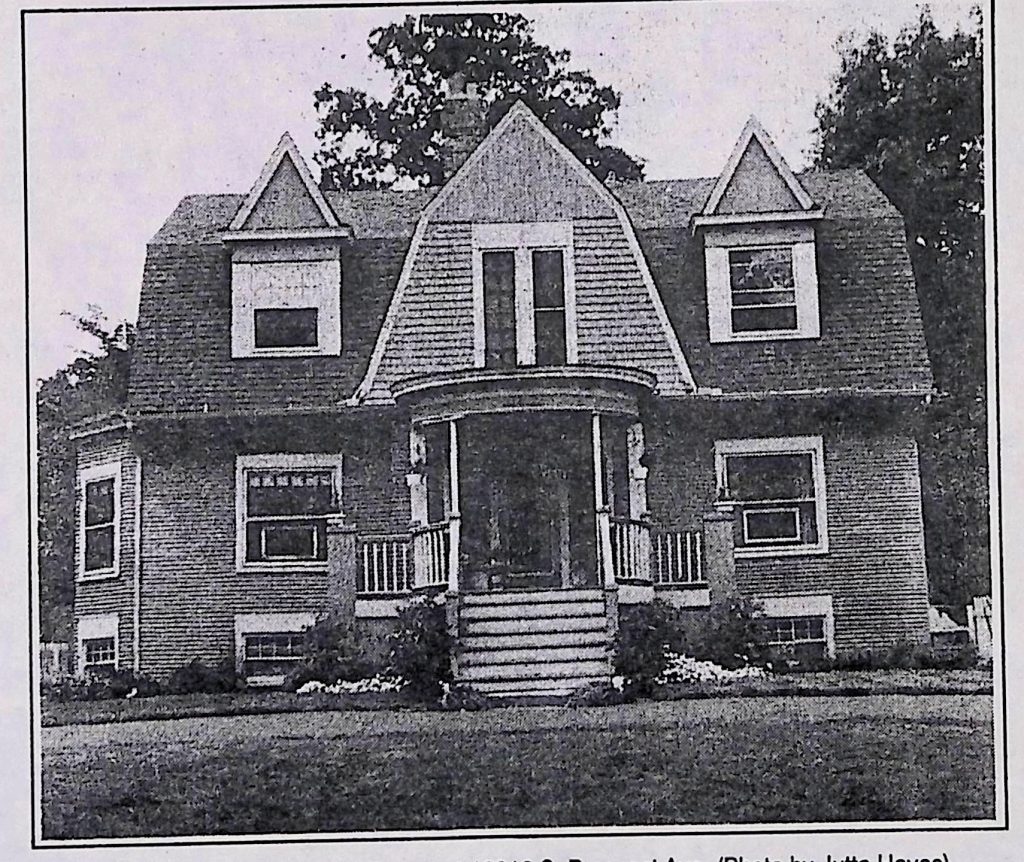
Today we can measure the success of that architect, George A. W. Kintz, because the house he designed for John H. Madigan still stands at 10312 S. Prospect Ave.
George A. W. Kintz was something of a local product, for although he was born in Ohio in 1861, he was brought to Chicago at an early age. George tried various occupations looking for something he liked. In 1885 he appeared in Chicago directories as a collector for the Western Union Telegraph Company, and in 1887 he was listed as a “draughts man.” Shortly after this he joined the architectural staff of the Chicago Board of Education, where he continued to work until about 1901.
After 1902, he was a traveling salesman for the American Luxfer Prism Company, an early manufacturer of glass blocks, until his death on Mar. 19, 1912. Kintz resided in Washington Heights.
Besides his listed occupations, Kintz designed houses. Much of his earliest known work was for the developer Frank F. Oviatt. Oviatt would buy individual lots, put houses on them and sell them. Even before Oviatt’s untimely death on Aug. 18, 1906 (he was crushed between two streetcars), Kintz had begun to buy and develop properties himself, particularly east of Longwood Drive. Kintz does not seem to have tried to develop an architectural style of his own, preferring to follow the fashions of the day: Queen Anne in the 1890s and Colonial Revival or American Foursquare in the following decade.
Apparently John H. Madigan first commissioned Kintz to design his house in 1902, but it was not actually erected until 1905. The house is a particularly elegant Colonial Revival frame structure, with a gambrel roof (which means that from the side it had the same profile as a barn) and a central front-facing gable, also with a gambrel roof. The front-facing gable is flanked by two dormers whose gables are steepened.
The particular elegance of this house arises from the discipline of the decoration, which is restricted to certain focal points about the building, without detracting from the simple massing of its basic form. For example, the second story, entirely under the gambrel roof, overhangs the first floor, giving the opportunity for four brackets and rows of dentils to set off the division between stories.
Similarly, while most of the windows are rectangular with simple box lintels, the side windows at the tops of the gables are oval with curved frames ornamented on top, bottom and sides with keystones. Other decoration is held to a minimum, but painted garlands adorn the lintel above the window in the front gable and panels below the windows that flank the front door.
Of course, the most assertive element of decoration is the front porch, which the present owner is in the process of restoring. Not only does its graceful, slightly flattened curve express the house’s elegance at the same time it welcomes the visitor, but its upper molding continues the line of dentils separating the first and second stories. Originally, there was a curved balustrade rimming the porch’s roof, and the owner hopes to replace this feature, seen in old photographs.
In his response to John H. Madigan’s desire to emulate the style of house erected by Hiram E. Horton, George A.W. Kintz probably produced the best work of his architectural career and, surely, Madigan did feel he had a house as nice as the boss’s.