By Harold T. Wolff
Ridge Historical Society
Considering that Harry Hale Waterman began his architectural career working alongside the two acknowledged masters of the Prairie School, Frank Lloyd Wright and George Washington Maher, it is disappointing not to find more of his work in this style.
The England J. Barker House, 10650 S. Longwood Dr. is probably the best surviving example.
The house was built in 1910 for Barker, the president of the United Autographic Register Company, which produced a set of business forms designed to simplify bookkeeping. It was subsequently used as a house of worship by the Church of Jesus Christ of Latter Day Saints and as the home of the Loring School for Girls. It currently houses the Beacon Therapeutic School.
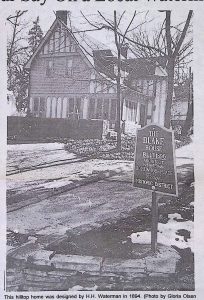
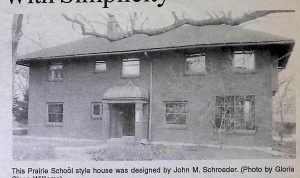
The architect of the house was Harry Hale Waterman (1869-1948), whose work has frequently appeared in this column. Waterman began his career as a draftsman in the office of Joseph Lyman Silsbee, where he worked from 1886 to 1892. During these years his fellow draftsmen included Wright and John M. Schroeder, all of whom were to make important contributions to the architecture of the Ridge.
Waterman's contact with Wright was perhaps a little closer than with the others, since the Waterman family was asked by Wright's uncle, the Reverend Jenkin Lloyd Jones, to take in his nephew when Wright first came to Chicago from Spring Green, Wisc.
Nevertheless, the Barker House really is closer in spirit to the work of Maher than to that of Wright.
In part, this is probably due to the fact that the house is quite large. Maher had a gift for attracting wealthy clients that was only by Wright's penchant for repelling them, and as a result Maher's major residential commissions are substantial structures of brick or stone rather than the wood and stucco that are characteristics of Wright's houses.
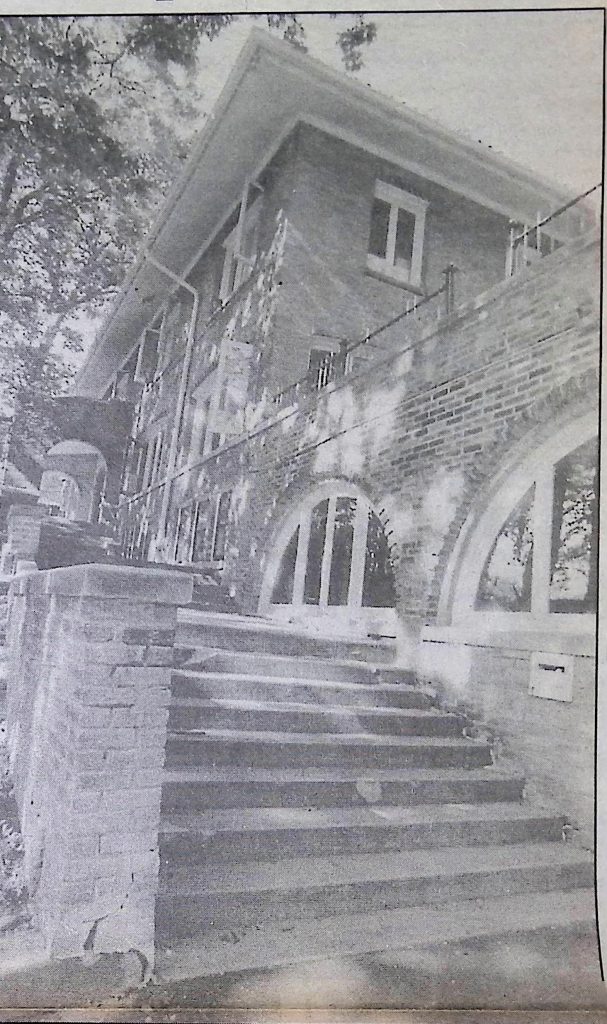
The Barker House is 33 feet deep and 83 feet long, not including the porte-cochere to the north. The house is of gray brick, with a green tile roof and yellow trim around the windows. The large ground-floor windows have segmental arched tops and are divided into vertical panels which open outward separately, for which Waterman probably drew his inspiration from Maher. Their sills rest on a limestone course which runs uninterruptedly along the front of the house and into the front porch columns, and continues beyond the north end of the house to form the coping along the top of the porte-cochere, thus tying the entire composition together.
The second floor windows are also grouped in vertical panels but have straight tops and rest on their own individual limestone sills. Decoration is sparse, consisting of alternating indented and protruding bricks in the arches and brick courses over the windows and door openings.
The front porch has massive columns and arched openings on three sides. The arched to left and right give onto the walks approaching the house, while the front arch has a visor roof over it for shade. The top of the porch has an elaborate ogive coping somewhat reminiscent of mission-style houses.
The hipped-roof projects well beyond the walls and has a band of stylized dentals on the underside of the eaves. There are three chimneys, and the two on the rear of the house have simple chevron plaque ornaments, a device of three limestone squares beneath the top coping, and elaborate chimney pots. The rear roof curves over an arched window in the center of the back of the house. The house also has a wing which extends out from the rear at the north end.
The porte-cochere on the north side of the house extends from the basement level and has archways on three sides. These continue the arched windows of the exposed portion of the basement, which is behind the staired walkway leading down from the front porch of the house to the driveway.
Adjacent to the porte-cochere at the rear of the house is a curved retaining wall with arched windows which supports a terrace above. The terrace is approached from the rear of the house through a door-sized arched opening in a wall which has an ogive coping similar to those atop the front porch.
In 1992 the Barker House was augmented for its current use as a school by the addition of a number of classroom pavilions. These were designed by Phillip Peecher to retain the original feel of the house, and have the same limestone course below the first-floor windows and the same alternation of protruding and indented brickwork above them that is found in the main house.
Perhaps the greatest compliment that successive generations have paid to the Barker House has been its continual use for over 60 years without substantial alteration of the design. The timelessness of its simplicity and clean lines continue to prove an attraction down to our day.