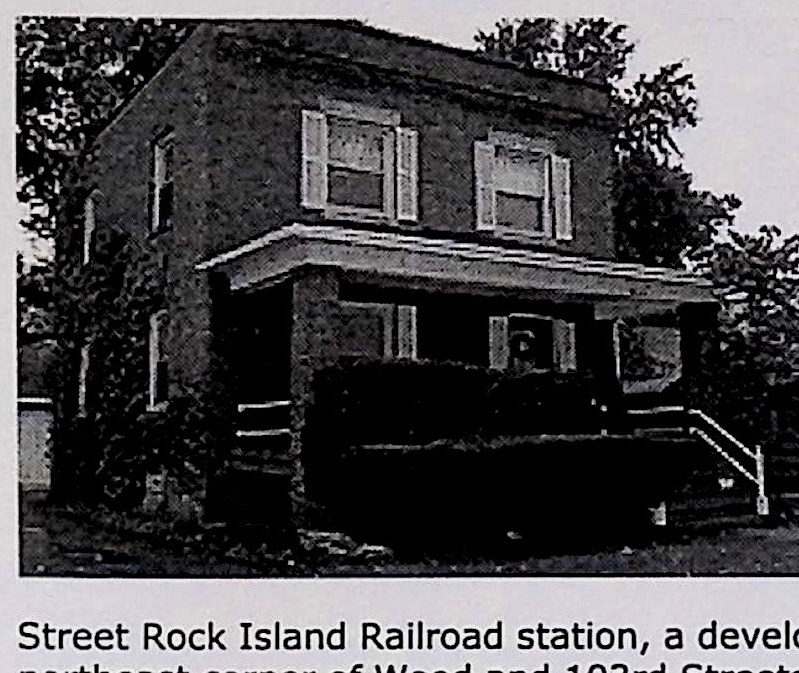
Sometimes an architect will come up with a solution to a problem presented by a client which admirably meets the requirements but nevertheless does not receive the flattery of imitation by others. Such houses enrich the community by addition to its variety, even when they do not set a trend themselves. And, in the case of the house at 10414 S. Wood St., such a residence has an air of distinction on its street.
Erastus A. Barnard (1833-1915), one of the early settlers of Beverly/Morgan Park. His brother William owned 160 acres bounded by 99th and 107th Streets and by Wood Street and (roughly) Longwood Drive. In 1854, Erastus purchased the south 80 acres of this property from 103rd to 107th Streets, and cleared it for farming.
Gradually, the community of Tracy grew up around the adjacent 103rd Street Rock Island Railroad station, a development much encouraged by the moving of Bethany Union Church to the northeast corner of Wood and 103rd Streets in 1903.
By the beginning of the 20th century, Erastus A. Barnard realized his property had more potential as a site for residential and commercial development than he could hope for in the continued practice of agriculture. After donating the land for a park in memory of his daughter Amy at 105th Street and Longwood Drive, he began to sell off house lots as buyers desired them.
In 1911, Barnard sped up the disposal of his land building nine houses. Three houses were built on Hale Avenue north of 104th Street, one of which has been demolished to make way for an apartment house. Three more were built on the north side of 104th Street, east of Hale. Two were built on the east side of Longwood Drive north o 107th Street. And the last is our house at 10414 S. Wood St. Each house cost $2,700.
For his architect Barnard chose John M. Schroeder (1863-1921), a native of Blue Island who spent 1886 as a draftsman for Joseph Lyman Silsbee, where George Washington Maher was also then working. Schroeder was known in the area having designed a number of interesting residences in Beverly/Morgan Park.
The American Foursquare House was in its heyday in 1911, and the bungalow was just establishing itself as a favorite for small families. But both of these house types had a drawback: in 1911 they were still built of wood. Schroeder designed a simple structure clad on all four sides in brick. Each had an almost flat roof to allow rain and snow to drain to the rear, and each had a large porch across the entire front of the house.
Like the American Foursquare, the houses were rather boxy, but this had the advantage in a brick house of retaining the heat, and there was no attic above. The ornamentation is extremely simple, consisting of a cornice with brick ends alternately indented and extruded, resting on a corbel table (that is, a series of projecting layers o bricks that extend progressively farther out from the building wall as they rise). Above the cornice is a low parapet wall capped by a stone coping. The feeling of strength in the design is enhanced by the large square piers supporting the front porch roof.
Although measuring only 24 by 30 feet, the floors were well organized. The first floor had a reception hall with stairs to the second floor behind the entrance. Behind this was the kitchen and pantry. On the other side the living room occupied the front and dining room the rear, next to the kitchen. The upper floor contained three bedroom s and the house's bathroom. The basement was devoted to the furnace and its coal bin, and a laundry area. Of course, all of these houses have had some interior modification over the years.
It is regrettable that this style of house was not copied in other places. It offered a third practical alternative, along with foursquares and bungalows, to the problem of providing comfortable housing on a low budget, and had the additional enhancement of a fireproof brick exterior. Even today, these houses greet their owners with a welcoming capacious front porch upon return from work or errands, with the delights of a cozy interior to follow.