The year was 1890 and Chicago was in the midst of a real estate boom encouraged by the prospect of a world's fair to celebrate the 500th anniversary of Columbus' discovery of America.
Enterprising realtor B.F. Cronkrite assembled an 80-acre tract between 95th and 99th Streets and between Damen Avenue and Leavitt Street, and sold it to Fred P. Bell of Pittsburgh for $12,000. By March, 1891, streets were macadamized, sidewalks and water pipes were laid, and shade trees had been planted. The new subdivision was called Forest Ridge, and B.F. Cronkrite & Company were the local agents.
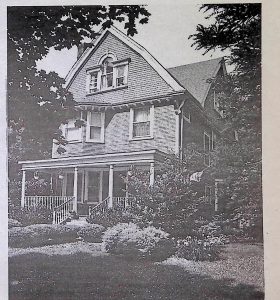
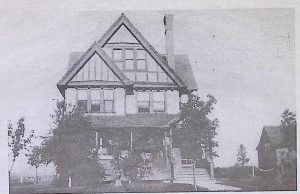
To give the subdivision that lived-in look, Cronkrite decided to build a few two-story Model Homes and scatter them over the streets of the subdivision, particularly Hoyne, Seeley and Hamilton. Of four original models identified by the Ridge Historical Society, the one at 9620 S. Hoyne Ave. is the closest to its original state.
The Forest Ridge Model Homes, designed by architect Swen Linderoth & Co., were constructed in Queen Ann style, then at the height of its popularity. They differ in design and dimensions, but all were frame on stone foundations and equipped for both gas and electric lights, though there wasn't electricity to connect in Beverly/Morgan Park in 1891.
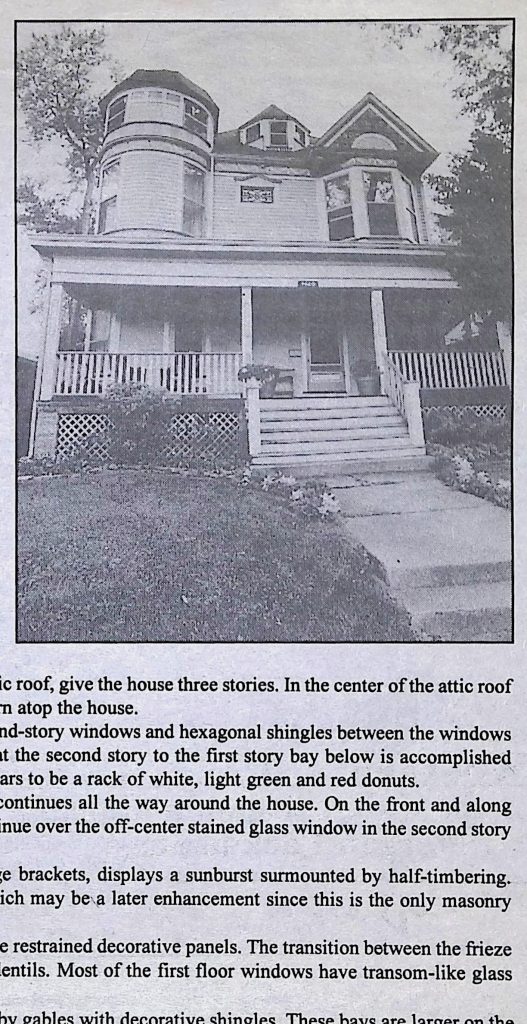
In Queen Ann style, exterior wall surfaces were primary decorative elements. Flat walls were avoided both by the use of structural features, such as towers, bays and overhangs, and by using wall materials of different textures. In the house at 9620 Hoyne Ave., the roofline is dominated by a round tower capped by an octagonal roof on the south side of the front, and by a high gable atop the north front bay on the second floor. These, combined with a steep attic roof, give the house three stories. In the center of the attic roof a polygonal dormer apes the tower to its south and is almost a lantern atop the house.
The south tower is ornamented with oval shingles below the second-story windows and hexagonal shingles between the windows of the third floor. The transition from the base of the round tower at the second story to the first story bay below is accomplished through hanging sections of rings, so that one looks up at what appears to be a rack of white, light green and red donuts.
Above the second floor windows of the tower is a frieze which continues all the way around much of the north side it is ornamented with garlands, and these continue over the off-center stained glass window in the second story and across the bay on the front.
Atop the north bay the gable, which appears to rest on two large brackets, displays a sunburst surmounted by half-timbering. Spaces between the timbers are filled with masonry and stones, which may be a later enhancement since this is the only masonry surface above the foundations on any of the four model homes.
The first floor has a simple front porch whose square columns have restrained decorative panels. The transition between the frieze of the porch and the overhang above is ornamented with a row of dentils. Most of the first floor windows have transom-like glass above them to admit additional light.
Both the north and the south sides of the house have bays capped by gables with decorative shingles. These bays are larger on the first floor than on the second, with the transition accomplished by skirts decorated with more shingles. The shingles of the gable on the south side of the house are laid in a wave pattern, and are unlike any of the shingles on the front.
Owing to the reversal of economic conditions following the World's Columbian Exposition in 1893, the four Forest Ridge Model Homes were joined by few companions, and the subdivision lapsed into inactivity.
The subdivision was not resurrected until 1913 when it was acquired by John Bain of the West Englewood Ashland State Bank. The four model houses, which had sat alone out on the high prairie for 20 years, were engulfed in a tide of bungalows and small houses, which in the meantime had become a fashion. Nevertheless, the Forest Ridge Model Homes make their own statement about the elegance and grandeur of the 1890s in which they were built.