In 1907, a couple of years after Thomas Tallmadge (1876-1940) and Vernon Watson (1878-1950) had formed their firm, a business journal said of their partnership, “their work shows an interesting attempt to discard precedent and to develop a style at once personal and true to local conditions,” which is a fairly concise summary of Prairie style architecture as it was thought of at the time. But when Tallmadge died in 1940, the sole fatality of a train crash that injured 54, what was said of him was that “his major interest in design was Gothic, and with his former partner, Vernon Watson, he became widely known for his construction of churches.” Is it possible to reconcile these two assessments of their work?
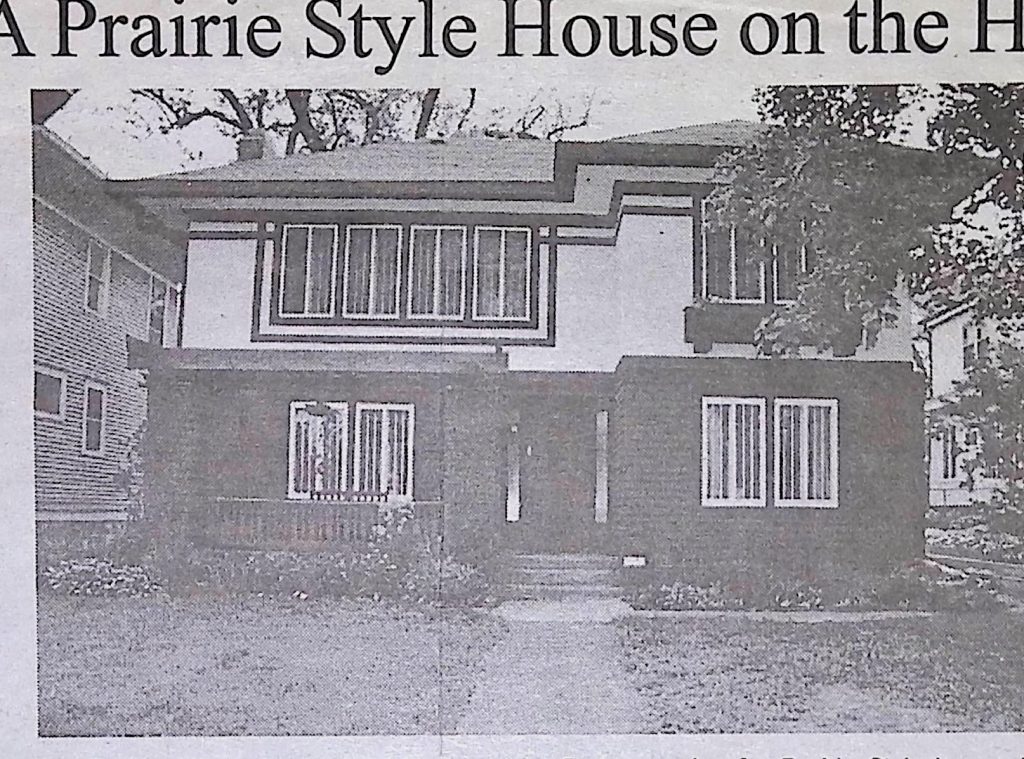
As it happens, the Ridge possesses one example each of the extremities of the Tallmadge & Watson spectrum. The church is the original building of Trinity Methodist Episcopal (now United Methodist) Church, 98th and Winchester, but it is now their social hall and is concealed behind the later sanctuary and chapel designed by Stoetzel & Janssen. The house, at 9640 S. Longwood Dr., was built in 1909 for Louis A. Tanner, a Loop insurance broker. It is very little altered and highly visible.
Of the two partners, Tallmadge was the better known. He graduated from M. I. T. in 1898, then worked as a draftsman for D. H. Burnham until 1905. He wrote histories of American and English architecture, and was at work on an account of Chicago architecture when he died.
Watson graduated from the Chicago School of Architecture, a combined program of the Art Institute of Chicago and the Armour Institute of Technology, in 1900. He first worked several years for Richard E. Schmidt, an important designer of innovative residences and commercial buildings at the turn of the century, and then he too was employed by Burnham until forming the partnership with Tallmadge in 1905. Although now we tend to appreciate the firm for its Prairie-style residential buildings, their first important commission was the Gothic-style First Methodist Church of Evanston, planning for which began in 1909.
The Tanner House, with Frank Lloyd Wright’s Evans House and other Prairie-style houses on the hill above Longwood Drive, combine to drive one point home: Prairie School houses are intended for prairies, not hills. With the exception of Harry Hale Waterman’s house for England J. Barker (now Beacon Therapeutic School), no one would ever accuse any of the architects who designed in the Prairie style for the west side of Longwood Drive of having the slightest interest in correlating their designs with the slope of the hill. Prairie style houses were invariably parked on the brow of the ridge so that they could be seen to best advantage, but no terracing or other integration of house and site was apparently considered desirable.
That said, it is hard not to appreciate the Tanner House’s attractions. The first story is sheathed in brown shingles, rather than the board-and-batten preferred by many Prairie designers, but you have to look closely to see the difference. The front porch is trellised, and its ballusters are formed by cutting away the spaces between, rather than inserting spindles. The windows are casements, divided vertically into thirds by mullions. The windows on the sides and rear of the house and those flanking the front entrance have set into them stained glass Prairie-style motifs.
The second story is stuccoed, and the forward-projecting wing has a window box that balances the trellised roof of the front porch. The geometric ornament that frames the second-floor windows and underlines the broad overhang of the hipped roof is formed of boards inlaid in the stucco.
Actually it is this geometric decoration that provides something of a link, if not continuity, between Tallmadge & Watson’s Prairie-style houses and their work in Gothic. Since the Tanner House has a hipped roof rather than gables, it is not particularly apparent here, but when the geometric decoration was used by them to highlight a triangular gable, or when triangular windows were run up under gables, then the composition became very reminiscent of Gothic. But there is no confusion of intent — residences were Prairie; churches were Gothic.
Of course, this explanation presupposes that all of the design work was provided by one partner or the other, and that is by no means certain. H. Allen Brooks, the architectural historian of the Prairie School, supposes that Watson did most of the designing, while the sociable Tallmadge had the task of luring clients to the firm. Certainly it is true that after Watson retired in 1936, Tallmadge’s Gothic churches continued, so it may be that the Prairie designs were Watson’s and the Gothic churches were Tallmadge’s.
No matter who was responsible for the design, there is no question that the entire concept of the Tanner House was inspired by a Prairie School program. The exterior exhibits the horizontality that is characteristic of the Prairie style. The interior space flows from one functional area to another, and rigid compartmentalization of rooms on the main floor is avoided. We are fortunate to have this excellent example of Tallmadge & Watson’s work on the Ridge, and we can be grateful that the owners have kept it in the original state.